


People who saw a stabbing attack in Taipei on Friday, as well as people exposed to images of the incident, could experience trauma, highlighting the need for awareness and care, a psychologists’ association said yesterday.
The suspect, 27-year-old Chang Wen (張文), carried out attacks at Taipei Main Station and Zhongshan MRT Station on Friday, killing three people and leaving 11 injured.
“The incident occurred in several crowded public spaces, and while those injured and their families would require long-term recovery and support, witnesses and people exposed to images of the attack might also need care,” the National Union of Counseling Psychologists’ Associations said.
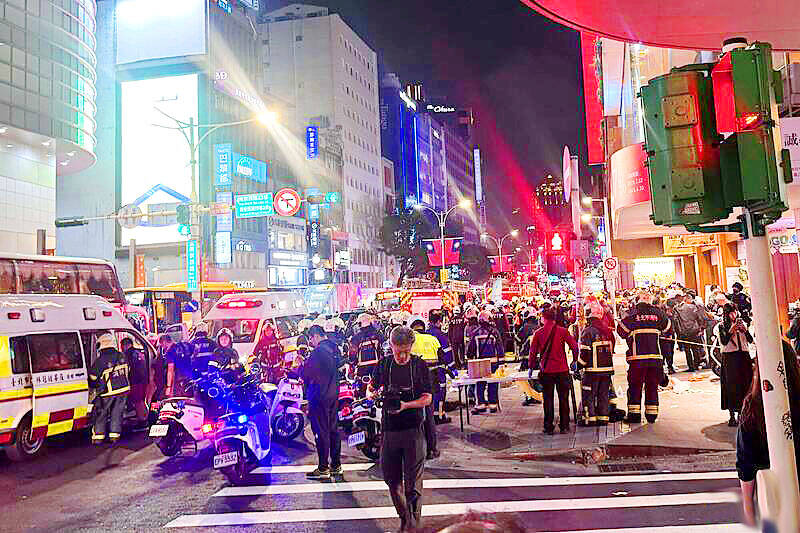
Photo: Taipei Times
“Some people might experience fear, anxiety, anger or sadness, accompanied by insomnia, appetite changes or heart palpitations,” executive board member Hu Yen-wei (胡延薇) said, adding that others may feel emotionally numb or detached.
“These are natural responses to sudden threats and should be considered normal,” Hu said.
When people perceive danger, the brain enters a heightened state of alert, chairwoman Tsai Hsiao-wen (蔡曉雯) said.
After leaving the scene of a traumatic event, it is important to gradually calm the mind and body, and reconnect with others at one’s own pace, she said, adding that social interaction can be reassuring and healing.
Union board member Chen Shao-min (陳劭旻) advised people who feel tense or easily startled to maintain regular routines, limit exposure to distressing news and remind themselves that they are safe.
Most symptoms ease over time, but if they persist for more than two weeks and interfere with daily life, professional help should be sought, he said.
The Ministry of Health and Welfare has announced that those affected can apply for up to three counseling sessions, Tsai said, urging people in need to make use of the program.
She also called on the public to remain attentive to others who might be struggling, saying that “mutual support is a vital force in collective recovery.”
Separately, psychologist Chen Chia-wei (陳家維), known online as “Mana Bear” (瑪那熊), wrote on Facebook that parents with preschool or school-aged children might feel unsure whether or how to discuss the attack.
While parents might worry that such conversations could frighten children, Chen Chia-wei said children are often more perceptive than adults assume and could notice tension, overhear conversations or hear about the incident from classmates.
When children piece together incomplete information on their own, misunderstandings can arise, potentially intensifying fear, he said.
Rather than avoiding the topic, he suggested that parents briefly explain what happened in a calm, age-appropriate way, while avoiding news footage or online videos, which can overwhelm children.
Parents should reassure children that fear is normal, discuss simple safety strategies and offer comfort based on family routines, he said.
Chen Chia-wei also reminded parents to care for their own well-being, adding that repeated exposure to distressing images can re-traumatize adults and reduce their ability to support their children.

FUKUOKA SITUATION: Japanese media reported that the pathogen is expected to be identified by the summer, while the CDC downplayed the idea that it was hMPV A “mysterious cold-like illness” reported in Japan’s Fukuoka Prefecture does not seem to be a new disease, but Japanese authorities have been asked about the situation, the Centers for Disease Control (CDC) said yesterday. The Fukuoka Prefectural Medical Association on Wednesday told a news conference that a “mystery cold” that has become a hot topic on social media is “highly likely to be caused by some kind of viral infection,” Japan’s KBC News reported. “Many people are experiencing symptoms starting with a sore throat, followed by a runny nose, phlegm and a severe cough,” KBC News reported, citing association officials. Health authorities are

Nvidia Corp CEO Jensen Huang (黃仁勳) arrived in Taiwan yesterday ahead of upcoming AI and technology events, saying he plans to meet with clients and Taiwan Semiconductor Manufacturing Co Chairman C.C. Wei (魏哲家) during his visit. After landing at Taipei Songshan Airport, Huang posed for photos with fans and handed out Yakult drinks to reporters and supporters waiting at the scene, saying he has “a lot to do” during the trip. Asked about reports that Nvidia’s planned headquarters site in Taipei’s Beitou Shilin Technology Park could break ground on May 27, Huang said that if the company holds an event, he would

The Ministry of Finance this afternoon announced the winning numbers for the March-April uniform invoice lottery. The winning number for the NT$10 million (US$318,060) special prize is 19531471, and the winning number for the NT$2 million grand prize is 85941329. Three numbers were drawn for the NT$200,000 first prize: 07225810, 20231230 and 83518781. Those with receipts matching the last seven digits of any of the first-prize numbers will win the NT$40,000 second prize, while those matching the last six digits will win the NT$10,000 third prize. Those whose receipts match the last five digits of the first-prize numbers can claim the NT$4,000 fourth prize,
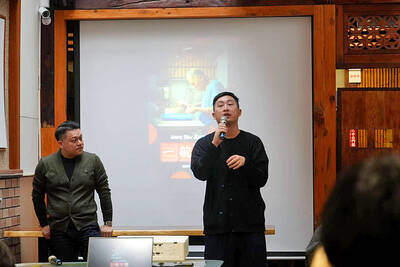
Taiwan Travelogue (臺灣漫遊錄), which earlier this week became the first Taiwanese novel to win the International Booker Prize, is to be adapted into a television series through a Taiwan-Japan coproduction, producer Chang Chen-yu (張辰漁) said yesterday. Chang, a producer at World Softest Production Film Co, wrote on Facebook that the company had been searching for projects with international appeal that retain a strong Taiwanese identity after colleagues and Japanese partners strongly recommended the novel. After reading the book, Chang said he immediately decided to pursue the screen rights. “A great story has the power to transcend time and borders, and connect countless people,”


 RSS
RSS