


The Taiwan Culture in Europe 2025 initiative has successfully showcased Taiwan’s freedom, openness and diversity through cultural events in Europe, a senior Taiwanese diplomat has said.
The initiative, launched this year by the Ministry of Culture and National Palace Museum, has held more than 70 art festivals, music fairs, and dancing and singing performances in 26 European countries, said Eric Huang (黃鈞耀), head of the Ministry of Foreign Affairs Department of European Affairs.
Among the highlights of the months-long project were the palace museum’s “100 Treasures, 100 Stories: Treasures from the National Palace Museum” exhibition in the Czech Republic, marking the first overseas showing of its most iconic artifact, the Jadeite Cabbage, since 2014.

Photo: CNA
The museum, known for its collection that offers a comprehensive record of Chinese history spanning thousands of years, held a separate exhibition in Paris last month, exploring the cultural and historical significance of dragons across Asia.
“The goal of the year-round campaign is to link Taiwan and Europe further via culture and art,” Huang said on Tuesday last week, adding that culture is “a shared language that transcends borders.”
“The essence of Taiwanese culture is its openness, diversity, depth, and vitality,” he said.
Only by embracing democracy, freedom, and human rights has Taiwan been able to give birth to such a creative and diversified culture, he added.
An exemplar of Taiwan’s cultural fusion is artist Xie Sheng-min (謝省民), who the foreign ministry invited to stage a woodblock printmaking exhibition in the country’s only diplomatic ally in Europe, the Holy See, in September.
Raised in a Catholic family, Xie grew up near the famous Chaotian Temple, dedicated to the Taoist goddess Matsu, in Yunlin County’s Beigang Township (北港).
His works are a combination of Taiwanese religious beliefs and Catholicism, exemplifying the spirit of peace and freedom, Huang said.
Another example is the
U-Theatre performing arts group, whose shows are known for their combination of theater arts and drumming, with a dash of traditional Japanese culture, according to Huang.
Under the foreign ministry campaign, the troupe performed in Italy in September.
Huang said this cultural diplomacy not only brought Taiwan and Europe closer, but helped pave the way for Minister of Foreign Affairs Lin Chia-lung (林佳龍) to visit several European countries, including the Czech Republic, Italy and Austria.
Taiwan’s foreign ministers rarely make public visits to countries that do not have official diplomatic ties with the nation.
Looking ahead, Huang said that one of the highlights for next year’s program would be an exchange between Taiwanese hand puppet groups and their European counterparts.


UPGRADE: The Kang Ding-class frigate is replacing its Chaparall missiles with Tien Chien II and Hua Yang VLS, which would provide it with long-range, 360° air defense Taiwan plans to produce 1,200 to 1,376 Hai Chien II missiles (海劍二, Sea Sword II) — also known as TC-2N — to serve as the standard air defense system of the navy’s surface combatant fleet, a source said yesterday. Last week, the Hai Chien II, the naval version of the Tien Kung II missile (天劍二, Sky Sword II), completed a live-fire test in waters off the National Chungshan Institute of Science and Technology’s Jiupeng facility (九鵬) in Pingtung County’s Manjhou Township (滿州). The MIM72 Chaparral and other dated air defense missiles that currently arm Taiwanese ships have inadequate range to combat Chinese

REASONS FOR TRAVEL: An assistant professor said that proposed amendments to penalize drivers if they used drugs overseas would not deter people from traveling People who operate a motor vehicle under the influence of marijuana would have their driver’s license revoked, even if they used the substance while overseas, the Ministry of Transportation and Communications said yesterday, citing proposed amendments to the Road Traffic Management and Penalty Act (道路交通管理處罰條例). The amendments would also authorize the government to revoke the licenses of people determined to have used Category 1 or Category 2 narcotics, even if they were not operating a vehicle while under the influence of drugs, as well as ban them from taking the license test for three years, the ministry said. People aged 18 or
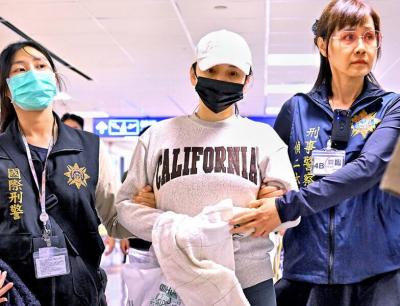
Johanne Liou (劉喬安), a Taiwanese woman who shot to unwanted fame during the Sunflower movement protests in 2014, returned to Taiwan last night after being deported from the US. She is to stand trial in Taiwan for charges involving embezzlement, fraud and drug crimes. The Criminal Investigation Bureau (CIB) said it took her into custody at Taiwan Taoyuan International Airport and would first question her before transferring her to the New Taipei District Prosecutors’ Office. She was arrested upon disembarking a flight from San Francisco that landed shortly before 7pm. Liou absconded to the US in 2019 after jumping bail
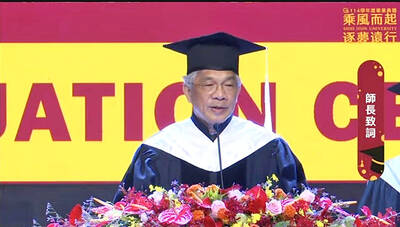
Shih Hsin University President Chen Ching-he (陳清河) yesterday issued a public apology for comments made in his commencement speech last week, stating that he has asked the school to suspend his duties and halt his wages for two months as a show of contrition. At the commencement ceremony on May 30, Chen said, “If you don’t manage your time well, or your own emotions, or your health, then I am telling every one of you — put a quick end to ‘you,’ because the world has no need for ‘you.’” The comments have sparked significant controversy online, and Chen through an open


 RSS
RSS