


The Trans-Pacific Unmanned Vehicle Parliamentary Alliance (TUVPA) was inaugurated in Taipei yesterday, with association members pledging to transform the uncrewed vehicle industry into Taiwan’s next “national defense pillar.”
Democratic Progressive Party caucus chief executive Chung Chia-pin (鍾佳濱), who initiated the launch of the alliance, said that the applications of uncrewed vehicles have surpassed military operations, extending widely into areas such as delivery logistics, disaster relief, maritime salvage and aerial surveying.
The alliance aims to leverage the stature of the legislature to align with international standards, promote the improvement of domestic legal systems, and share experiences in cross-border promotion and application, he said.
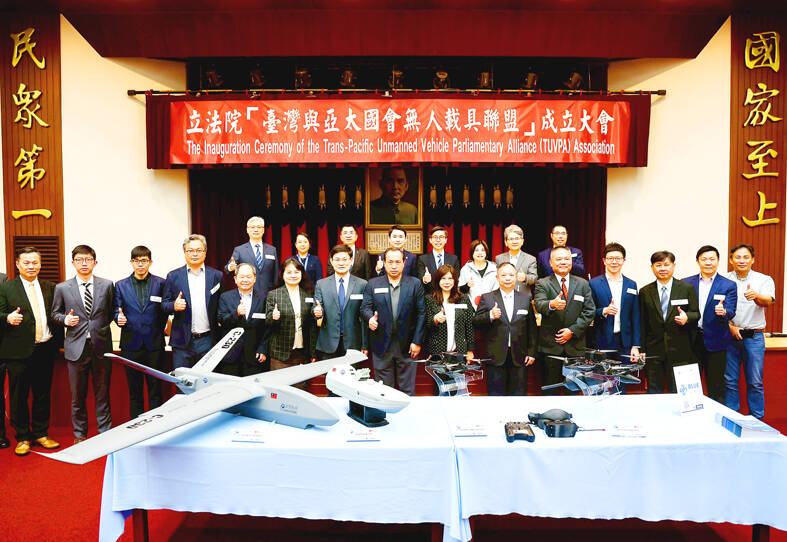
Photo: CNA
Taiwan has the most important core of uncrewed vehicles — the “chip,” he said.
If Taiwan can improve its system integration capabilities, and connect its industry and supply chains, it is bound to become the most important hub of the global democratic alliance’s “non-red supply chain,” he added.
It is hoped that through this platform, Taiwan’s independent and rich technological achievements would be seen by the world, Chung said, adding that this would allow the uncrewed vehicle industry to not only take root in Taiwan, but also expand internationally, “becoming the second ‘national defense pillar’ after semiconductors.”
One of the highlights of the inauguration ceremony yesterday was a key briefing by Peter Mattis, president of the Jamestown Foundation in Washington, and Sunny Cheung (張崑陽), a Chinese affairs researcher.
Cheung referenced a survey conducted in collaboration with the Wall Street Journal which revealed that the Chinese Ministry of Industry and Information Technology last month announced the establishment of a national-level Humanoid Robot Special Committee. The committee integrates top companies such as Unitree and Fourier, along with research institutions with ties to the Chinese People’s Liberation Army.
This indicates that China is undergoing an unprecedented “military-civil fusion” effort to develop autonomous platform technologies, he said.
In this context, the US and its democratic allies are pushing for a global realignment of supply chains, he added.
Taiwan, with its expertise in motors, sensors and critical edge computing artificial intelligence chips, plays a pivotal role in building a supply chain controlled by like-minded nations, Cheung said, urging Taiwan to mobilize its national resources through the alliance.
In the face of the rapid evolution of technology and manufacturing, Taiwan, as the technology hub in the Asia-Pacific region, must master the ability to produce independent research and development, and manufacturing, Legislative Yuan Deputy Secretary-General Chang Yu-jung (張裕榮) said.
He expressed the hope that through the alliance, Taiwan can deepen its partnerships with friendly nations and strengthen its resilience in a changing international landscape.
Among the attendees at the event were representatives from the American Institute in Taiwan, the British Office in Taipei, the Manila Economic and Cultural Office, the India-Taipei Association and the Vietnam Economic and Cultural Office in Taipei.
Representatives from government agencies such as the National Police Agency, the Ministry of Foreign Affairs, the Ministry of Economic Affairs, the National Development Council and the Industrial Technology Research Institute, as well as companies such as Thunder Tiger Technology and Taiwan Drone 100, also took part in the event.

FUKUOKA SITUATION: Japanese media reported that the pathogen is expected to be identified by the summer, while the CDC downplayed the idea that it was hMPV A “mysterious cold-like illness” reported in Japan’s Fukuoka Prefecture does not seem to be a new disease, but Japanese authorities have been asked about the situation, the Centers for Disease Control (CDC) said yesterday. The Fukuoka Prefectural Medical Association on Wednesday told a news conference that a “mystery cold” that has become a hot topic on social media is “highly likely to be caused by some kind of viral infection,” Japan’s KBC News reported. “Many people are experiencing symptoms starting with a sore throat, followed by a runny nose, phlegm and a severe cough,” KBC News reported, citing association officials. Health authorities are

Nvidia Corp CEO Jensen Huang (黃仁勳) arrived in Taiwan yesterday ahead of upcoming AI and technology events, saying he plans to meet with clients and Taiwan Semiconductor Manufacturing Co Chairman C.C. Wei (魏哲家) during his visit. After landing at Taipei Songshan Airport, Huang posed for photos with fans and handed out Yakult drinks to reporters and supporters waiting at the scene, saying he has “a lot to do” during the trip. Asked about reports that Nvidia’s planned headquarters site in Taipei’s Beitou Shilin Technology Park could break ground on May 27, Huang said that if the company holds an event, he would

The Ministry of Finance this afternoon announced the winning numbers for the March-April uniform invoice lottery. The winning number for the NT$10 million (US$318,060) special prize is 19531471, and the winning number for the NT$2 million grand prize is 85941329. Three numbers were drawn for the NT$200,000 first prize: 07225810, 20231230 and 83518781. Those with receipts matching the last seven digits of any of the first-prize numbers will win the NT$40,000 second prize, while those matching the last six digits will win the NT$10,000 third prize. Those whose receipts match the last five digits of the first-prize numbers can claim the NT$4,000 fourth prize,
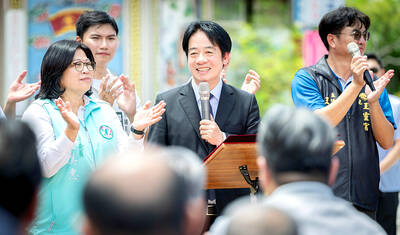
SIX SUBSIDIES: The monthly allowance for older farmers is to increase to NT$10,000, and NT$5,000 is to be given to homemakers under the national pension system, Lai said The government is to implement major welfare policies for disadvantaged groups, including raising the monthly allowance for older farmers to NT$10,000 and providing homemakers with NT$5,000 per month, President William Lai (賴清德) said yesterday. Lai made the remarks during a visit to Wangling Temple in Chiayi County, saying that the planned increases were being introduced amid economic growth and an increase in tax revenue. Touting a policy, in which the government plans to provide a monthly allowance of NT$5,000 for every child under the age of 18 in a bid to address Taiwan’s low birthrate, Lai said that if received for the


 RSS
RSS