


The opposition parties yesterday said they would attempt to impeach President William Lai (賴清德) over what they described as his “undemocratic” practices, despite practical obstacles that would preclude the scenario.
The move came after Lai on Monday refused to promulgate a legislative amendment that would have allowed local governments to receive a larger share of government revenue, arguing that the legislation would hurt the nation’s fiscal sustainability.
Premier Cho Jung-tai (卓榮泰) had declined to countersign the legislation earlier that day, which Lai cited as the reason for not publicly announcing the law, normally considered to be routine.
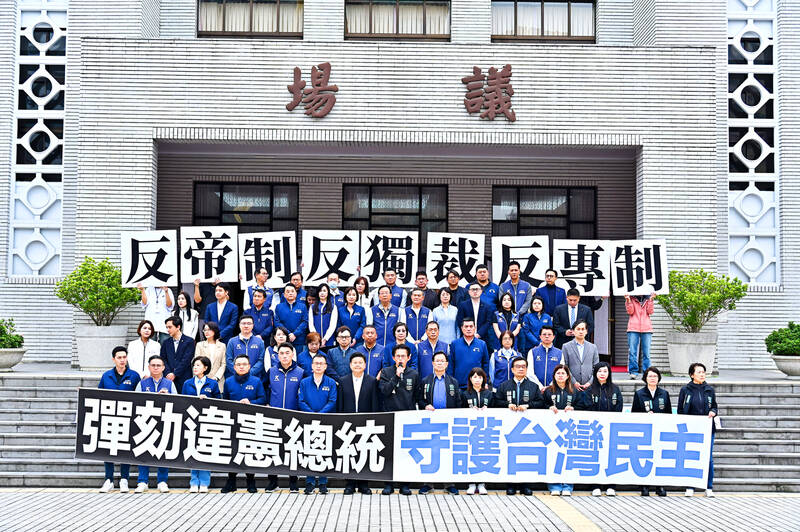
Photo: Tu Chien-jung, Taipei Times
“Lai has made himself emperor. He has shown that he has no regard for public opinion,” Chinese Nationalist Party (KMT) caucus whip Fu Kun-chi (傅?萁) told a news conference at the legislature.
Taiwan People’s Party (TPP) Chairman Huang Kuo-chang (黃國昌) said that according to the Constitution, Lai should have promulgated the bill within 10 days after the legislature voted down on Dec. 5 an Executive Yuan motion to reconsider the amendment.
“Never has there been a president who has gone so far as to refuse to promulgate a law passed by the legislature,” Huang said.
He said the opposition caucuses would tender a motion to impeach Lai for review at a plenary session, but he did not specify when.
The Additional Articles of the Constitution of the Republic of China (中華民國憲法增修條文) state that a motion to impeach the president or vice president can be initiated after gaining the backing of half of lawmakers.
It then must gain the approval of two-thirds of lawmakers before being forwarded to the Constitutional Court to be adjudicated.
However, the court, which normally has 15 justices, but currently has only eight, is below the legal threshold for adjudication and the government’s attempts to fill the vacancies have failed.
That means the proposed impeachment could not be put into effect even if it cleared the legislative floor, which is a near impossibility in itself.
The KMT and TPP together control 60 of the 113 seats in the legislature. The Democratic Progressive Party (DPP) has 51 seats, with the remaining two held by KMT-leaning independent lawmakers, making a two-thirds majority in any vote highly unlikely.
Asked to comment on the opposition parties’ proposed impeachment drive, Presidential Office spokeswoman Karen Kuo (郭雅慧) said the Presidential Office respected any move as long as it is within constitutional limits.
DPP spokesman Lee Kun-cheng (李坤城) said that it is absurd for the opposition parties to claim they are fighting against dictatorship and an authoritarian regime when they dare not criticize Chinese President Xi Jinping (習近平) and Russian President Vladimir Putin.
“It is the KMT and TPP combining to take power from other government branches and to paralyze the Constitutional Court. Now they pass a motion to impeach President Lai. It is aimed at deceiving the public with a fake move,” Lee said. “KMT Chairwoman Cheng Li-wun (鄭麗文) even stated that Putin is not a dictator.”
As they dare not to condemn Putin and Xi, they have no credibility talking about fighting against authoritarianism in the motion to impeach Lai,” he said.
Additional reporting by Jason Pan
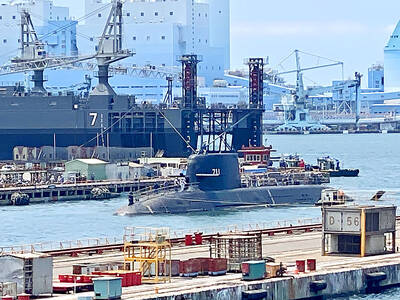
AGING: While Japan has 22 submarines, Taiwan only operates four, two of which were commissioned by the US in 1945 and 1946, and transferred to Taiwan in 1973 Taiwan would need at least 12 submarines to reach modern fleet capabilities, CSBC Corp, Taiwan chairman Chen Cheng-hung (陳政宏) said in an interview broadcast on Friday, citing a US assessment. CSBC is testing the nation’s first indigenous defense submarine, the Hai Kun (海鯤, Narwhal), which is scheduled to be delivered to the navy next month or in July. The Hai Kun has completed torpedo-firing tests and is scheduled to undergo overnight sea trials, Chen said on an SET TV military affairs program. Taiwan would require at least 12 submarines to establish a modern submarine force after assessing the nation’s operational environment and defense

A white king snake that frightened passengers and caused a stir on a Taipei MRT train on Friday evening has been claimed by its owner, who would be fined, Taipei Rapid Transit Corp (TRTC) said yesterday. A person on Threads posted that he thought he was lucky to find an empty row of seats on Friday after boarding a train on the Bannan (Blue) Line, only to spot a white snake with black stripes after sitting down. Startled, he jumped up, he wrote, describing the encounter as “terrifying.” “Taipei’s rat control plan: Release snakes on the metro,” one person wrote in reply, referring
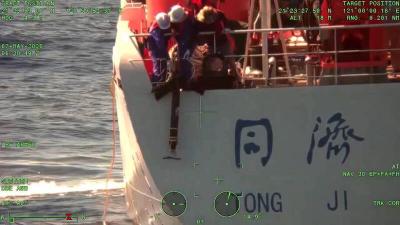
The coast guard today said that it had disrupted "illegal" operations by a Chinese research ship in waters close to the nation and driven it away, part of what Taipei sees a provocative pattern of China's stepped up maritime activities. The coast guard said that it on Thursday last week detected the Chinese ship Tongji (同濟號), which was commissioned only last year, 29 nautical miles (54km) southeast of the southern tip of Taiwan, although just outside restricted waters. The ship was observed lowering ropes into the water, suspected to be the deployment of scientific instruments for "illegal" survey operations, and the coast
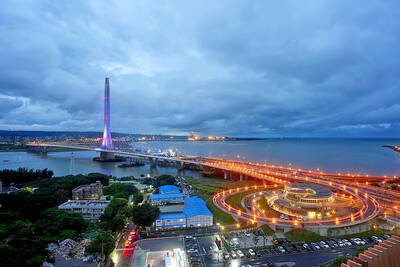
An inauguration ceremony was held yesterday for the Danjiang Bridge, the world’s longest single-mast asymmetric cable-stayed bridge, ahead of its official opening to traffic on Tuesday, marking a major milestone after nearly three decades of planning and construction. At the ceremony in New Taipei City attended by President William Lai (賴清德), Premier Cho Jung-tai (卓榮泰), Minister of Transportation and Communications Chen Shih-kai (陳世凱) and New Taipei City Mayor Hou Yu-ih (侯友宜), the bridge was hailed as both an engineering landmark and a long-awaited regional transport link connecting Tamsui (淡水) and Bali (八里)


 RSS
RSS