


The Ministry of Agriculture yesterday awarded experts and institutions for commitment to laboratory animal welfare, as animal experimentations decreased by 9 percent nationwide over the past decade.
The Animal Protection Act (動物保護法) was promulgated in 1998 with lab animals included under its protections, while the ‘3R’ principles — refine, reduce and replace — has been adopted to promote animal welfare for more than 20 years, the ministry said.
Recently developed artificial intelligence-driven predictive toxicology platforms and replacement techniques can reduce research animal use 50 to 100 percent, it said.
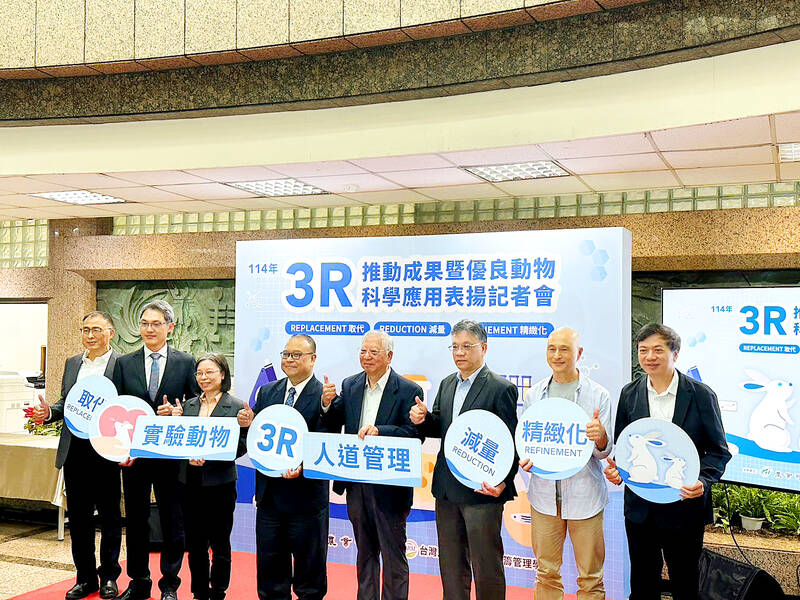
Photo: Yang Yuan-ting, Taipei Times
Non-animal acute toxicity testing helped to reduce the demand for lab animals by 72 percent and test duration by 83 percent, the ministry said.
Such efforts effectively reduced the total number of animals used in research by 9 percent nationwide from 2014 to last year, of which experimental rabbits decreased by 59 percent, experimental fish by 28 percent and experimental rodents by 4.2 percent, it said.
Special contribution awards were given to Level Biotechnology Inc consultant Hung Chao-chu (洪昭竹), China Medical University Dean of the College of Pharmacy Chen Chiung-tong (陳炯東), and Environment and Animal Society of Taiwan executive director Chu Tseng-hung (朱增宏), recognizing their efforts in standardizing humane management of lab animals and implementing the 3R principles.
The ministry also recognized 22 institutions for their outstanding performance in conducting humane care of research animals and providing training for personnel.
Hung in his remarks said animal testing was improved through “refinement” and “reduction” of animal use in 3Rs.
While fruitful outcomes have been achieved in refinement and reduction, replacement remains challenging, as few alternative techniques can meet the international certification body’s strict standards and regulations, he said.
Department of Animal Welfare Director Chiang Wen-chuan (江文全) said the idea of respecting life in research animal use has become well-established in Taiwan over the past 30 years, as a mechanism has been developed to design, review and conduct animal experiments with a focus on animal welfare.
Animal experimentation was involved in more than 7,800 projects per year in Taiwan, with 1.1 million to 1.2 million lab animals used per year, of which rodents made up the largest part at about 60 percent, he said.
Each animal is a life, Chiang said, adding that the ministry would continue to implement the 3Rs through cross-agency cooperation.

FUKUOKA SITUATION: Japanese media reported that the pathogen is expected to be identified by the summer, while the CDC downplayed the idea that it was hMPV A “mysterious cold-like illness” reported in Japan’s Fukuoka Prefecture does not seem to be a new disease, but Japanese authorities have been asked about the situation, the Centers for Disease Control (CDC) said yesterday. The Fukuoka Prefectural Medical Association on Wednesday told a news conference that a “mystery cold” that has become a hot topic on social media is “highly likely to be caused by some kind of viral infection,” Japan’s KBC News reported. “Many people are experiencing symptoms starting with a sore throat, followed by a runny nose, phlegm and a severe cough,” KBC News reported, citing association officials. Health authorities are

Nvidia Corp CEO Jensen Huang (黃仁勳) arrived in Taiwan yesterday ahead of upcoming AI and technology events, saying he plans to meet with clients and Taiwan Semiconductor Manufacturing Co Chairman C.C. Wei (魏哲家) during his visit. After landing at Taipei Songshan Airport, Huang posed for photos with fans and handed out Yakult drinks to reporters and supporters waiting at the scene, saying he has “a lot to do” during the trip. Asked about reports that Nvidia’s planned headquarters site in Taipei’s Beitou Shilin Technology Park could break ground on May 27, Huang said that if the company holds an event, he would

The Ministry of Finance this afternoon announced the winning numbers for the March-April uniform invoice lottery. The winning number for the NT$10 million (US$318,060) special prize is 19531471, and the winning number for the NT$2 million grand prize is 85941329. Three numbers were drawn for the NT$200,000 first prize: 07225810, 20231230 and 83518781. Those with receipts matching the last seven digits of any of the first-prize numbers will win the NT$40,000 second prize, while those matching the last six digits will win the NT$10,000 third prize. Those whose receipts match the last five digits of the first-prize numbers can claim the NT$4,000 fourth prize,

SIX SUBSIDIES: The monthly allowance for older farmers is to increase to NT$10,000, and NT$5,000 is to be given to homemakers under the national pension system, Lai said The government is to implement major welfare policies for disadvantaged groups, including raising the monthly allowance for older farmers to NT$10,000 and providing homemakers with NT$5,000 per month, President William Lai (賴清德) said yesterday. Lai made the remarks during a visit to Wangling Temple in Chiayi County, saying that the planned increases were being introduced amid economic growth and an increase in tax revenue. Touting a policy, in which the government plans to provide a monthly allowance of NT$5,000 for every child under the age of 18 in a bid to address Taiwan’s low birthrate, Lai said that if received for the


 RSS
RSS