


The opposition parties should call for a vote of no confidence against Premier Cho Jung-tai (卓榮泰) instead of passing a censure motion and requesting that the Control Yuan impeach him, Democratic Progressive Party (DPP) members said yesterday.
Opposition lawmakers can propose a no-confidence vote under Article 3 Item 3 of the Additional Articles of the Constitution (中華民國憲法增修條文), DPP caucus chief executive Chung Chia-pin (鍾佳濱) said.
If passed, the president could dissolve the Legislative Yuan and a general election would follow.
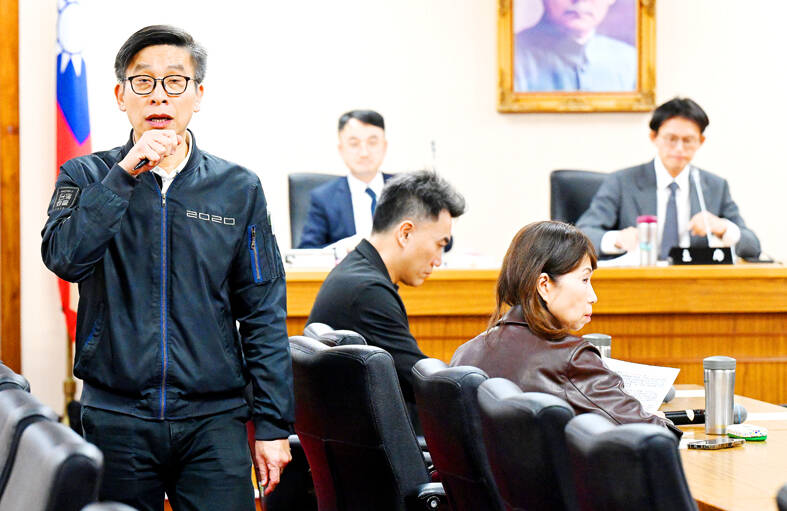
Photo: Liao Chen-huei, Taipei Times
During a Judiciary and Organic Laws Committee meeting yesterday, Chinese Nationalist Party (KMT) and Taiwan People’s Party (TPP) legislators approved a motion to censure Cho, who refused to countersign an amended revenue allocation bill.
TPP caucus whip Huang Kuo-chang (黃國昌) and KMT Legislator Lo Chih-chiang (羅智強) also requested that the Control Yuan impeach Cho.
Cho’s refusal to countersign the Act Governing the Allocation of Government Revenues and Expenditures (財政收支劃分法) was “unprecedented” and had disrupted constitutional governance, the opposition said.
However, DPP Legislator Rosalia Wu (吳思瑤) said that was not true, citing as an example then-premier Hau Pei-tsun (郝柏村) in 1992 refusing to countersign then-president Lee Teng-hui’s (李登輝) attempt to promote General Chiang Chung-ling (蔣仲苓), resulting in Lee withdrawing the promotion.
“The KMT and the TPP are afraid of the legislature getting dissolved, as they would have to face voters again and the new election could result in fewer seats for them,” Chung said. “There would also likely be no seat for the TPP, and they would lose their combined majority.”
Asked about Huang’s proposal to ask the Control Yuan to impeach Cho, Chung called it a joke.
“With the support of KMT and TPP lawmakers, Huang last year led the move to drastically cut the Control Yuan’s budget by 97 percent. So it is quite laughable, now, for him to ask the same body to conduct a probe and impeach the premier,” he said.
DPP officials also rebuted KMT and TPP legislators’ description of Cho as a “rogue premier” who contravened the Constitution by not countersigning the bill and President William Lai (賴清德) a “dictator” who was “subverting Taiwan’s constitutional democracy.”
“It is the two opposition parties who abused their majority in the legislature to undermine Taiwanese democracy and the pillars of the nation’s Constitution,” DPP spokeswoman Han Ying (韓瑩) said. “They rammed through numerous malevolent legislature amendments, hollowing out central government finances and slashing most ministries’ budgets, resulting in difficulties in regular operations and providing public services.”
“Throughout the process, the Executive Yuan had repeatedly provided explanations, and pointed to problems and issues that would arise from such actions. However, the opposition parties still pushed through these amendments and dismissed all forms of appeal for reconsideration,” Han said.
The only way to resolve the political impasse was to seek a constitutional interpretation, but that route was also shut down by opposition parties, who amended the law to raise the quorum for the Constitutional Court and rejected all nominations for new grand justices, so the court has been unable to convene, she said.
“Due to this situation, and the ruling government has no recourse and cannot seek a constitutional interpretation. Therefore, the only route left is for Cho not to countersign,” she added.

FUKUOKA SITUATION: Japanese media reported that the pathogen is expected to be identified by the summer, while the CDC downplayed the idea that it was hMPV A “mysterious cold-like illness” reported in Japan’s Fukuoka Prefecture does not seem to be a new disease, but Japanese authorities have been asked about the situation, the Centers for Disease Control (CDC) said yesterday. The Fukuoka Prefectural Medical Association on Wednesday told a news conference that a “mystery cold” that has become a hot topic on social media is “highly likely to be caused by some kind of viral infection,” Japan’s KBC News reported. “Many people are experiencing symptoms starting with a sore throat, followed by a runny nose, phlegm and a severe cough,” KBC News reported, citing association officials. Health authorities are

Nvidia Corp CEO Jensen Huang (黃仁勳) arrived in Taiwan yesterday ahead of upcoming AI and technology events, saying he plans to meet with clients and Taiwan Semiconductor Manufacturing Co Chairman C.C. Wei (魏哲家) during his visit. After landing at Taipei Songshan Airport, Huang posed for photos with fans and handed out Yakult drinks to reporters and supporters waiting at the scene, saying he has “a lot to do” during the trip. Asked about reports that Nvidia’s planned headquarters site in Taipei’s Beitou Shilin Technology Park could break ground on May 27, Huang said that if the company holds an event, he would

The Ministry of Finance this afternoon announced the winning numbers for the March-April uniform invoice lottery. The winning number for the NT$10 million (US$318,060) special prize is 19531471, and the winning number for the NT$2 million grand prize is 85941329. Three numbers were drawn for the NT$200,000 first prize: 07225810, 20231230 and 83518781. Those with receipts matching the last seven digits of any of the first-prize numbers will win the NT$40,000 second prize, while those matching the last six digits will win the NT$10,000 third prize. Those whose receipts match the last five digits of the first-prize numbers can claim the NT$4,000 fourth prize,
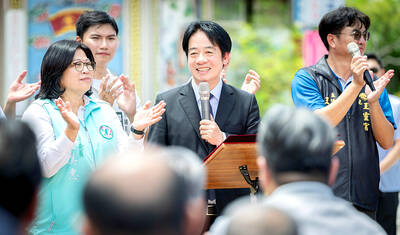
SIX SUBSIDIES: The monthly allowance for older farmers is to increase to NT$10,000, and NT$5,000 is to be given to homemakers under the national pension system, Lai said The government is to implement major welfare policies for disadvantaged groups, including raising the monthly allowance for older farmers to NT$10,000 and providing homemakers with NT$5,000 per month, President William Lai (賴清德) said yesterday. Lai made the remarks during a visit to Wangling Temple in Chiayi County, saying that the planned increases were being introduced amid economic growth and an increase in tax revenue. Touting a policy, in which the government plans to provide a monthly allowance of NT$5,000 for every child under the age of 18 in a bid to address Taiwan’s low birthrate, Lai said that if received for the


 RSS
RSS