


The Executive Yuan today said that its approval of draft amendments to four laws aimed at countering national security threats and “united front” tactics was not politically timed.
The move came shortly after Premier Cho Jung-tai (卓榮泰) refused to countersign the Legislative Yuan’s version of the Act Governing the Allocation of Government Revenues and Expenditures (財政收支劃分法).
Asked if the timing of advancing the proposed amendments was considered sensitive and would escalate tensions between the ruling and opposition parties, Executive Yuan spokeswoman Michelle Lee (李慧芝) said that there was no timing issue.
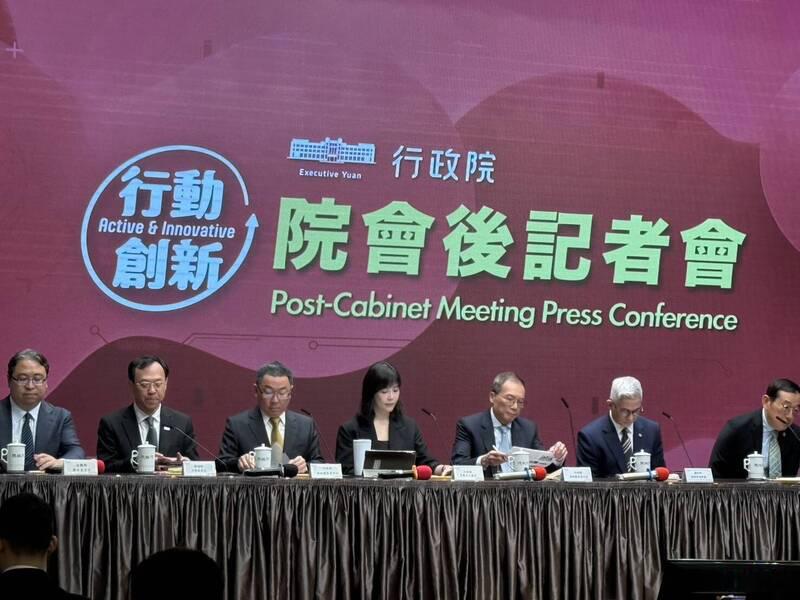
Photo: Chung Li-hua, Taipei Times
The Cabinet’s proposed amendments are in line with President William Lai’s (賴清德) directives aimed at countering five major national security threats and “united front” efforts against the nation, Lee said.
In March, Lai announced 17 strategies to counter increasing infiltration efforts against Taiwan, calling for national unity and concerted efforts against social division, she said.
The proposed amendments are intended to reinforce national security and prevent infiltration, and should receive bipartisan support regardless of party affiliation, she said.
The amendments would affect the National Security Act (國家安全法), the Criminal Code of the Armed Forces (陸海空軍刑法), the Act of Military Service for Officers and Non-commissioned Officers of the Armed Forces (陸海空軍軍官士官服役條例) and the Veterans Assistance Act (國軍退除役官兵輔導條例).
The Cabinet has discussed and approved the amendments, which are to be sent to the Legislative Yuan for deliberation, the Ministry of Justice said.
The ministry outlined five major revisions to the National Security Act in response to national security threats.
First, participating in organizations that affect national security would be added as an offense, as the act does not penalize mere participation in organizations, the ministry said.
Second, elements constituting the crime of developing organizations would be adjusted from “attempt to endanger national security or social stability” to “sufficient to cause danger to national security or social stability" to clarify the threshold for prosecution, it said.
Third, a tiered penalty system would be established for developing organizations, spying or leaking official secrets, based on whether the beneficiary is a "foreign country" or "Mainland China, Hong Kong, Macau and foreign hostile forces," the ministry said.
Aggravated penalties would also be introduced for offenses committed for China, Hong Kong, Macau or overseas hostile forces, as well as for those committed by active-duty military personnel or public servants, it said.
Fourth, with reference to the Anti-Infiltration Act (反滲透法), provisions would be added to hold intermediaries liable, including local collaborators recruited by foreign forces or those who relay instructions, it said.
Fifth, people receiving retirement pensions who are convicted of national security-related crimes, would have 50 percent of their benefits suspended if they receive a guilty sentence of imprisonment or heavier to serve as punishment and deterrence while preserving funds, the ministry said.
The measure would also apply to survivors receiving bereavement pensions or annuities, it added.
The ministry would continue to support subsequent legislative processes, with the goal of swiftly completing the amendments to bolster the national security legal framework, it said.
Combined with the enforcement capabilities of national security investigation teams, the ministry aims to rigorously handle such cases in accordance with the law, safeguarding public safety and the democratic constitutional order, it added.

Considering that most countries issue more than five denominations of banknotes, the central bank has decided to redesign all five denominations, the bank said as it prepares for the first major overhaul of the banknotes in more than 24 years. Central bank Governor Yang Chin-lung (楊金龍) is expected to report to the Legislative Yuan today on the bank’s operations and the redesign’s progress. The bank in a report sent to the legislature ahead of today’s meeting said it had commissioned a survey on the public’s preferences. Survey results showed that NT$100 and NT$1,000 banknotes are the most commonly used, while NT$200 and NT$2,000

The Centers for Disease Control (CDC) yesterday reported the first case of a new COVID-19 subvariant — BA.3.2 — in a 10-year-old Singaporean girl who had a fever upon arrival in Taiwan and tested positive for the disease. The girl left Taiwan on March 20 and the case did not have a direct impact on the local community, it said. The WHO added the BA.3.2 strain to its list of Variants Under Monitoring in December last year, but this was the first imported case of the COVID-19 variant in Taiwan, CDC Deputy Director-General Lin Ming-cheng (林明誠) said. The girl arrived in Taiwan on

ANNUAL EVENT: Two massive Pokemon balloons are to be set up in Daan Park, with an event zone operating from 10am to 6pm This year’s Taipei Floral Picnic is to be held at Daan Park today and tomorrow, featuring an exclusive Pokemon Go event, a themed food market, a coffee rave picnic area and stage performances, the Taipei Department of Information and Tourism said yesterday. Two massive Pokemon balloons are to be set up in the park as attractions, with an exclusive event zone operating from 10am to 6pm, it said. Participants who complete designated tasks on-site would have a chance to receive limited-edition souvenirs, it added. People could also try the newly launched game Pokemon Pokopia in the trial area, the department said. Three PokeStops are

South Korea is planning to revise its controversial electronic arrival card, a step Taiwanese officials said prompted them to hold off on planned retaliatory measures, a South Korean media report said yesterday. A Yonhap News Agency report said that the South Korean Ministry of Foreign Affairs is planning to remove the “previous departure place” and “next destination” fields from its e-arrival card system. The plan, reached after interagency consultations, is under review and aims to simplify entry procedures and align the electronic form with the paper version, a South Korean ministry official said. The fields — which appeared only on the electronic form


 RSS
RSS