


Legislators today passed motions of censure against Premier Cho Jung-tai (卓榮泰) and Presidential Office Secretary-General Pan Meng-an (潘孟安).
Cho on Monday refused to countersign a fiscal planning bill that had already passed its third reading in the Legislative Yuan.
He cited concerns that the legislature’s version of the Act Governing the Allocation of Government Revenues and Expenditures (財政收支劃分法) would harm national development, infringe on executive authority and was passed in an undemocratic manner.
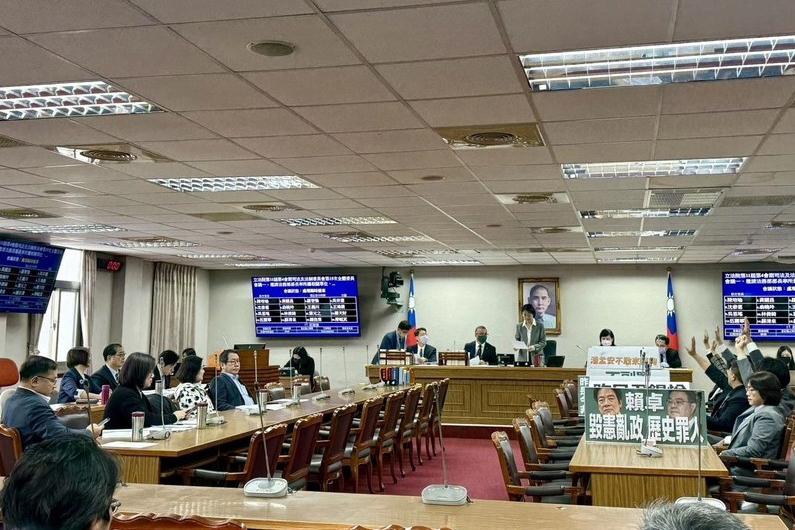
Photo: CNA
The bill passed on Nov. 14 was required to be promulgated by Monday.
Meanwhile, Pan did not report to a meeting of the legislature’s Judiciary and Organic Laws and Statutes Committee to give a special report on Cho’s actions.
Both proposals were this morning passed with a majority vote, with six legislators from the Chinese Nationalist Party (KMT) and the Taiwan People’s Party (TPP) voting in favor, versus two Democratic Progressive Party (DPP) legislators voting against the first motion, and a six-four split, respectively, for the second motion.
TPP Chairman Huang Kuo-chang (黃國昌), KMT caucus secretary-general Lo Chih-chiang (羅智強) and KMT Legislator Wang Hung-wei (王鴻薇) today proposed the motion of censure against Cho, saying that his actions contravened the Constitution and disrupted constitutional governance.
President William Lai (賴清德) is a “shameless president” and Cho a “rogue premier,” who must bear political responsibility, Lo said.
According to Article 37 of the Constitution, laws promulgated by the president must be countersigned by the premier to keep presidential power in check, Huang, Lo and Wang said.
Lai and Cho therefore distorted the constitutional meaning of Article 37, as they refused to sign into law amendments that had passed a third reading in the legislature, they said.
It sets a negative constitutional precedent and represents a “green dictatorship,” they said.
The executive branch should not be able to overturn bills already passed in the third reading by the legislature, as it constitutes overstepping judicial authority by unilaterally deciding whether laws are constitutional, affecting the separation of powers, they said.
They called for a resolution issuing the strongest condemnation of Lai and Cho that demands they countersign and promulgate all laws that pass a third reading in accordance with the Constitution to defend democratic constitutional order.
The three then signed their names to request that the case be referred to the Control Yuan to seek Cho’s impeachment.
The TPP would propose an impeachment motion against Lai in the next plenary session, which the president must attend according to the Act Governing the Legislative Yuan's Power (立法院職權行使法), Huang said.
Meanwhile, five legislators this morning submitted a proposal to censure Pan for his refusal to attend today’s meeting.
The legislature’s judiciary committee convened this morning, with Minister of Justice Cheng Ming-chien (鄭銘謙) delivering a report on efforts to combat corruption in the green energy sector, while Pan was expected to deliver a report on Cho’s refusal to sign the fiscal budget.
As the head of an agency, Pan showed contempt for legislative oversight and the representative office of public opinion, which constitutes a boycott of the legislature, the proposing legislators said.
The move verged on contravening the Constitution and disrupting constitutional governance, they said.
Under the administrations of former presidents, including Tsai Ing-wen (蔡英文), Ma Ying-jeou (馬英九) and Chen Shui-bian (陳水扁), Presidential Office secretaries-general have declined invitations to report to the legislature, Pan wrote on Facebook.
His decision not to attend the session was not the position of any single political party, but a long-standing, non-partisan institutional practice grounded in constitutional norms, Pan said.
He said he wanted to clearly explain to the public that he did not attend today precisely to “safeguard the sound development of the nation's constitutional system.”
The Presidential Office, as an agency assisting the president in exercising constitutional powers, must strictly adhere to the boundaries of constitutional norms, ensuring that in exercising authority it does not overstep constitutional limits to maintain the stability and sustainability of democratic politics, he said.
Aside from budget-related bills and legislation, the Presidential Office does not go to the Legislative Yuan for questioning, in line with constitutional provisions, Executive Yuan Secretary-General Xavier Chang (張惇涵) said.
Moreover, had the legislature been willing to rationally discuss the budget bill and invite Cho to give a full report, he would not have refused to countersign under the Constitution, Chang said.
According to Article 3 of the Additional Articles of the Constitution, the legislature can apply for a constitutional interpretation under the Act Governing the Legislative Yuan's Power or propose a vote of no confidence under the additional articles if it disagrees with the premier’s decision not to countersign a bill, he said.
Therefore, mechanisms for mutual oversight and checks and balances are in place, and there is no issue of the Executive Yuan acting unconstitutionally or requiring corrective measures, he said.
Cases involving civil servants are handled in accordance with the Control Act (監察法), the Control Yuan said, adding that petitions are processed in keeping with established procedures.
Under articles 6 and 8 of the Control Act, at least two members of the Control Yuan must submit a proposal to impeach a public servant who is believed guilty of contravening the law or dereliction of duty, which then must be reviewed by at least nine other Control Yuan members and passed by commissioners with a majority vote, the Control Yuan said.
Once an impeachment case is passed, the individual can be referred to the disciplinary body for further proceedings, it said.
Additional reporting by Hsieh Jun-lin, Liu Wan-lin and Su Yung-yao

FUKUOKA SITUATION: Japanese media reported that the pathogen is expected to be identified by the summer, while the CDC downplayed the idea that it was hMPV A “mysterious cold-like illness” reported in Japan’s Fukuoka Prefecture does not seem to be a new disease, but Japanese authorities have been asked about the situation, the Centers for Disease Control (CDC) said yesterday. The Fukuoka Prefectural Medical Association on Wednesday told a news conference that a “mystery cold” that has become a hot topic on social media is “highly likely to be caused by some kind of viral infection,” Japan’s KBC News reported. “Many people are experiencing symptoms starting with a sore throat, followed by a runny nose, phlegm and a severe cough,” KBC News reported, citing association officials. Health authorities are

Nvidia Corp CEO Jensen Huang (黃仁勳) arrived in Taiwan yesterday ahead of upcoming AI and technology events, saying he plans to meet with clients and Taiwan Semiconductor Manufacturing Co Chairman C.C. Wei (魏哲家) during his visit. After landing at Taipei Songshan Airport, Huang posed for photos with fans and handed out Yakult drinks to reporters and supporters waiting at the scene, saying he has “a lot to do” during the trip. Asked about reports that Nvidia’s planned headquarters site in Taipei’s Beitou Shilin Technology Park could break ground on May 27, Huang said that if the company holds an event, he would

The Ministry of Finance this afternoon announced the winning numbers for the March-April uniform invoice lottery. The winning number for the NT$10 million (US$318,060) special prize is 19531471, and the winning number for the NT$2 million grand prize is 85941329. Three numbers were drawn for the NT$200,000 first prize: 07225810, 20231230 and 83518781. Those with receipts matching the last seven digits of any of the first-prize numbers will win the NT$40,000 second prize, while those matching the last six digits will win the NT$10,000 third prize. Those whose receipts match the last five digits of the first-prize numbers can claim the NT$4,000 fourth prize,
SIX SUBSIDIES: The monthly allowance for older farmers is to increase to NT$10,000, and NT$5,000 is to be given to homemakers under the national pension system, Lai said The government is to implement major welfare policies for disadvantaged groups, including raising the monthly allowance for older farmers to NT$10,000 and providing homemakers with NT$5,000 per month, President William Lai (賴清德) said yesterday. Lai made the remarks during a visit to Wangling Temple in Chiayi County, saying that the planned increases were being introduced amid economic growth and an increase in tax revenue. Touting a policy, in which the government plans to provide a monthly allowance of NT$5,000 for every child under the age of 18 in a bid to address Taiwan’s low birthrate, Lai said that if received for the


 RSS
RSS