


The Coast Guard Administration (CGA) yesterday said that it, in conjunction with other agencies, had seized a record 13.8 tonnes of narcotics so far this year, about 1.46 times the amount seized in last year.
Among the drug busts were seven major maritime smuggling cases and two container smuggling cases, which uncovered a combined 7,236kg of narcotics, the CGA told a news conference in Taichung.
Authorities also raided five drug manufacturing sites, yielding 2,042kg of drugs and 481 cannabis plants, the agency said.
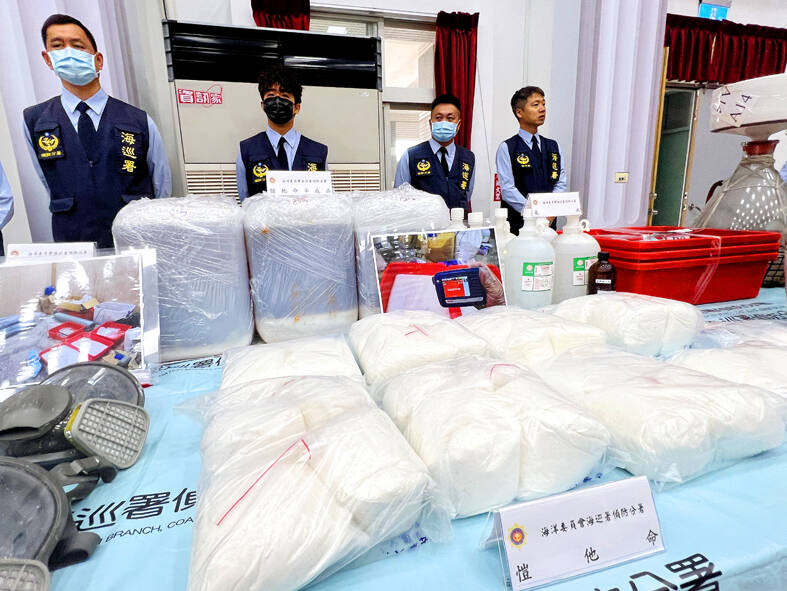
Photo: Liao Yao-tung, Taipei Times
It also collaborated with foreign authorities through international information-sharing channels to intercept 4,147kg of drugs destined for Taiwan, the CGA said.
The authorities seized 9,441kg of narcotics last year.
The CGA highlighted four cases at the news conference, three of which involved illegal drug manufacturing sites, where finished and semi-finished narcotics valued at NT$400 million (US$12.67 million) on the black market were seized.
The seized drugs primarily consisted of ketamine, mephedrone and pseudoephedrine, the CGA said.
The drugs seized from the illicit manufacturing premises were enough to produce about 2 million doses and would have had “unthinkable” consequences for society if they had entered circulation, Ocean Affairs Council Minister Kuan Bi-ling (管碧玲) said.
Kuan praised the “seamless” collaboration by the CGA, prosecutors, police and customs authorities in cracking down on narcotics-related offenses and pledged to step up inspection efforts.
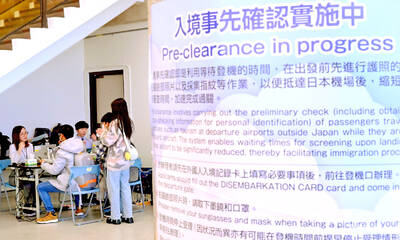
A preclearance service to facilitate entry for people traveling to select airports in Japan would be available from Thursday next week to Feb. 25 at Taiwan Taoyuan International Airport, Taoyuan International Airport Corp (TIAC) said on Tuesday. The service was first made available to Taiwanese travelers throughout the winter vacation of 2024 and during the Lunar New Year holiday. In addition to flights to the Japanese cities of Hakodate, Asahikawa, Akita, Sendai, Niigata, Okayama, Takamatsu, Kumamoto and Kagoshima, the service would be available to travelers to Kobe and Oita. The service can be accessed by passengers of 15 flight routes operated by
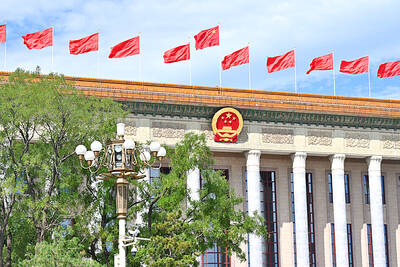
MORE FALL: An investigation into one of Xi’s key cronies, part of a broader ‘anti-corruption’ drive, indicates that he might have a deep distrust in the military, an expert said China’s latest military purge underscores systemic risks in its shift from collective leadership to sole rule under Chinese President Xi Jinping (習近平), and could disrupt its chain of command and military capabilities, a national security official said yesterday. If decisionmaking within the Chinese Communist Party has become “irrational” under one-man rule, the Taiwan Strait and the regional situation must be approached with extreme caution, given unforeseen risks, they added. The anonymous official made the remarks as China’s Central Military Commission Vice Chairman Zhang Youxia (張又俠) and Joint Staff Department Chief of Staff Liu Zhenli (劉振立) were reportedly being investigated for suspected “serious
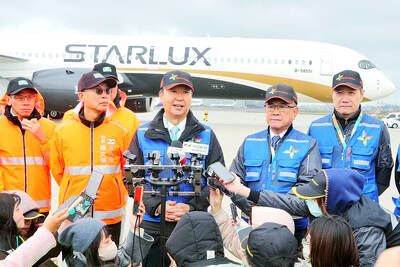
ENHANCING EFFICIENCY: The apron can accommodate 16 airplanes overnight at Taoyuan airport while work on the third runway continues, the transport minister said A new temporary overnight parking apron at Taiwan Taoyuan International Airport is to start operating on Friday next week to boost operational efficiency while the third runway is being constructed, the Ministry of Transportation and Communications said yesterday. The apron — one of the crucial projects in the construction of the third runway — can accommodate 16 aircraft overnight at the nation’s largest international airport, Minister of Transportation and Communications Chen Shih-kai (陳世凱) told reporters while inspecting the new facility yesterday morning. Aside from providing the airport operator with greater flexibility in aircraft parking during the third runway construction,
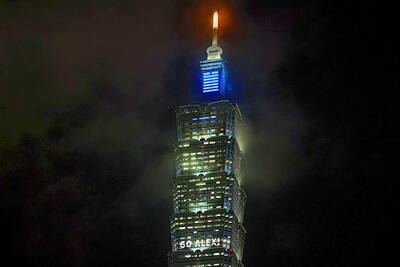
American climber Alex Honnold is to attempt a free climb of Taipei 101 today at 9am, with traffic closures around the skyscraper. To accommodate the climb attempt and filming, the Taipei Department of Transportation said traffic controls would be enforced around the Taipei 101 area. If weather conditions delay the climb, the restrictions would be pushed back to tomorrow. Traffic controls would be in place today from 7am to 11am around the Taipei 101 area, the department said. Songzhi Road would be fully closed in both directions between Songlian Road and Xinyi Road Sec 5, it said, adding that bidirectional traffic controls would


 RSS
RSS