


The Ministry of Foreign Affairs (MOFA) yesterday said that it strongly denies and condemns the Chinese Ministry of Foreign Affairs’ claim on Tuesday that Taiwan uses “dollar diplomacy” to mislead the international community that it is a trustworthy partner.
Chinese Ministry of Foreign Affairs spokesman Guo Jiakun (郭嘉昆) said that “the Taiwan authorities’ ‘dollar diplomacy’ under the disguise of ‘trust’ and ‘prosperity’ cannot cover up their inclination to use any means possible to advance the ‘Taiwan independence’ agenda.”
He was responding to a question about Minister of Foreign Affairs Lin Chia-lung’s (林佳龍) remark that Taiwan builds relationships of trust and prosperity, in competing with China to maintain friendly ties with Honduras.
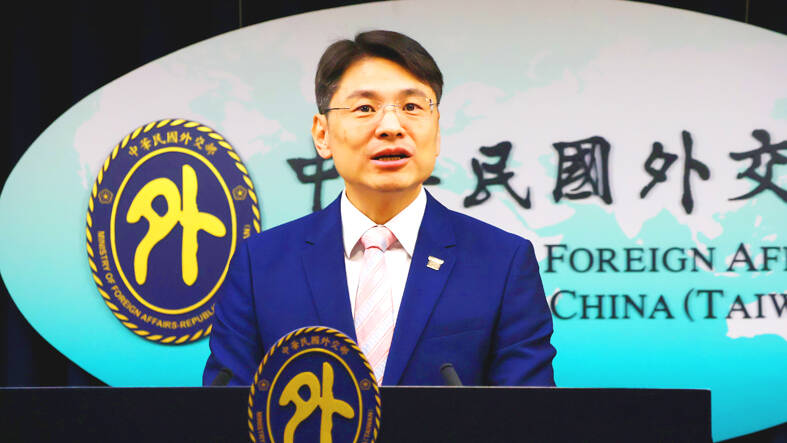
Photo: Huang Ching-hsuan, Taipei Times
The ministry yesterday expressed its severest condemnation and strongly denied the Chinese foreign ministry’s “shameless” claim.
Since Lin took office in May last year, the ministry has been pushing forward the “Diplomatic Allies Prosperity Project” based on the spirit of integrated diplomacy, and its accomplishments have been affirmed and praised by the people and governments of Taiwan’s allies and like-minded nations, it said
The project integrates Taiwan’s competitive industries, and shares knowledge, experience and skills with Taiwan’s allies and like-minded nations according to their substantial developmental demands, to create the best cooperative plan for achieving mutual prosperity and reciprocity, the ministry said.
“The nature of the Diplomatic Allies Prosperity Project is mutual benefit and prosperity, and through systematic and sustainable and long-term cooperation models, offers feasible and comprehensive solutions to help partner countries address structural challenges during their development,” it said.
The ministry said that all the collaborative projects are carried out under open and transparent mechanisms, and the systematic and sustainable partnership builds long-term trust and substantial results.
“The international co-prosperity cooperation model based on values and people-centered clearly cannot be understood and imagined by the narrow-minded dictatorial China, which has long manipulated its foreign relations with an authoritarian mindset,” the ministry said.
China, which has repeatedly used false promises and empty words to lure Taiwan’s allies to switch diplomatic recognition, including promising a vast market and huge investments, is the one practicing “dollar diplomacy,” it said.
The ministry said that actual outcomes prove that China failed to fulfill its promises, and Honduras and other nations did not receive their expected economic benefits, but instead faced the negative impacts from rapid industrial collapse, rising unemployment and a significant trade imbalance.
The result of Honduras’ presidential election clearly exposed the Chinese foreign ministry’s lie that “since the establishment of China-Honduras diplomatic relations ... the two countries and two peoples benefited greatly,” the ministry said.
It also proves that China’s purpose of luring Honduras to switch diplomatic recognition was to maliciously squeeze Taiwan’s international space, not to assist with Honduras’ development, it said.
The ministry called on the international community and Taiwan’s former allies to recognize that Beijing’s so-called “cooperation” is often “nothing more than sugar-coated poison” to realize the true nature and ambition of China’s authoritarian expansionism, and to severely condemn it for its irresponsible words and actions.
Separately, Taiwan is to donate US$650,000 to APEC this year to continue funding projects and research, the ministry said.
Department of International Organizations Director-General Jonathan Sun (孫儉元) signed the agreement while in Shenzhen, China, to attend the APEC Informal Senior Officials’ Meeting, the ministry said in a statement.
Meanwhile, Taiwan yesterday also donated US$50,000 to Songkhla Red Cross.
The funds would be used to assist the local government and residents in facilitating post-disaster recovery and reconstruction, the Representative Office in Thailand said.
Additional reporting by CNA

FUKUOKA SITUATION: Japanese media reported that the pathogen is expected to be identified by the summer, while the CDC downplayed the idea that it was hMPV A “mysterious cold-like illness” reported in Japan’s Fukuoka Prefecture does not seem to be a new disease, but Japanese authorities have been asked about the situation, the Centers for Disease Control (CDC) said yesterday. The Fukuoka Prefectural Medical Association on Wednesday told a news conference that a “mystery cold” that has become a hot topic on social media is “highly likely to be caused by some kind of viral infection,” Japan’s KBC News reported. “Many people are experiencing symptoms starting with a sore throat, followed by a runny nose, phlegm and a severe cough,” KBC News reported, citing association officials. Health authorities are

Nvidia Corp CEO Jensen Huang (黃仁勳) arrived in Taiwan yesterday ahead of upcoming AI and technology events, saying he plans to meet with clients and Taiwan Semiconductor Manufacturing Co Chairman C.C. Wei (魏哲家) during his visit. After landing at Taipei Songshan Airport, Huang posed for photos with fans and handed out Yakult drinks to reporters and supporters waiting at the scene, saying he has “a lot to do” during the trip. Asked about reports that Nvidia’s planned headquarters site in Taipei’s Beitou Shilin Technology Park could break ground on May 27, Huang said that if the company holds an event, he would

The Ministry of Finance this afternoon announced the winning numbers for the March-April uniform invoice lottery. The winning number for the NT$10 million (US$318,060) special prize is 19531471, and the winning number for the NT$2 million grand prize is 85941329. Three numbers were drawn for the NT$200,000 first prize: 07225810, 20231230 and 83518781. Those with receipts matching the last seven digits of any of the first-prize numbers will win the NT$40,000 second prize, while those matching the last six digits will win the NT$10,000 third prize. Those whose receipts match the last five digits of the first-prize numbers can claim the NT$4,000 fourth prize,

SIX SUBSIDIES: The monthly allowance for older farmers is to increase to NT$10,000, and NT$5,000 is to be given to homemakers under the national pension system, Lai said The government is to implement major welfare policies for disadvantaged groups, including raising the monthly allowance for older farmers to NT$10,000 and providing homemakers with NT$5,000 per month, President William Lai (賴清德) said yesterday. Lai made the remarks during a visit to Wangling Temple in Chiayi County, saying that the planned increases were being introduced amid economic growth and an increase in tax revenue. Touting a policy, in which the government plans to provide a monthly allowance of NT$5,000 for every child under the age of 18 in a bid to address Taiwan’s low birthrate, Lai said that if received for the


 RSS
RSS