


All QR codes at Taiwan's airports are safe and the Taiwan Arrival Card (TWAC) filing process is free, the National Immigration Agency said yesterday, amid reports that a Japanese tourist was scammed by an unidentified QR code.
Some media outlets reported that the visitor was scammed after arriving at a local airport and scanning a QR code displayed on a banner upon arrival to complete the TWAC, with the fraudulent Web site requesting a US$50 "processing fee."
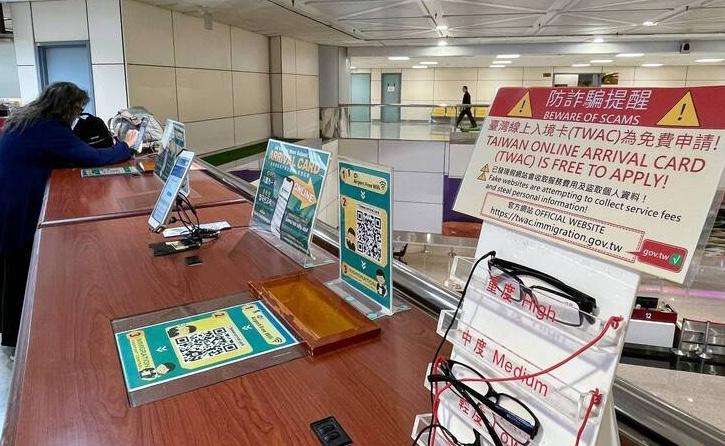
Photo: Chu Pei-hsiung, Taipei Times
In a news release, the agency said its Border Affairs Corps stationed at airports and seaports regularly inspects all QR codes linked to the TWAC system.
The agency said it conducted another comprehensive inspection yesterday and found no banners or QR codes directing users to fraudulent or fee-charging Web sites.
"Publicity banners" are not used at ports or airports due to safety considerations, it added.
The agency cautioned that while no misleading information is displayed at airports or seaports, travelers could still be redirected to fraudulent Web sites if they searched for the TWAC on their own.
It advised travelers to stick to the official Web address for TWAC applications — https://twac.immigration.gov.tw — and reiterated that filling out the TWAC was free.
Travelers with questions are advised to seek assistance from the Border Affairs Corps or send an e-mail to tia@immigration.gov.tw, the agency said.
To prevent scams, the agency said it has produced instructional videos and is disseminating anti-fraud information in multiple languages through its Development Network for immigrants.
The Border Affairs Corps has also strengthened on-site notices in arrival halls at airports and seaports to guide foreign visitors to the official TWAC Web site, it said.
Introduced in October last year, the TWAC requires foreign visitors to submit the form online within three days before arriving in Taiwan.
The process is free of charge, and once the form is completed, the system automatically sends a confirmation to the traveler's registered e-mail address.

Considering that most countries issue more than five denominations of banknotes, the central bank has decided to redesign all five denominations, the bank said as it prepares for the first major overhaul of the banknotes in more than 24 years. Central bank Governor Yang Chin-lung (楊金龍) is expected to report to the Legislative Yuan today on the bank’s operations and the redesign’s progress. The bank in a report sent to the legislature ahead of today’s meeting said it had commissioned a survey on the public’s preferences. Survey results showed that NT$100 and NT$1,000 banknotes are the most commonly used, while NT$200 and NT$2,000

The Centers for Disease Control (CDC) yesterday reported the first case of a new COVID-19 subvariant — BA.3.2 — in a 10-year-old Singaporean girl who had a fever upon arrival in Taiwan and tested positive for the disease. The girl left Taiwan on March 20 and the case did not have a direct impact on the local community, it said. The WHO added the BA.3.2 strain to its list of Variants Under Monitoring in December last year, but this was the first imported case of the COVID-19 variant in Taiwan, CDC Deputy Director-General Lin Ming-cheng (林明誠) said. The girl arrived in Taiwan on

ANNUAL EVENT: Two massive Pokemon balloons are to be set up in Daan Park, with an event zone operating from 10am to 6pm This year’s Taipei Floral Picnic is to be held at Daan Park today and tomorrow, featuring an exclusive Pokemon Go event, a themed food market, a coffee rave picnic area and stage performances, the Taipei Department of Information and Tourism said yesterday. Two massive Pokemon balloons are to be set up in the park as attractions, with an exclusive event zone operating from 10am to 6pm, it said. Participants who complete designated tasks on-site would have a chance to receive limited-edition souvenirs, it added. People could also try the newly launched game Pokemon Pokopia in the trial area, the department said. Three PokeStops are

South Korea is planning to revise its controversial electronic arrival card, a step Taiwanese officials said prompted them to hold off on planned retaliatory measures, a South Korean media report said yesterday. A Yonhap News Agency report said that the South Korean Ministry of Foreign Affairs is planning to remove the “previous departure place” and “next destination” fields from its e-arrival card system. The plan, reached after interagency consultations, is under review and aims to simplify entry procedures and align the electronic form with the paper version, a South Korean ministry official said. The fields — which appeared only on the electronic form


 RSS
RSS