


The military has spotted China's new aircraft carrier, the Fujian (福建), for the first time since it was commissioned making a transit through the Taiwan Strait and released a surveillance photograph of it.
In a statement today, the Ministry of National Defense said it closely monitored the Fujian's passage yesterday, without providing any other details.
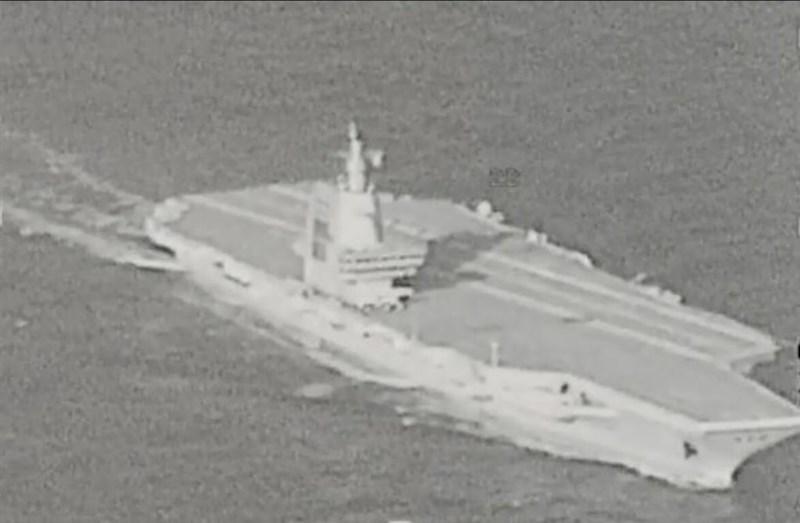
Photo courtesy of the Ministry of National Defense
The photograph of the ship showed no aircraft on its flight deck.
It was the first time Taiwan's military had seen it navigating through the Taiwan Strait since the vessel was commissioned early last month, the ministry said.
Minister of National Defense Wellington Koo (顧立雄) said at a legislative hearing today that his ministry believed the aircraft carrier did not have any aircraft on it, as it was headed back to its manufacturer on Shanghai's Changxing Island to improve some of its flaws.
According to China's state-run media Xinhua news agency, the Fujian entered service during a ceremony marking its handover to the Chinese People's Liberation Army's (PLA) Navy in Hainan Province on Nov. 5 that was presided over by Chinese President Xi Jinping (習近平).
It is China's third aircraft carrier and China's first designed domestically and also the first capable of more advanced catapult-assisted take-offs — a powerful launch system to rapidly accelerate fixed-wing planes for short-distance flight.
As of the end of last month, PLA aircraft, including fighter jets, had flown 4,935 sorties in Taiwan's vicinity, ministry data showed.
The full year total was likely to surpass the previous record of 5,107 flown last year, up from 2,799 in 2022, according to CommonWealth Magazine figures based on publicly available ministry data.
Of the sorties in the year through last month, 3,467 had crossed the median line of the Taiwan Strait, already topping the previous full year record of 3,074 set last year, signaling a further ratcheting up of pressure by the PLA on Taiwan, the data showed.
The median line of the Strait was once considered a tacit boundary between Taiwan and China that was rarely breached by either side.
The campaign has continued unabated this month, with nine sorties of PLA warplanes detected near Taiwan from 6am yesterday to 6am today, the ministry said.
Five out of the nine sorties crossed the Taiwan Strait median line and entered the northern and southwestern sections of Taiwan's air defense identification zone.

Considering that most countries issue more than five denominations of banknotes, the central bank has decided to redesign all five denominations, the bank said as it prepares for the first major overhaul of the banknotes in more than 24 years. Central bank Governor Yang Chin-lung (楊金龍) is expected to report to the Legislative Yuan today on the bank’s operations and the redesign’s progress. The bank in a report sent to the legislature ahead of today’s meeting said it had commissioned a survey on the public’s preferences. Survey results showed that NT$100 and NT$1,000 banknotes are the most commonly used, while NT$200 and NT$2,000

The Centers for Disease Control (CDC) yesterday reported the first case of a new COVID-19 subvariant — BA.3.2 — in a 10-year-old Singaporean girl who had a fever upon arrival in Taiwan and tested positive for the disease. The girl left Taiwan on March 20 and the case did not have a direct impact on the local community, it said. The WHO added the BA.3.2 strain to its list of Variants Under Monitoring in December last year, but this was the first imported case of the COVID-19 variant in Taiwan, CDC Deputy Director-General Lin Ming-cheng (林明誠) said. The girl arrived in Taiwan on

ANNUAL EVENT: Two massive Pokemon balloons are to be set up in Daan Park, with an event zone operating from 10am to 6pm This year’s Taipei Floral Picnic is to be held at Daan Park today and tomorrow, featuring an exclusive Pokemon Go event, a themed food market, a coffee rave picnic area and stage performances, the Taipei Department of Information and Tourism said yesterday. Two massive Pokemon balloons are to be set up in the park as attractions, with an exclusive event zone operating from 10am to 6pm, it said. Participants who complete designated tasks on-site would have a chance to receive limited-edition souvenirs, it added. People could also try the newly launched game Pokemon Pokopia in the trial area, the department said. Three PokeStops are

South Korea is planning to revise its controversial electronic arrival card, a step Taiwanese officials said prompted them to hold off on planned retaliatory measures, a South Korean media report said yesterday. A Yonhap News Agency report said that the South Korean Ministry of Foreign Affairs is planning to remove the “previous departure place” and “next destination” fields from its e-arrival card system. The plan, reached after interagency consultations, is under review and aims to simplify entry procedures and align the electronic form with the paper version, a South Korean ministry official said. The fields — which appeared only on the electronic form


 RSS
RSS