


Taipei Mayor Chiang Wan-an (蔣萬安) yesterday said that major city-wide gaming events could boost visitation across three venues managed by Taipei Metro Recreation Co.
The Maokong Gondola in Wenshan District (文山), Taipei Children’s Amusement Park in Shilin District (士林) and Taipei Arena in Songshan District (松山) are geographically dispersed, which makes it challenging to maximize promotional efforts through conventional joint marketing, Chiang said.
To overcome the geographical hurdle, he has instructed officials to study the feasibility of inviting large mobile events to Taipei, he said, citing the Pokemon GO City Safari game as an example.

Photo: CNA
Urban adventure games such as Pokemon would encourage travel across districts, he said.
The gaming experience would increase the time people spend in the city, creating an economic ripple effect across transportation, catering, shopping districts and the hospitality sector, Chiang said.
Another game that might suit the proposal is Minecraft, he said, citing a player who spent a year designing the area around Taipei Railway Station in the building simulator.
Games are one of the most powerful tools to draw participation among young people, he said.
The three venues could collaborate with internationally renowned games to draw young people into urban design, he added.
They could create a “virtual Taipei,” in which participants build neighborhoods, design parks, optimize pedestrian environments and propose other changes, he added.
Chiang said that he had instructed Taipei Metro Recreation to coordinate and brainstorm concepts with the Taipei Department of Education, the Taipei Department for Youth and the Taipei Department of Urban Development.
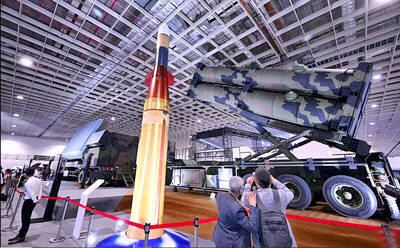
Taiwan is to commence mass production of the Tien Kung (天弓, “Sky Bow”) III, IV and V missiles by the second quarter of this year if the legislature approves the government’s NT$1.25 trillion (US$39.78 billion) special defense budget, an official said yesterday. Commenting on condition of anonymity, a defense official with knowledge of the matter said that the advanced systems are expected to provide crucial capabilities against ballistic and cruise missiles for the proposed “T-Dome,” an advanced, multi-layered air defense network. The Tien Kung III is an air defense missile with a maximum interception altitude of 35km. The Tien Kung IV and V
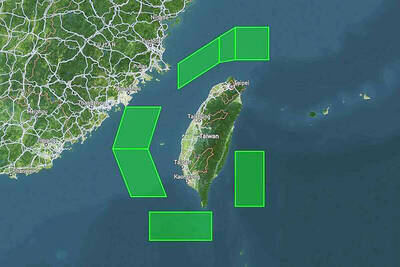
The disruption of 941 flights in and out of Taiwan due to China’s large-scale military exercises was no accident, but rather the result of a “quasi-blockade” used to simulate creating the air and sea routes needed for an amphibious landing, a military expert said. The disruptions occurred on Tuesday and lasted about 10 hours as China conducted live-fire drills in the Taiwan Strait. The Civil Aviation Administration (CAA) said the exercises affected 857 international flights and 84 domestic flights, affecting more than 100,000 travelers. Su Tzu-yun (蘇紫雲), a research fellow at the government-sponsored Institute for National Defense and Security Research, said the air
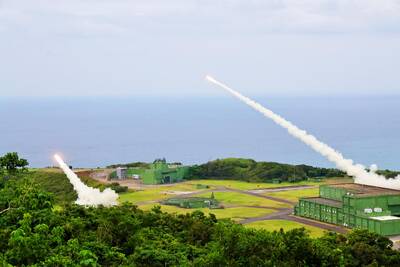
Taiwan lacks effective and cost-efficient armaments to intercept rockets, making the planned “T-Dome” interception system necessary, two experts said on Tuesday. The concerns were raised after China’s military fired two waves of rockets during live-fire drills around Taiwan on Tuesday, part of two-day exercises code-named “Justice Mission 2025.” The first wave involved 17 rockets launched at 9am from Pingtan in China’s Fujian Province, according to Lieutenant General Hsieh Jih-sheng (謝日升) of the Office of the Deputy Chief of the General Staff for Intelligence at the Ministry of National Defense. Those rockets landed 70 nautical miles (129.6km) northeast of Keelung without flying over Taiwan,
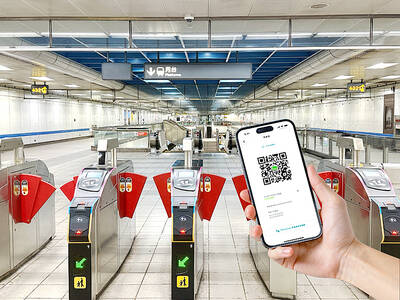
City buses in Taipei and New Taipei City, as well as the Taipei MRT, would on Saturday begin accepting QR code payments from five electronic payment providers, the Taipei Department of Transportation said yesterday. The new option would allow passengers to use the “transportation QR code” feature from EasyWallet, iPass Money, iCash Pay, Jkopay or PXPay Plus. Passengers should open their preferred electronic payment app, select the “transportation code” — not the regular payment code — unlock it, and scan the code at ticket readers or gates, General Planning Division Director-General Liu Kuo-chu (劉國著) said. People should move through the


 RSS
RSS