


The endemic period of enterovirus has ended, but as there were still 10,283 cases last week, caregivers of young children should not let their guards down, the Centers for Disease Control (CDC) said yesterday.
CDC Deputy Director-General and spokesman Lin Min-cheng (林明誠) said that the weekly number of hospital visits for enterovirus infection has been below the epidemic threshold of 11,000 cases for two consecutive weeks, meaning that the endemic period has “tentatively ended.”
However, people should remain cautious, as virus activity is known to fluctuate, as it did in 2023, when weekly cases switched between above and below the threshold for nearly three months, Lin said.
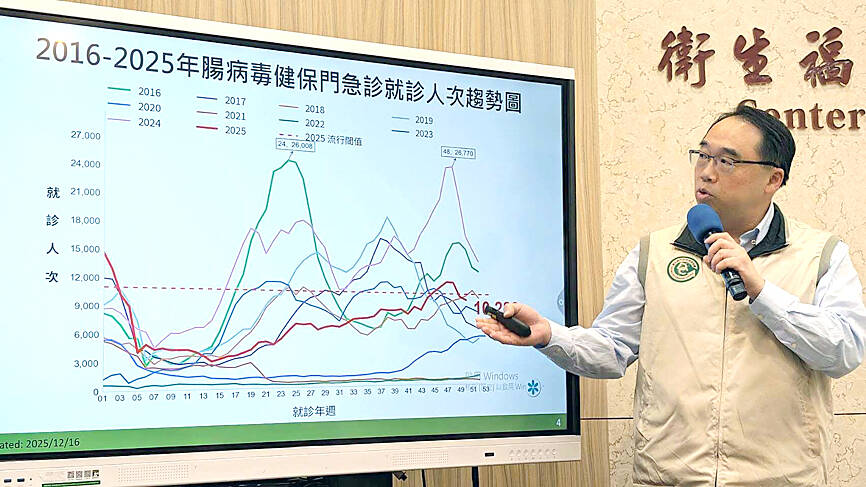
Photo: CNA
CDC Epidemic Intelligence Center Director Guo Hung-wei (郭宏偉) said that no new serious cases were reported last week.
However, there have been 19 serious cases, including nine deaths, reported so far this year, the highest for the period in six years, Guo said.
Of the 19 serious cases, 15 were newborns, he said, adding that 17 had echovirus 11, and one each had coxsackievirus A16 and coxsackievirus B5.
Hospital visit numbers remain relatively high, and five to seven cluster infections have been reported in each of the past four weeks, so there is still a considerably high risk of infection in local communities, he said.
Regarding enterovirus activity in nearby countries, cases have plateaued in South Korea, but remain at the highest in the period in three years; cases are falling in China and Hong Kong, but are still higher than in the same period last year; and cases in Thailand, Singapore and Japan have been steadily reducing, Guo said.
People with enterovirus are most contagious one week after symptoms, so young children who are infected are advised to stay home, rest and avoid contact with other young children, the CDC said.
People can excrete the virus in their feces for eight to 12 weeks after symptoms subside, so caregivers should remind children to practice good hand hygiene, while also frequently disinfecting environments with alcohol or diluted bleach, the centers said.
Good hand hygiene includes “wet, rub, rinse, clean and wipe,” meaning to wet the hands with tap water, rub the hands thoroughly with soap for at least 20 seconds, rinse with water, scoop water over the faucet to clean it and dry the hands with a towel, it said.
Children aged five or younger are at higher risk of developing severe complications from infection, so caregivers should pay close attention to their symptoms and take them to an emergency room if they develop unusual drowsiness, loss of consciousness, weakness or numbness in the limbs, myoclonus (involuntary muscle twitching or jerking), persistent vomiting, shortness of breath or rapid heartbeat, the CDC said.
Signs of severe illness in infected newborns might also include fever, low body temperature, low energy levels or reduced milk intake, and caregivers should seek immediate medical attention, as it can rapidly progress into myocarditis, encephalitis, multiple organ failure or other fatal complications if left untreated, it said.

A magnitude 6.1 earthquake struck off the coast of Yilan County at 8:39pm tonight, the Central Weather Administration (CWA) said, with no immediate reports of damage or injuries. The epicenter was 38.7km east-northeast of Yilan County Hall at a focal depth of 98.3km, the CWA’s Seismological Center said. The quake’s maximum intensity, which gauges the actual physical effect of a seismic event, was a level 4 on Taiwan’s 7-tier intensity scale, the center said. That intensity level was recorded in Yilan County’s Nanao Township (南澳), Hsinchu County’s Guansi Township (關西), Nantou County’s Hehuanshan (合歡山) and Hualien County’s Yanliao (鹽寮). An intensity of 3 was

Instead of focusing solely on the threat of a full-scale military invasion, the US and its allies must prepare for a potential Chinese “quarantine” of Taiwan enforced through customs inspections, Stanford University Hoover fellow Eyck Freymann said in a Foreign Affairs article published on Wednesday. China could use various “gray zone” tactics in “reconfiguring the regional and ultimately the global economic order without a war,” said Freymann, who is also a nonresident research fellow at the US Naval War College. China might seize control of Taiwan’s links to the outside world by requiring all flights and ships entering or leaving Taiwan
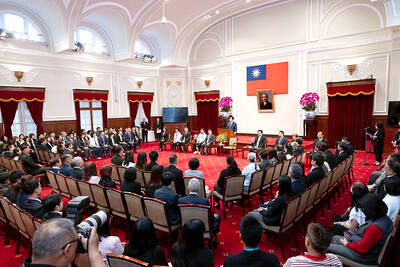
The next minimum wage hike is expected to exceed NT$30,000, President William Lai (賴清德) said yesterday during an award ceremony honoring “model workers,” including migrant workers, at the Presidential Office ahead of Workers’ Day today. Lai said he wished to thank the awardees on behalf of the nation and extend his most sincere respect for their hard work, on which Taiwan’s prosperity has been built. Lai specifically thanked 10 migrant workers selected for the award, saying that although they left their home countries to further their own goals, their efforts have benefited Taiwan as well. The nation’s industrial sector and small businesses lay
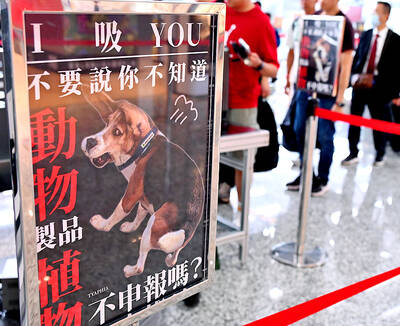
Quarantine awareness posters at Taiwan Taoyuan International Airport have gone viral for their use of wordplay. Issued by the airport branch of the Animal and Plant Health Inspection Agency, the posters feature sniffer dogs making a range of facial expressions, paired with advisory messages built around homophones. “We update the messages for holidays and campaign needs, periodically refreshing materials to attract people’s attention,” quarantine officials said. “The aim is to use the dogs’ appeal to draw focus to quarantine regulations.” A Japanese traveler visiting Taiwan has posted a photo on X of a poster showing a quarantine dog with a


 RSS
RSS