

Former premier Liu Chao-shiuan (劉兆玄) yesterday highlighted opportunities for deeper cross-strait industrial cooperation at the 2025 Cross-Strait CEO Summit (CSCS) in Nanjing, China.
Speaking at the summit, Liu, co-president of CSCS, said that industries in Taiwan and China are facing new challenges and opportunities amid shifting global and regional conditions.
As China prepares to roll out its next five-year plan covering 2026 to 2030, CSCS would adopt new thinking and pursue broader and higher-level cooperation, Liu said.

Photo: CNA
China’s recently published five-year plan serves as a national blueprint outlining the country’s key economic, industrial and social development priorities for the period.
Liu said the CSCS plans to visit Chinese battery maker Contemporary Amperex Technology Co (CATL) in Fujian Province recently to cooperate on energy storage and battery recycling.
There will also be discussions to set up a “zero-carbon park” in Fujian, bringing together Taiwanese and Chinese firms to promote green industry, Liu added.
He highlighted Taiwan’s experience in multinational supply chains and encouraged joint efforts to build smart manufacturing ecosystems and strengthen industrial cooperation.
In his opening remarks at the summit, Wang Huning (王滬寧), a Chinese Communist Party (CCP) Standing Committee member, said the 15th Five-Year Plan provides top-level design and strategic planning, and will inject new momentum into cross-strait economic cooperation and shared development.
Wang also reaffirmed the so-called “1992 Consensus,” opposed Taiwan independence, and emphasized support for Taiwanese businesses and cross-strait economic integration.
The “1992 consensus” refers to a tacit understanding between the Chinese Nationalist Party (KMT) and the CCP that both sides of the Strait acknowledge there is “one China,” with each side having its own interpretation of what “China” means.
Liu and Wang met in a brief media session before the summit, during which Liu underscored the strategic significance of China’s 15th Five- Year Plan, saying it would have a major impact on global economic growth and cross-strait trade.
The CSCS will closely track key policy priorities under the plan, including technological self-reliance, efforts to strengthen China’s domestic market, the promotion of a comprehensive green transition and continued cross-strait industrial cooperation, Liu said.
Liu was premier from 2008 to 2009 under then-president Ma Ying-jeou’s (馬英九) administration.
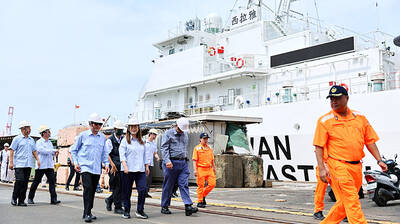
Ocean Affairs Council (OAC) Minister Kuan Bi-ling (管碧玲) on Wednesday said decommissioned coast guard vessels were given to the Philippines to enhance regional rescue capacity and would not affect Taiwanese fishers’ rights and benefits. Kuan made the remarks after confirmation on Tuesday that a 500-tonne Coast Guard Administration (CGA) patrol and rescue vessel would be given to the Philippine Coast Guard. The donation ceremony was reportedly done in Manila, but whether the vessel — previously numbered “CG123” and named Kinmen (金門) — has been handed over has yet to be confirmed. China’s Taiwan Affairs Office (TAO) on Wednesday criticized the donation for “taking

The Ministry of Finance today announced the winning numbers for the July-August uniform invoice lottery. The winning number for the NT$10 million (US$314,663) special prize is 89996565, while the winning number for the NT$2 million grand prize is 91098182. Three numbers were drawn for the NT$200,000 first prize: 54348835, 44991397 and 06595111. Those with receipts matching the last seven digits of any of the first-prize numbers can claim the NT$40,000 second prize, while those matching the last six digits qualify for the NT$10,000 third prize. Those whose receipts match the last five digits of the first-prize numbers are eligible for the NT$4,000 fourth prize,
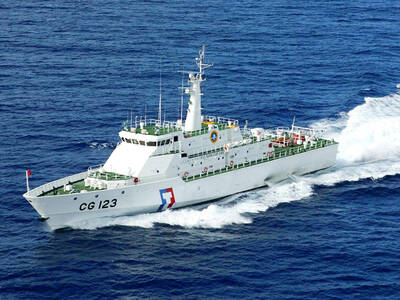
A decommissioned 500-tonne Kinmen-class patrol vessel recently donated by Taiwan’s Coast Guard Administration (CGA) has been delivered to the Philippine Coast Guard (PCG), a source said yesterday. The source said the vessel transferred to the PCG at a ceremony organized by the Philippine Non-government WPS Foundation on Monday was donated by the CGA. The CGA confirmed the donation on Wednesday last week following a United Daily News (UDN) report of a Philippine law enforcement vessel registered as "BLINGNO.1" setting sail for sea trials from Kaohsiung Port that day, citing tracking data from
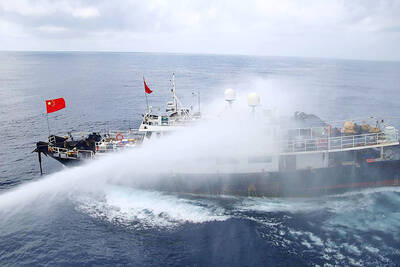
Taiwan has upgraded its maritime patrol capacity around the Pratas Islands (Dongsha Islands, 東沙群島) in the disputed South China Sea, including regularly sending larger ships there, the government said on Wednesday, responding to an increase in Chinese activities. Lying roughly between southern Taiwan and Hong Kong, the Taiwan-controlled Pratas Islands are seen by security experts as vulnerable to a Chinese attack due to their distance — more than 400km — from Taiwan. In a statement late on Wednesday, the Coast Guard Administration (CGA) said its overall patrol and enforcement capacity in Pratas waters has been “comprehensively upgraded.” With the completion of a wharf


 RSS
RSS