


An initial plan by the Legislative Yuan to hold cross-party negotiations today on a proposed amendment that would exclude the China Youth Corps (CYC) from being classified as an affiliated organization of the Chinese Nationalist Party (KMT) has been canceled.
The CYC was established by former president Chang Ching-kuo (蔣經國) in 1952 to organize military training for high-school and college students.
KMT caucus secretary-general Lo Chih-chiang (羅智強), who was to oversee the negotiations, yesterday said that lawmakers have a schedule conflict, so negotiations would be held at another time.
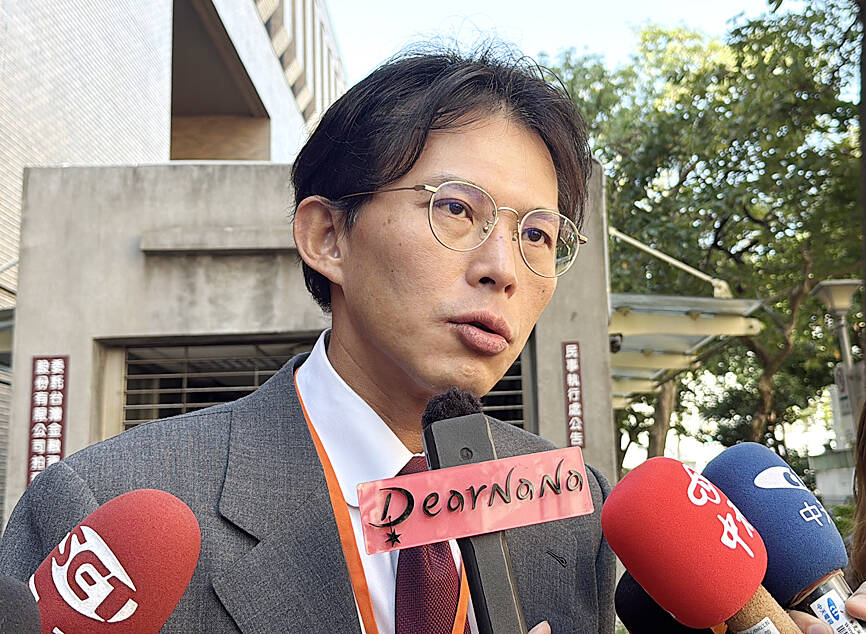
Photo: Liu Hsin-de, Taipei Times
However, sources said that the cancelation was due to strong opposition from Taiwan People’s Party (TPP) Chairman and caucus whip Huang Kuo-chang (黃國昌).
If the KMT had insisted on holding the negotiations, TPP legislators would not attend, the sources said.
At the center of the case were amendments to the Act Governing the Settlement of Ill-gotten Properties by Political Parties and Their Affiliate Organizations (政黨及其附隨組織不當取得財產處理條例) proposed by KMT Legislator Yu Hao (游灝) that were sent directly to a second reading on Dec. 2.
The Ill-gotten Party Assets Settlement Committee (IGPAC) previously identified the CYC and the National Women’s League (NWL) as KMT-affiliated organizations.
The committee in 2019 said that since its establishment, the CYC had made about NT$600 million (US$19.06 million at the current exchange rate) from selling property.
The IGPAC was founded in 2016 to help achieve transitional justice.
The CYC owns 61 properties and more than NT$1.635 billion in cash that were reportedly improperly obtained and must be returned to the state, and the NWL reportedly has about NT$38.7 billion in assets that are also ill-gotten.
Both cases are in litigation at the Administration Court.
Yu’s proposed amendments would add a clause to the definition of affiliated organizations, excluding those that were once under state authority.
In addition, the original definition says that an affiliated organization’s personnel, finances or operations are substantially controlled by a political party, while the amended definition changes “or” to “and,” requiring the political party to maintain substantial control over all three aspects for the organization to be considered affiliated.
Yu said that administrative watchdogs have overstepped their authority, subjecting many public welfare organizations to excessive scrutiny.
The goal of the amendment is to allow such organizations to operate without political interference, he said.
People recognize that the IGPAC is being improperly used to target the KMT, he added.
Meanwhile, the CYC said it was a government organization at first, carrying out government tasks with government funding, adding that when it became a private organization, its revenue started to come from public events and donations as well as government contracts.
It said its assets have nothing to do with a particular party, but the IGPAC has taken a biased stance despite objective evidence it presented.
The IGPAC has spoken out against the bill being sent directly to a second reading, saying that the Taipei High Administrative Court ruled the CYC was a KMT-affiliated organization on Aug. 1 last year.
The Democratic Progressive Party caucus accused Yu of advocating the proposed changes as part of an attempt to protect KMT assets.
An official familiar with the legal regulations said that according to current law, as long as a political party substantially controls or once controlled an organization’s personnel, finances or operations, and later transferred control without proper compensation, the IGPAC can classify it as an affiliated organization.
However, the proposed amendment would require a political party to control all three aspects of an organization for it to be considered affiliated, which would make it much harder to reclaim ill-gotten party assets for the state, the official said.
dditional reporting by Liu Wan-lin

A magnitude 6.1 earthquake struck off the coast of Yilan County at 8:39pm tonight, the Central Weather Administration (CWA) said, with no immediate reports of damage or injuries. The epicenter was 38.7km east-northeast of Yilan County Hall at a focal depth of 98.3km, the CWA’s Seismological Center said. The quake’s maximum intensity, which gauges the actual physical effect of a seismic event, was a level 4 on Taiwan’s 7-tier intensity scale, the center said. That intensity level was recorded in Yilan County’s Nanao Township (南澳), Hsinchu County’s Guansi Township (關西), Nantou County’s Hehuanshan (合歡山) and Hualien County’s Yanliao (鹽寮). An intensity of 3 was

Instead of focusing solely on the threat of a full-scale military invasion, the US and its allies must prepare for a potential Chinese “quarantine” of Taiwan enforced through customs inspections, Stanford University Hoover fellow Eyck Freymann said in a Foreign Affairs article published on Wednesday. China could use various “gray zone” tactics in “reconfiguring the regional and ultimately the global economic order without a war,” said Freymann, who is also a nonresident research fellow at the US Naval War College. China might seize control of Taiwan’s links to the outside world by requiring all flights and ships entering or leaving Taiwan
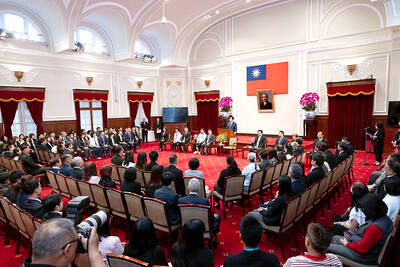
The next minimum wage hike is expected to exceed NT$30,000, President William Lai (賴清德) said yesterday during an award ceremony honoring “model workers,” including migrant workers, at the Presidential Office ahead of Workers’ Day today. Lai said he wished to thank the awardees on behalf of the nation and extend his most sincere respect for their hard work, on which Taiwan’s prosperity has been built. Lai specifically thanked 10 migrant workers selected for the award, saying that although they left their home countries to further their own goals, their efforts have benefited Taiwan as well. The nation’s industrial sector and small businesses lay
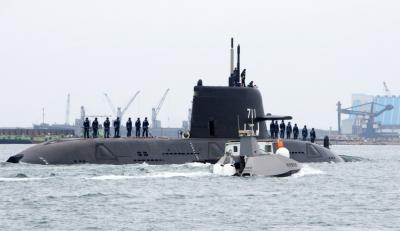
Taiwan's first indigenous defense submarine, the SS-711 Hai Kun (海鯤, or Narwhal), departed for its 13th sea trial at 7am today, marking its seventh submerged test, with delivery to the navy scheduled for July. The outing also marked its first sea deployment since President William Lai (賴清德) boarded the submarine for an inspection on March 19, drawing a crowd of military enthusiasts who gathered to show support. The submarine this morning departed port accompanied by CSBC Corp’s Endeavor Manta (奮進魔鬼魚號) uncrewed surface vessel and a navy M109 assault boat. Amid public interest in key milestones such as torpedo-launching operations and overnight submerged trials,


 RSS
RSS