


The National Center for Research on Earthquake Engineering (NCREE) said it would next year launch an updated version of its Townhouse Earthquake-Resistance Portal to include information on apartment buildings.
The portal provides information on the seismic risk of townhouses five stories and under. Since about 70 percent of Taiwan’s population lives in some form of multi-unit apartment building, and more than 6 million residential units nationwide are more than 30 years old, an updated portal to include information on those buildings was urgently needed, the NCREE said.
“The center has been studying nationwide seismic force data, such as basin effects, seismic-wave amplification and soil conditions,” NCREE Director Yu Chen (昱辰) said. “At the same time, we are developing seismic-resilience technologies and drafting structural safety standards.”
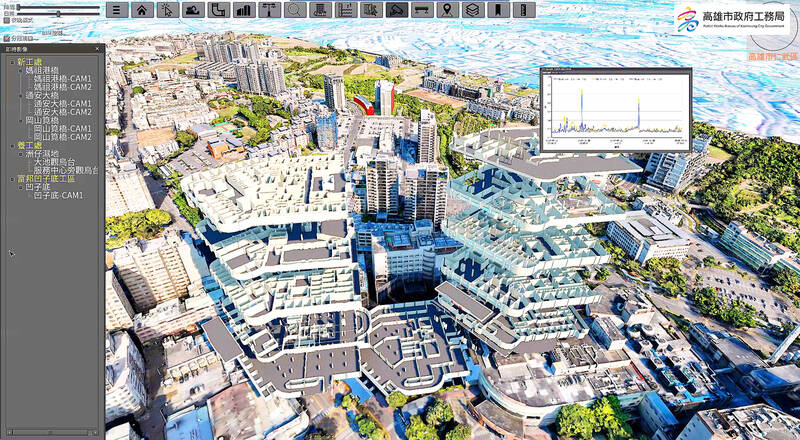
Photo courtesy of the Kaohsiung Public Works Bureau
The NCREE was instrumental in efforts to reinforce thousands of school structures following the 921 Earthquake, when a magnitude 7.3 earthquake hit Taiwan in the early morning hours of Sept. 21, 1999.
However, the collapse of the Weiguan Jinlong housing complex due to a magnitude 6.6 quake on Feb. 6, 2016, highlighted the pressing need to evaluate the seismic capacity of the nation’s aging private residences, Yu said.
The building’s collapse resulted in the deaths of 115 people.
Partially in response to the Weiguan incident, the NCREE in 2020 established a project office tasked with reinforcing weak buildings and prioritizing high-risk multi-unit apartment complexes, he said, adding that the office has reinforced 171 buildings to date.
It also established the portal so that people living in private townhouses could check the seismic vulnerability of their building and use that information to decide whether building reinforcements are necessary, Yu said.
The apartment building version of the portal would allow residents to look up their building’s structural risk, he said.
“However, we acknowledge that old-building ownership structures are often complicated, and seismic retrofits require additional spending by all residents,” Yu said, adding that a building assessment alone could cost between tens of thousands and several hundred thousand New Taiwan dollars, and reinforcement work could cost residents up to NT$200,000 per unit.
“The high costs, combined with the fact that design work takes several months and construction can require up to half a year means many homeowners are unwilling to proceed,” he said.
Separately, NCREE Deputy Director Chai Chun-fu (柴駿甫) said AI and smart city technologies that integrate drone imagery, satellite data, 6G, virtual reality, big data, image recognition and cloud computing are making cities safer and improving the efficiency of urban services.
He cited as an example the 5D SmartES Smart City Platform in Kaohsiung, which could support flood control, disaster prevention, landslide monitoring, traffic-flow optimization, construction-site management, and smart healthcare and tourism.
“For instance, during a recent heavy-rain event, the system successfully predicted a slope failure in Kaohsiung, demonstrating its ability to forecast disasters,” he said. “This allows decisionmakers — even those far away — to issue disaster-response instructions immediately.”

The military has spotted two Chinese warships operating in waters near Penghu County in the Taiwan Strait and sent its own naval and air forces to monitor the vessels, the Ministry of National Defense (MND) said. Beijing sends warships and warplanes into the waters and skies around Taiwan on an almost daily basis, drawing condemnation from Taipei. While the ministry offers daily updates on the locations of Chinese military aircraft, it only rarely gives details of where Chinese warships are operating, generally only when it detects aircraft carriers, as happened last week. A Chinese destroyer and a frigate entered waters to the southwest
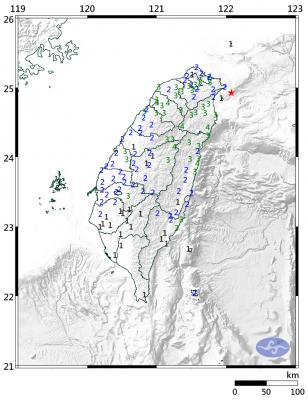
A magnitude 6.1 earthquake struck off the coast of Yilan County at 8:39pm tonight, the Central Weather Administration (CWA) said, with no immediate reports of damage or injuries. The epicenter was 38.7km east-northeast of Yilan County Hall at a focal depth of 98.3km, the CWA’s Seismological Center said. The quake’s maximum intensity, which gauges the actual physical effect of a seismic event, was a level 4 on Taiwan’s 7-tier intensity scale, the center said. That intensity level was recorded in Yilan County’s Nanao Township (南澳), Hsinchu County’s Guansi Township (關西), Nantou County’s Hehuanshan (合歡山) and Hualien County’s Yanliao (鹽寮). An intensity of 3 was

Japanese Prime Minister Sanae Takaichi’s comment last year on Tokyo’s potential reaction to a Taiwan-China conflict has forced Beijing to rewrite its invasion plans, a retired Japanese general said. Takaichi told the Diet on Nov. 7 last year that a Chinese naval blockade or military attack on Taiwan could constitute a “survival-threatening situation” for Japan, potentially allowing Tokyo to exercise its right to collective self-defense. Former Japan Ground Self-Defense Force general Kiyofumi Ogawa said in a recent speech that the remark has been interpreted as meaning Japan could intervene in the early stages of a Taiwan Strait conflict, undermining China’s previous assumptions
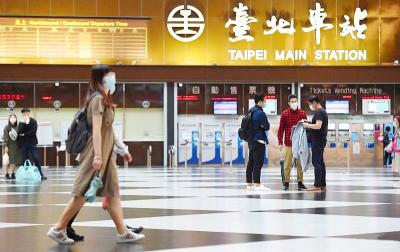
Taiwan Railways Corp (TRC) today announced that Shin Kong Mitsukoshi has been selected as the preferred bidder to operate the Taipei Railway Station shopping mall, replacing the current operator, Breeze Development Co Ltd. Among eight qualified firms that delivered presentations and were evaluated by a review committee, Shin Kong Mitsukoshi was ranked first, while Breeze was named the runner-up, the rail company said in a statement. Contract negotiations are to proceed in accordance with regulations, it said, adding that if negotiations with the top bidder fail, it could invite the second-ranked applicant to enter talks. Breeze in a statement today expressed doubts over


 RSS
RSS