


Groups yesterday gathered to request that the government establish schools to teach courses in Hoklo (commonly known as Taiwanese), make it one of the nation’s official languages, and promote its use in central and local governments, as well as society at large.
“We ask the government to help reverse the decline of Taigi by normalizing its use, and implementing policies and initiating programs for Taigi,” Taiwanese Language Policy Promotion Alliance convener Hsu Hui-ying (許慧盈) said. “It is the language that best represents Taiwanese culture and its people around the world.”
Taiwanese and other native languages were suppressed and discriminated against by the Chinese Nationalist Party (KMT) regime for many decades, but despite that, it is still being used today, Hsu said, citing a 2020 survey that found 31 percent of the population use Taiwanese as their main language, while 54 percent use it as their second language.

Photo: Yang Mien-chieh, Taipei Times
“That means 85 percent of the population are able to speak Taiwanese,” they said.
“Although there is a worrying trend among young people, as only 7.4 percent of Taiwanese aged between six and 14 use Taiwanese as their main language, most people can speak it, but they seldom do, “ Hsu said. “The government should rejuvenate it and promote its use in society and daily life.”
The alliance urged the government to establish school programs focused on Taiwanese, and to set up dedicated bodies to revitalize the language at the central and local government levels.
It also called for programs promoting its use in society.
“When it comes to communication in the government, political circles and society, speaking Taiwanese is discouraged and Mandarin is commonly used,” Hsu said. “That shows that Taiwan is still constrained by the Chinese linguistic system, with people misled into believing Mandarin is the ‘main language.’”
“We need to have Taiwanese, to build up the basis of Taiwanese sovereignty,” Minister Without Portfolio Lin Ming-hsin (林明昕) said.
“Due to policies in the past, native Taiwanese languages are facing a severe crisis and a serious decline in use,” Lin said.
The Cabinet in 2022 mandated heads of the Ministry of Education, Ministry of Culture, Council of Indigenous Peoples, Hakka Affairs Council and other agencies to come up with a plan to develop the nation’s languages, Lin said.
It had a five-year NT$32.4 billion (US$1.04 billion) budget to organize “speak Taiwanese” activities, create a friendly environment for native Taiwanese languages and initiate programs to encourage and increase the use of Hoklo in daily life, Lin added.
Deputy Minister of Education Liu Kuo-wei (劉國偉) said the ministry next year plans to set up the first “Taigi immersion” learning base (台語沉浸學習基地) in Chiayi City.
Taiwanese learning has also been started in more than 400 kindergartens, and more than 100,000 grade-school classes are teaching the local district’s language, Liu said, adding that of the 1.6 million grade-school students in those classes, 1.4 million students were learning Taiwanese this year.
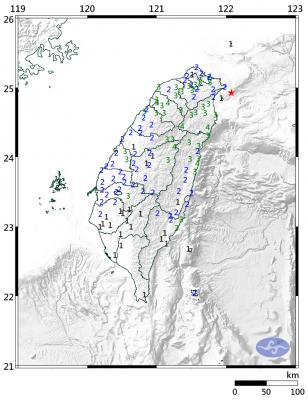
A magnitude 6.1 earthquake struck off the coast of Yilan County at 8:39pm tonight, the Central Weather Administration (CWA) said, with no immediate reports of damage or injuries. The epicenter was 38.7km east-northeast of Yilan County Hall at a focal depth of 98.3km, the CWA’s Seismological Center said. The quake’s maximum intensity, which gauges the actual physical effect of a seismic event, was a level 4 on Taiwan’s 7-tier intensity scale, the center said. That intensity level was recorded in Yilan County’s Nanao Township (南澳), Hsinchu County’s Guansi Township (關西), Nantou County’s Hehuanshan (合歡山) and Hualien County’s Yanliao (鹽寮). An intensity of 3 was
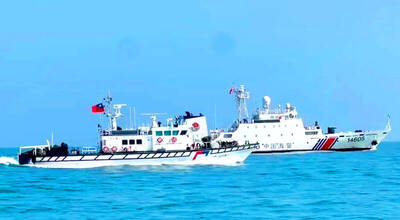
Instead of focusing solely on the threat of a full-scale military invasion, the US and its allies must prepare for a potential Chinese “quarantine” of Taiwan enforced through customs inspections, Stanford University Hoover fellow Eyck Freymann said in a Foreign Affairs article published on Wednesday. China could use various “gray zone” tactics in “reconfiguring the regional and ultimately the global economic order without a war,” said Freymann, who is also a nonresident research fellow at the US Naval War College. China might seize control of Taiwan’s links to the outside world by requiring all flights and ships entering or leaving Taiwan
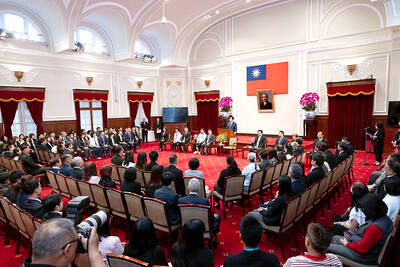
The next minimum wage hike is expected to exceed NT$30,000, President William Lai (賴清德) said yesterday during an award ceremony honoring “model workers,” including migrant workers, at the Presidential Office ahead of Workers’ Day today. Lai said he wished to thank the awardees on behalf of the nation and extend his most sincere respect for their hard work, on which Taiwan’s prosperity has been built. Lai specifically thanked 10 migrant workers selected for the award, saying that although they left their home countries to further their own goals, their efforts have benefited Taiwan as well. The nation’s industrial sector and small businesses lay
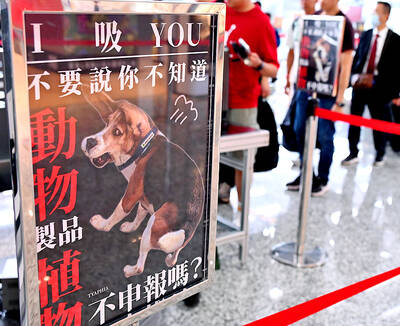
Quarantine awareness posters at Taiwan Taoyuan International Airport have gone viral for their use of wordplay. Issued by the airport branch of the Animal and Plant Health Inspection Agency, the posters feature sniffer dogs making a range of facial expressions, paired with advisory messages built around homophones. “We update the messages for holidays and campaign needs, periodically refreshing materials to attract people’s attention,” quarantine officials said. “The aim is to use the dogs’ appeal to draw focus to quarantine regulations.” A Japanese traveler visiting Taiwan has posted a photo on X of a poster showing a quarantine dog with a


 RSS
RSS