


Council of Indigenous Peoples Minister Ljaucu Zingrur on Friday thanked World Indigenous Traditional Games (WITG) participants for what he called warm friendship and building links between countries, in his remarks at the closing ceremony of the Games held in Pingtung County’s Laiyi Township (來義) from Wednesday to Friday.
New Zealand topped the medal table with two gold, one silver and bronze medals to secure a NT$200,000 prize.
After receiving a trophy made of lily flowers — a symbol of Pingtung’s Paiwan community — from the minister, members of the New Zealand team performed a traditional Maori haka.
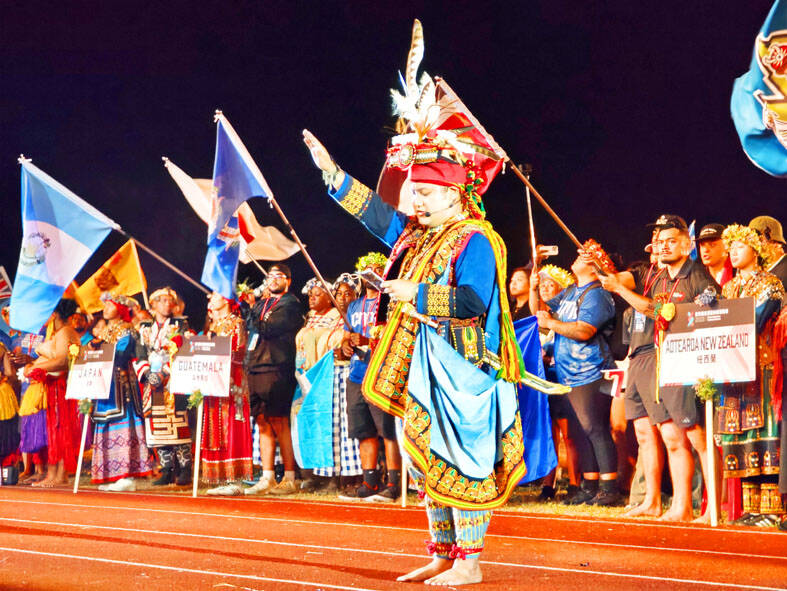
Photo: Chen Yen-ting, Taipei Times
The Atayal team won the domestic contest, earning seven gold, one silver and two bronze medals, and also being awarded NT$200,000.
“In the past few days, we have shared some wonderful and unforgettable moments here,” Ljaucu Zingrur said. “We want to express our deepest thanks to all the international teams who traveled from your countries.”
“Thank you for bringing your culture, skills and passion, also for showing respect and friendship to help make this gathering of indigenous peoples truly meaningful,” he said.
Ljaucu Zingrur also thanked Taiwan’s indigenous teams “for showing the world the beauty and strength of your cultures, and for filling the Games with culture, depth and warmth.”
“Through sports, we introduce our culture [to others], and through culture, we connect with one another,” he said. “Once again, the world witnessed the strength of indigenous peoples.”
The inaugural Games had more than 1,100 participants from 12 international teams including Canada, Guatemala, Japan, Marshall Islands, New Zealand, Northern Mariana Islands, Palau, the Philippines, Tuvalu, and the US’ Hawaii and Guam.
The Games were held by the council, the Pingtung County Government, Taiwan Indigenous TV and the Indigenous People’s Cultural Foundation, at Laiyi High School and other locations in Kaohsiung and Pingtung County.
Participants competed in 10 categories: traditional archery, traditional music and dance, log sawing, tug of war, wrestling, net casting, canoe racing, road running, weight carrying and freediving sprint.
“We wish to see Taiwan’s and other countries’ indigenous peoples interacting and coming closer to forge links,” Pingtung County Commissioner Chou Chun-mi (周春米) said at the opening ceremony.
Taiwan had 17 teams representing the indigenous groups who are officially recognized.
However, some Pingpu rights activists said that despite their request to participate in the event, Pingpu groups in central and northern Taiwan were not allowed to participate, resulting in only the three Pingpu groups in southern Taiwan — Siraya, Makatao and Taivoan — competing, as they accused the council and organizers of negligence.
The requirements to register as indigenous Pingpu groups through a three-year application period, and evaluation and approval by appointed indigenous officials makes the process unnecessarily arduous, they said.
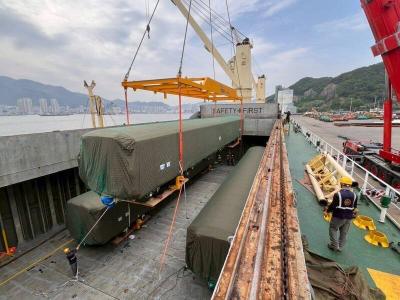
The first of 10 new high-capacity trains purchased from South Korea’s Hyundai Rotem arrived at the Port of Taipei yesterday to meet the demands of an expanding metro network, Taipei Rapid Transit Corp (TRTC) said yesterday. The train completed a three-day, 1,200km voyage from the Port of Masan in South Korea, the company said. Costing NT$590 million (US$18.79 million) each, the new six-carriage trains feature a redesigned interior based on "human-centric" transportation concepts, TRTC said. The design utilizes continuous longitudinal seating to widen the aisles and optimize passenger flow, while also upgrading passenger information displays and driving control systems for a more comfortable
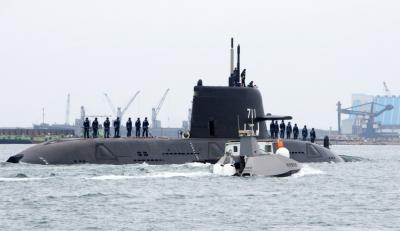
Taiwan's first indigenous defense submarine, the SS-711 Hai Kun (海鯤, or Narwhal), departed for its 13th sea trial at 7am today, marking its seventh submerged test, with delivery to the navy scheduled for July. The outing also marked its first sea deployment since President William Lai (賴清德) boarded the submarine for an inspection on March 19, drawing a crowd of military enthusiasts who gathered to show support. The submarine this morning departed port accompanied by CSBC Corp’s Endeavor Manta (奮進魔鬼魚號) uncrewed surface vessel and a navy M109 assault boat. Amid public interest in key milestones such as torpedo-launching operations and overnight submerged trials,
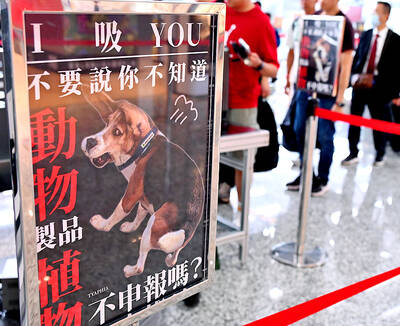
Quarantine awareness posters at Taiwan Taoyuan International Airport have gone viral for their use of wordplay. Issued by the airport branch of the Animal and Plant Health Inspection Agency, the posters feature sniffer dogs making a range of facial expressions, paired with advisory messages built around homophones. “We update the messages for holidays and campaign needs, periodically refreshing materials to attract people’s attention,” quarantine officials said. “The aim is to use the dogs’ appeal to draw focus to quarantine regulations.” A Japanese traveler visiting Taiwan has posted a photo on X of a poster showing a quarantine dog with a

SECURITY RISK: A university student sent a general alarm signal to THSRC’s control center on April 5, causing four operating trains to temporarily halt services The Ministry of Transportation and Communications yesterday pledged to submit a report on ways to harden the communication security of railway systems after a university student hacked into Taiwan High Speed Rail Corp’s (THSRC) radio communications system and disrupted operations of four high-speed rail trains last month. Investigation by the police and prosecutors found that the university student and radio enthusiast, surnamed Lin (林), first used a software-defined radio (SDR) filter to analyze THSRC signals, downloaded the data to a computer, cracked the parameters and then programmed the codes into his radio devices. Lin then sent a general alarm signal to


 RSS
RSS