


Underage driving in remote areas is rampant due to insufficient transportation and part-time work, the Jing Chuan Child Safety Foundation said yesterday, adding that its survey suggested that more than half of parents knew about their children’s behavior.
The foundation was commissioned by the Ministry of Transportation and Communications’ Highway Bureau to conduct research on the cause of underage driving in Taiwan, foundation executive director Hsu Ya-jen (許雅荏) told a news conference.
Bureau data showed that an average of more than 40,000 underage unlicensed driving cases per year were recorded over the past five years, while international studies showed that minors’ road traffic fatality rate is three times higher than adults, she said.
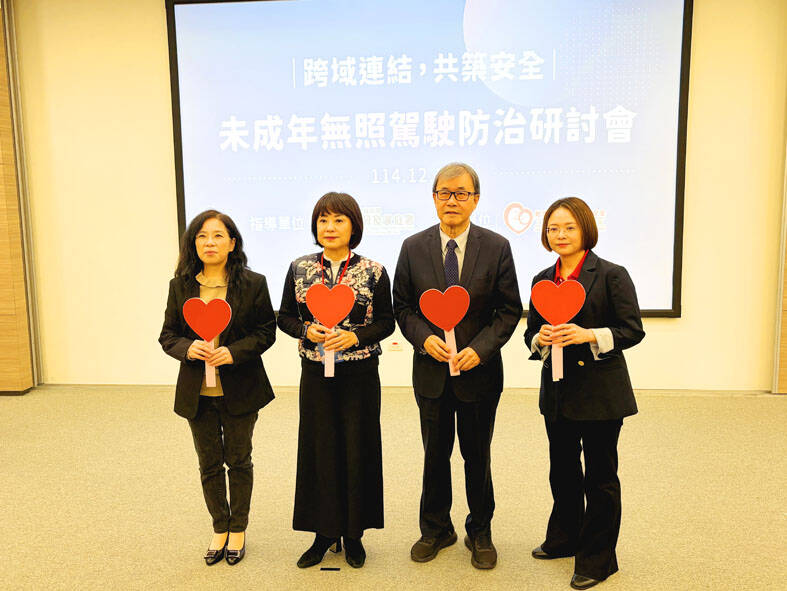
Photo: CNA
In most cases, violators were teenagers aged 15 to 17, Hsu said, adding about 50 percent of minors did not consider it dangerous to ride a motorcycle.
Family-related issues topped the list of factors that led to underage driving — 54.3 percent of minors had access to vehicles owned by their family, while 52.3 percent of parents knew it without intervention, she said.
However, many teenagers drove without a license not because they were rebellious, but because they had to work part-time and had no choice but to operate vehicles in areas lacking transportation resources, Hsu said.
They were forced to bear such road safety risks, she said, urging the government to plan solutions instead of attributing the situation to teenagers’ personal issues.
The Ministry of Education (MOE) this year allocated NT$400 million (US$12.8 million) to 49 vocational and senior-high schools in remote areas to purchase school buses, Minister of Education Cheng Ying-yao (鄭英耀) said.
The MOE has also funded 10 universities with a high rate of traffic accidents to aid their efforts in improving road safety, he said.
Road safety is not just an engineering or management problem, but involves education on empathy, responsibility and civic consciousness, Cheng said, adding that the government would collaborate with schools and the private sector to foster a culture of respecting life among teenagers.
Democratic Progressive Party Legislator Lin Yue-chin (林月琴) said underage unlicensed driving is caused by inadequate transportation planning, as well as insufficient road safety education and teenager support mechanisms.
The problem must be addressed through collaborations between agencies in charge of education, transportation, law enforcement and social affairs, she said, adding that overall coordination and promotion is lacking.
Given that amendments to the Road Traffic Management and Penalty Act (道路交通管理處罰條例) came into effect this year — which increased unlicensed drivers’ accountability by raising fines and introducing on-the-spot vehicle impoundment — such contraventions are expected to decrease, she added.
Lin said she would ask the central government to improve public transportation and traffic safety education resources in remote areas.
However, monetary fines and one-way road safety lectures have limited effect, Hsu said, adding that excessive amounts of fines and long hours of lecturing might be unbearable for some teenagers.
While first-time and repeat violators should be addressed differently, interactive courses tailored to teenagers’ language and lifestyle should be developed, she said.
Family participation and support mechanisms should also be enhanced to enable teenagers to work on the issue with their parents, Hsu added.
Data from the foundation showed that about 60 percent of underage drivers were curious first-time violators, while 40 percent were repeat violators.
The foundation also urged the development of a training and certification system for riding bicycles and e-bikes, and its implementation across schools in remote areas.

FUKUOKA SITUATION: Japanese media reported that the pathogen is expected to be identified by the summer, while the CDC downplayed the idea that it was hMPV A “mysterious cold-like illness” reported in Japan’s Fukuoka Prefecture does not seem to be a new disease, but Japanese authorities have been asked about the situation, the Centers for Disease Control (CDC) said yesterday. The Fukuoka Prefectural Medical Association on Wednesday told a news conference that a “mystery cold” that has become a hot topic on social media is “highly likely to be caused by some kind of viral infection,” Japan’s KBC News reported. “Many people are experiencing symptoms starting with a sore throat, followed by a runny nose, phlegm and a severe cough,” KBC News reported, citing association officials. Health authorities are

Nvidia Corp CEO Jensen Huang (黃仁勳) arrived in Taiwan yesterday ahead of upcoming AI and technology events, saying he plans to meet with clients and Taiwan Semiconductor Manufacturing Co Chairman C.C. Wei (魏哲家) during his visit. After landing at Taipei Songshan Airport, Huang posed for photos with fans and handed out Yakult drinks to reporters and supporters waiting at the scene, saying he has “a lot to do” during the trip. Asked about reports that Nvidia’s planned headquarters site in Taipei’s Beitou Shilin Technology Park could break ground on May 27, Huang said that if the company holds an event, he would

The Ministry of Finance this afternoon announced the winning numbers for the March-April uniform invoice lottery. The winning number for the NT$10 million (US$318,060) special prize is 19531471, and the winning number for the NT$2 million grand prize is 85941329. Three numbers were drawn for the NT$200,000 first prize: 07225810, 20231230 and 83518781. Those with receipts matching the last seven digits of any of the first-prize numbers will win the NT$40,000 second prize, while those matching the last six digits will win the NT$10,000 third prize. Those whose receipts match the last five digits of the first-prize numbers can claim the NT$4,000 fourth prize,

SIX SUBSIDIES: The monthly allowance for older farmers is to increase to NT$10,000, and NT$5,000 is to be given to homemakers under the national pension system, Lai said The government is to implement major welfare policies for disadvantaged groups, including raising the monthly allowance for older farmers to NT$10,000 and providing homemakers with NT$5,000 per month, President William Lai (賴清德) said yesterday. Lai made the remarks during a visit to Wangling Temple in Chiayi County, saying that the planned increases were being introduced amid economic growth and an increase in tax revenue. Touting a policy, in which the government plans to provide a monthly allowance of NT$5,000 for every child under the age of 18 in a bid to address Taiwan’s low birthrate, Lai said that if received for the


 RSS
RSS