


President William Lai’s (賴清德) “T-Dome” initiative to build a multilayered air defense network would cost an estimated NT$400 billion (US$12.8 billion), or about one-third of the proposed NT$1.25 trillion special defense budget, according to a senior official.
Commenting on condition of anonymity, the source said that Taiwan would need to buy new arms and equipment to supplement the nation’s existing air defense systems to achieve the advanced capabilities envisioned for the initiative.
This means procurements for an array of domestic and foreign systems, including at least two Chiang Kung (強弓, “Strong Bow”) systems and 128 missiles for NT$36.6 billion, they said.
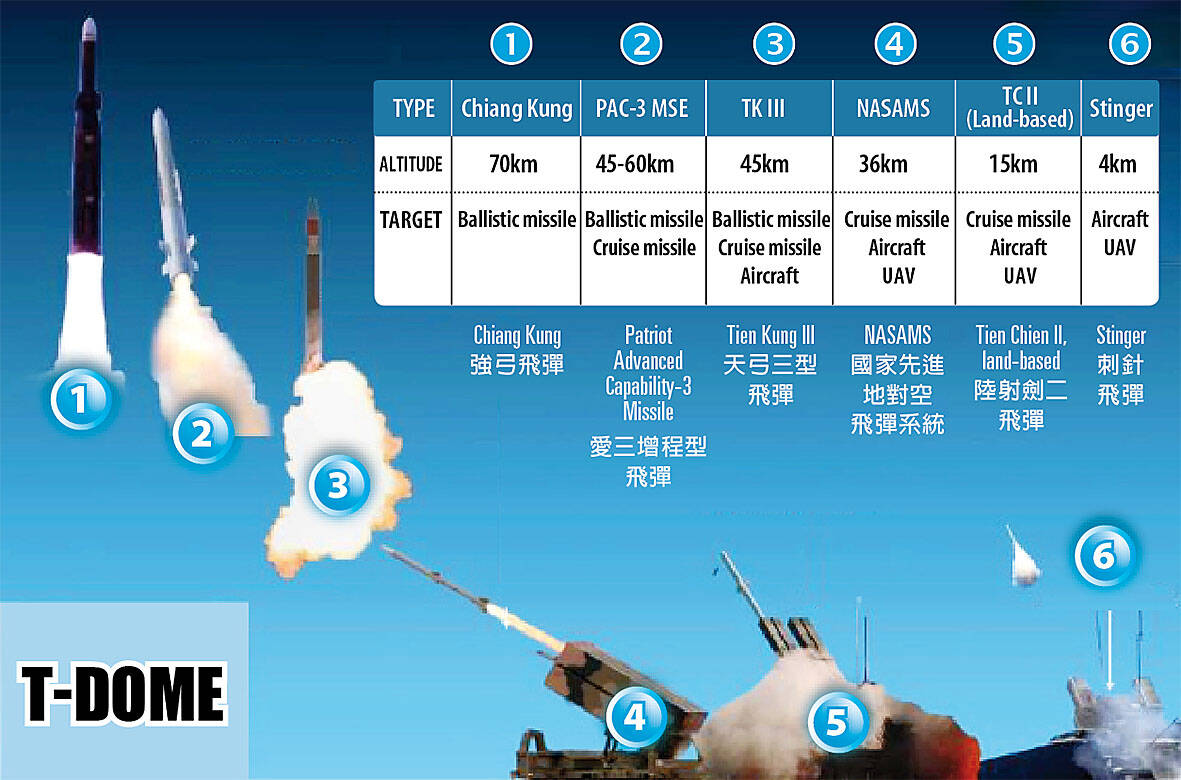
The Chungshan Institute of Science and Technology-developed air defense system with a maximum interception height of 70km — an offshoot of the Tien Kung III (天弓, “Sky Bow”) missile’s design — would become Taiwan’s primary high-altitude defense missile, the official said.
Patriot Advanced Capability-3 Missile Segment Enhancement systems (PAC-3 MSE), with an interception height of 45km to 60km, would fill the medium-altitude defense role, they said.
The nation is planning to buy enough PAC-3 MSEs to equip an air-defense battalion for NT$125 billion, they said.
The government would buy 230 Tien Kung III missiles with an interception height of 45km for NT$15 billion and a number of National Advanced Surface-to-Air Missile Systems for NT$115 billion to handle lower-altitude threats, they said.
The Integrated Air and Missile Defense Battle Command System, which costs about NT$94 billion, would likely be used to control missile engagements for the air defense network, the official added.
The PAC-3 currently in use with a 24km intercept height, land-based Tien Chien II with a 15km intercept height and Stinger with a 4km intercept height would continue to be used to counter cruise missiles, airplanes, helicopters and drones.
Minister of National Defense Wellington Koo (顧立雄) previously told lawmakers during a legislative committee meeting on the defense resilience and asymmetric capabilities enhancement special budget that the program would be spent over a period of eight years, from next year to 2033.
The special budget, which focuses on one-time investments, centralizes the allocation of resources to ensure the nation would acquire key capabilities without delay, he said.
These capabilities are precision artillery, long-range attack missiles, anti-ballistic missile systems, anti-armor guided missiles, uncrewed aerial vehicles (UAVs) and UAV countermeasures, equipment related to operational sustainability, and artificial intelligence (AI)-enabled command and control systems, as well as weapons jointly developed by Taiwan and the US, he said.
According to Koo, the defense ministry is prioritizing the needs of the T-Dome initiative, capabilities that use AI and other technology to shorten kill chains, and systems that facilitate the nation’s drive to decouple defense supply chains from China.
On Friday at the Legislative Yuan, motions by opposition parties requiring Lai to take questions from the legislature on his proposed NT$1.25 trillion special defense budget were sent directly to a second reading and cross-party negotiations.
Additional reporting by CNA
Fast food chain McDonald's is to raise prices by up to NT$5 on some products at its restaurants across Taiwan, starting on Wednesday next week, the company announced today. The prices of all extra value meals and sharing boxes are to increase by NT$5, while breakfast combos and creamy corn soup would go up by NT$3, the company said in a statement. The price of the main items of those meals, if ordered individually, would remain the same. Meanwhile, the price of a medium-sized lemon iced tea and hot cappuccino would rise by NT$3, extra dipping sauces for chicken nuggets would go up

Nvidia Corp CEO Jensen Huang (黃仁勳) arrived in Taiwan yesterday ahead of upcoming AI and technology events, saying he plans to meet with clients and Taiwan Semiconductor Manufacturing Co Chairman C.C. Wei (魏哲家) during his visit. After landing at Taipei Songshan Airport, Huang posed for photos with fans and handed out Yakult drinks to reporters and supporters waiting at the scene, saying he has “a lot to do” during the trip. Asked about reports that Nvidia’s planned headquarters site in Taipei’s Beitou Shilin Technology Park could break ground on May 27, Huang said that if the company holds an event, he would

FUKUOKA SITUATION: Japanese media reported that the pathogen is expected to be identified by the summer, while the CDC downplayed the idea that it was hMPV A “mysterious cold-like illness” reported in Japan’s Fukuoka Prefecture does not seem to be a new disease, but Japanese authorities have been asked about the situation, the Centers for Disease Control (CDC) said yesterday. The Fukuoka Prefectural Medical Association on Wednesday told a news conference that a “mystery cold” that has become a hot topic on social media is “highly likely to be caused by some kind of viral infection,” Japan’s KBC News reported. “Many people are experiencing symptoms starting with a sore throat, followed by a runny nose, phlegm and a severe cough,” KBC News reported, citing association officials. Health authorities are
Carrefour Taiwan is to begin using a new name from the start of July, but it cannot divulge the name until then, the chairman of the supermarket chain's parent company said today. President Chain Store Co chairman Lo Chih-hsien (羅智先) was asked by reporters after a shareholders' meeting to confirm whether the company has settled on a new name for the supermarket brand. In March, the government-registered name of two Carrefour Taiwan branches was quietly changed to "Le Chia Kang" (樂家康) in Chinese, raising speculation that has been selected as the name. Lo said that because of local regulations and contractual obligations, the


 RSS
RSS