


Comments made a month ago by Japanese Prime Minister Sanae Takaichi that triggered a diplomatic spat with China over Taiwan appear to have been unscripted, based on documents obtained by a lawmaker.
Tensions between Tokyo and Beijing have flared since Takaichi said in parliament on Nov. 7 that a Taiwan crisis might constitute a “survival-threatening situation” for Japan — a classification that would provide a legal justification for Tokyo to deploy its military alongside other countries if they chose to respond.
A script the government prepared for Takaichi in advance of her testimony showed that the planned response for any queries related to Taiwan was for her to decline to comment on hypothetical situations such as a Taiwan crisis, according to documents obtained by opposition lawmaker Kiyomi Tsujimoto.
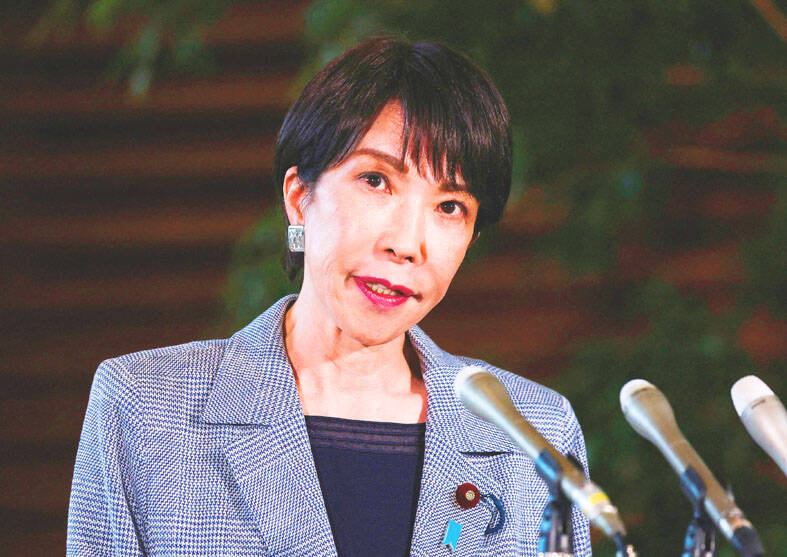
Photo: Reuters
Bureaucrats in Japan regularly prepare answers for Cabinet members before they take questions in parliament or at news conferences. The discrepancy between the prepared response and Takaichi’s actual comment suggests she veered off-script from official policy.
Beijing has sought a retraction of her comments, but she has refused to do so, saying that the government’s position on Taiwan remains unchanged.
“The Cabinet Secretariat’s response was the same as that of previous administrations, and she should have said she would refrain from answering hypothetical questions about a Taiwan emergency,” Tsujimoto said after posting images of the script on X.
The script prepared by bureaucrats includes both questions submitted in advance by lawmakers and the recommended responses. The prime minister was advised to stay somewhat vague in discussing Taiwan, the images showed.
The Cabinet Secretariat declined to confirm over the phone the authenticity of the documents posted on Tsujimoto’s X account, but acknowledged disclosing documents to her.
Tsujimoto, in pressing the Cabinet Office for more information, obtained a written response that said the prime minister’s answers in parliament were largely in line with the government’s stance.
“Prime Minister Takaichi repeatedly said that ‘the government will make a judgement based on all available information, based on the specific circumstances of that situation,’ which is aligned with the government’s stance on the matter,” that document read, according to Tsujimoto.
Japanese Chief Cabinet Secretary Minoru Kihara deflected a question on whether Takaichi’s Taiwan comments were prepared beforehand, asking reporters to direct such questions to the relevant department.
Although Takaichi has refused to recant her comments, she said in parliament last month that she learned her lesson and would avoid speaking about specific scenarios.
Still, Takaichi’s comments triggered furious retaliation from Beijing in what has become a deepening dispute.
The Chinese government has warned its citizens against traveling to Japan, submitted letters of complaint to the UN and urged other states to back its “one China” principle.
Tokyo has claimed that at least one Chinese fighter jet trained fire-control radars on Japanese fighter jets on Saturday last week, while Beijing retorted by saying the Japanese fighter jets interfered with its military training exercises.

FUKUOKA SITUATION: Japanese media reported that the pathogen is expected to be identified by the summer, while the CDC downplayed the idea that it was hMPV A “mysterious cold-like illness” reported in Japan’s Fukuoka Prefecture does not seem to be a new disease, but Japanese authorities have been asked about the situation, the Centers for Disease Control (CDC) said yesterday. The Fukuoka Prefectural Medical Association on Wednesday told a news conference that a “mystery cold” that has become a hot topic on social media is “highly likely to be caused by some kind of viral infection,” Japan’s KBC News reported. “Many people are experiencing symptoms starting with a sore throat, followed by a runny nose, phlegm and a severe cough,” KBC News reported, citing association officials. Health authorities are

Nvidia Corp CEO Jensen Huang (黃仁勳) arrived in Taiwan yesterday ahead of upcoming AI and technology events, saying he plans to meet with clients and Taiwan Semiconductor Manufacturing Co Chairman C.C. Wei (魏哲家) during his visit. After landing at Taipei Songshan Airport, Huang posed for photos with fans and handed out Yakult drinks to reporters and supporters waiting at the scene, saying he has “a lot to do” during the trip. Asked about reports that Nvidia’s planned headquarters site in Taipei’s Beitou Shilin Technology Park could break ground on May 27, Huang said that if the company holds an event, he would

The Ministry of Finance this afternoon announced the winning numbers for the March-April uniform invoice lottery. The winning number for the NT$10 million (US$318,060) special prize is 19531471, and the winning number for the NT$2 million grand prize is 85941329. Three numbers were drawn for the NT$200,000 first prize: 07225810, 20231230 and 83518781. Those with receipts matching the last seven digits of any of the first-prize numbers will win the NT$40,000 second prize, while those matching the last six digits will win the NT$10,000 third prize. Those whose receipts match the last five digits of the first-prize numbers can claim the NT$4,000 fourth prize,
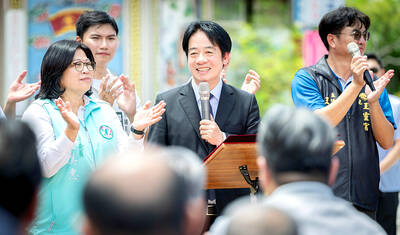
SIX SUBSIDIES: The monthly allowance for older farmers is to increase to NT$10,000, and NT$5,000 is to be given to homemakers under the national pension system, Lai said The government is to implement major welfare policies for disadvantaged groups, including raising the monthly allowance for older farmers to NT$10,000 and providing homemakers with NT$5,000 per month, President William Lai (賴清德) said yesterday. Lai made the remarks during a visit to Wangling Temple in Chiayi County, saying that the planned increases were being introduced amid economic growth and an increase in tax revenue. Touting a policy, in which the government plans to provide a monthly allowance of NT$5,000 for every child under the age of 18 in a bid to address Taiwan’s low birthrate, Lai said that if received for the


 RSS
RSS