


The US’ updated national security policy appears to be forcing Latin American leaders to choose sides, a development that Minister of Foreign Affairs Lin Chia-lung (林佳龍) said was making Taiwan a better choice than China.
Speaking in an exclusive interview with the Chinese-language Liberty Times (the Taipei Times’ sister paper) published yesterday, Lin said China’s Belt and Road Initiative has caused many problems for countries such as Honduras.
Honduras, which switched recognition to China in 2023, is facing challenges such as Chinese control over critical infrastructure projects, commodity dumping, rising unemployment and national security concerns after Beijing failed to honor numerous promises, Lin said.
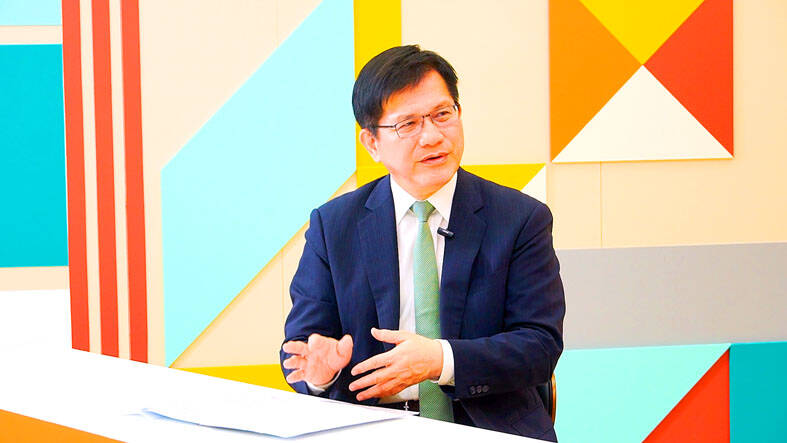
Photo: Huang Ching-hsuan, Taipei Times
In comparison, Taiwan’s policy helped foster coprosperity by assisting Honduras in training its people and assessing which industries were most suitable for development, Lin said.
That is why Honduras’ two leading presidential candidates openly favor resuming ties with Taiwan, he added.
Lin said he believed that China would spare no effort to pressure Honduras to elect the candidate who would favor Beijing.
The minister expressed hope that the US and other nations would lend their support to the resumption of diplomatic ties between Taiwan and Honduras.
He added that he believed the Honduran presidential candidates would be able to weather the storm and resist Chinese economic pressure to achieve the best for the Honduran people.
Global efforts to establish a “non-red” supply chain and the US’ new national security strategy announced last month leave Latin American and Caribbean countries with no room for strategic ambiguity, Lin said.
With US President Donald Trump’s administration demanding that they choose sides, Taiwan appears to be a better choice than China, he said.
Commenting on a Panamanian delegation’s visit to Taiwan last month, Lin said the US’ focus on the Western Hemisphere is an opportunity for Taiwan and other countries in the region.
Despite switching recognition to China, Panama remains a critical trade partner for Taiwan, with the Taiwan-Panama Free Trade Agreement still in place and Taiwanese shipping firms among the top 10 users of the Panama Canal, he said.
The Panamanian delegation expressed an interest in joining relevant supply chains for Taiwan’s semiconductor and artificial industries, Lin said.
Taiwan’s eight main programs for fostering coprosperity among allied nations play a significant role in why many countries seek to engage with Taiwan to deepen bilateral relations, Lin added.
Taiwan maintains an open and flexible attitude toward the possibility of re-establishing ties with Panama, but hopes that it would not be a mere show, but would be based on a desire to foster mutual prosperity, he said.
Lin added that Taiwan and Japan might explore collaborations in the Philippines in the transportation, logistics and telecommunications fields, adding that Taiwanese businesspeople exiting the Chinese market might consider relocating their operations to the Philippines.
Japan, which already has significant investment in the Philippines, could work with Taiwan to extend geopolitical cooperation to enhance regional security in the first island chain to cover economic and technology collaboration, he said.

Considering that most countries issue more than five denominations of banknotes, the central bank has decided to redesign all five denominations, the bank said as it prepares for the first major overhaul of the banknotes in more than 24 years. Central bank Governor Yang Chin-lung (楊金龍) is expected to report to the Legislative Yuan today on the bank’s operations and the redesign’s progress. The bank in a report sent to the legislature ahead of today’s meeting said it had commissioned a survey on the public’s preferences. Survey results showed that NT$100 and NT$1,000 banknotes are the most commonly used, while NT$200 and NT$2,000

The Centers for Disease Control (CDC) yesterday reported the first case of a new COVID-19 subvariant — BA.3.2 — in a 10-year-old Singaporean girl who had a fever upon arrival in Taiwan and tested positive for the disease. The girl left Taiwan on March 20 and the case did not have a direct impact on the local community, it said. The WHO added the BA.3.2 strain to its list of Variants Under Monitoring in December last year, but this was the first imported case of the COVID-19 variant in Taiwan, CDC Deputy Director-General Lin Ming-cheng (林明誠) said. The girl arrived in Taiwan on

ANNUAL EVENT: Two massive Pokemon balloons are to be set up in Daan Park, with an event zone operating from 10am to 6pm This year’s Taipei Floral Picnic is to be held at Daan Park today and tomorrow, featuring an exclusive Pokemon Go event, a themed food market, a coffee rave picnic area and stage performances, the Taipei Department of Information and Tourism said yesterday. Two massive Pokemon balloons are to be set up in the park as attractions, with an exclusive event zone operating from 10am to 6pm, it said. Participants who complete designated tasks on-site would have a chance to receive limited-edition souvenirs, it added. People could also try the newly launched game Pokemon Pokopia in the trial area, the department said. Three PokeStops are

South Korea is planning to revise its controversial electronic arrival card, a step Taiwanese officials said prompted them to hold off on planned retaliatory measures, a South Korean media report said yesterday. A Yonhap News Agency report said that the South Korean Ministry of Foreign Affairs is planning to remove the “previous departure place” and “next destination” fields from its e-arrival card system. The plan, reached after interagency consultations, is under review and aims to simplify entry procedures and align the electronic form with the paper version, a South Korean ministry official said. The fields — which appeared only on the electronic form


 RSS
RSS