


The Executive Yuan today released its fifth national report on Taiwan’s efforts to meet the Convention on the Elimination of All Forms of Discrimination Against Women (CEDAW) and announced that international experts would help review the report in July next year.
Today also marks Human Rights Day, which commemorates the Universal Declaration on Human Rights enacted by the UN on Dec. 10, 1948.
The UN passed the CEDAW in 1979 and promulgated it in 1981, requiring signatory countries to enact legislation and take measures to eliminate discrimination against women and ensure equal rights between genders.
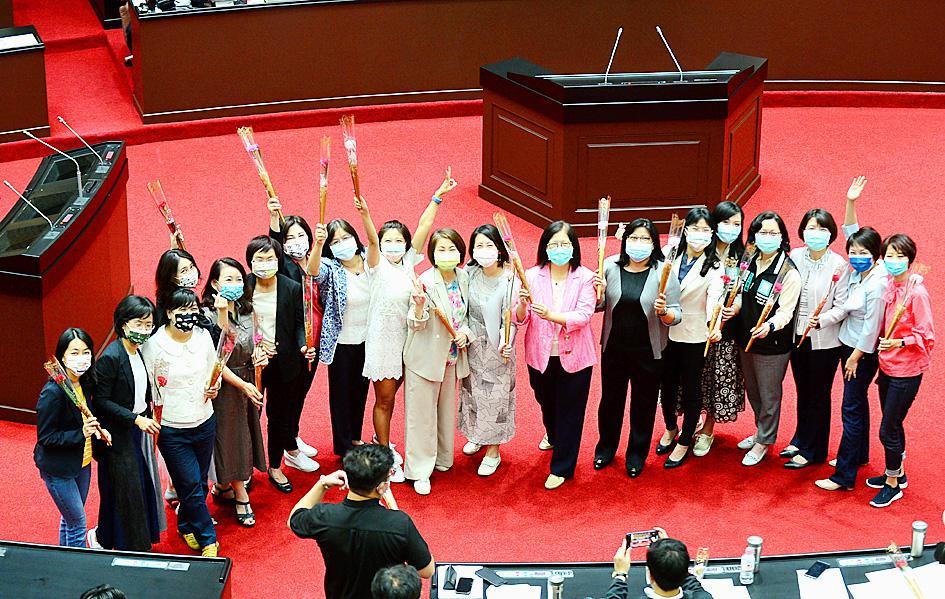
Photo: Wang Yi-sung, Taipei Times
Since 2009, Taiwan has published a national report on the CEDAW every four years to assess its progress on women’s rights and gender equality.
Although it is not a formal signatory to the agreement due to its exclusion from the UN, Taiwan in 2011 passed the Enforcement Act of CEDAW (消除對婦女一切形式歧視公約施行法), making it part of the nation’s legal framework.
The Executive Yuan’s Gender Equality Committee today announced in a news release that it has published the fifth national CEDAW report, which was presented by Minister Without Portfolio Lin Ming-hsin (林明昕).
The report details Taiwan’s concrete achievements in promoting women’s rights and advancing gender equality, Lin said during his presentation.
It shows the world how Taiwan is moving closer to international human rights standards and working hard to ensure gender equality, he added.
The report covers Taiwan’s efforts between 2021 and last year to eliminate discrimination against women, improve women’s rights and work toward gender equality.
For example, it notes that Taiwan was ranked sixth globally and first in Asia in the Organization for Economic Co-operation and Development’s 2023 Social Institutions and Gender Index.
Taiwan leads Asia in gender equality, having passed marriage equality in 2019 and expanded protections for transnational marriages and adoption rights in 2023, the report says.
In addition, 41.6 percent of Taiwan’s legislators last year were women, the highest in Asia, it says.
Taiwan has also passed measures to support women who want to have kids and provide more resources to help raise them, foster family-friend workplaces, eliminate gender stereotypes, promote gender equality in education and improve women’s health services, the committee said.
Taiwan enacted the Stalking Harassment and Prevention Act (跟蹤騷擾防制法) in 2021 and amended gender equality, sexual harassment and domestic violence prevention laws all within the past four years, strengthening Taiwan’s system for preventing gender-based violence, it said.
Taiwan may not be a member of the UN, but its CEDAW review committee followed the UN’s procedures to ensure a fair assessment, the committee said.
It also announced that five international experts would come to Taiwan in July next year to join the review of the report and offer advice.
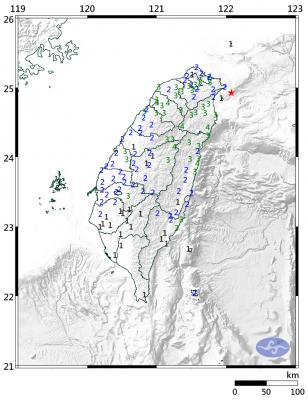
A magnitude 6.1 earthquake struck off the coast of Yilan County at 8:39pm tonight, the Central Weather Administration (CWA) said, with no immediate reports of damage or injuries. The epicenter was 38.7km east-northeast of Yilan County Hall at a focal depth of 98.3km, the CWA’s Seismological Center said. The quake’s maximum intensity, which gauges the actual physical effect of a seismic event, was a level 4 on Taiwan’s 7-tier intensity scale, the center said. That intensity level was recorded in Yilan County’s Nanao Township (南澳), Hsinchu County’s Guansi Township (關西), Nantou County’s Hehuanshan (合歡山) and Hualien County’s Yanliao (鹽寮). An intensity of 3 was
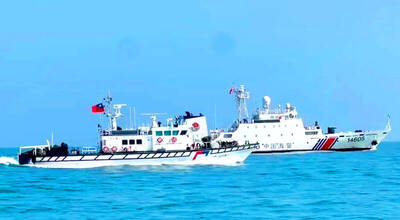
Instead of focusing solely on the threat of a full-scale military invasion, the US and its allies must prepare for a potential Chinese “quarantine” of Taiwan enforced through customs inspections, Stanford University Hoover fellow Eyck Freymann said in a Foreign Affairs article published on Wednesday. China could use various “gray zone” tactics in “reconfiguring the regional and ultimately the global economic order without a war,” said Freymann, who is also a nonresident research fellow at the US Naval War College. China might seize control of Taiwan’s links to the outside world by requiring all flights and ships entering or leaving Taiwan
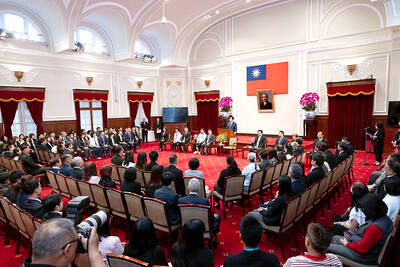
The next minimum wage hike is expected to exceed NT$30,000, President William Lai (賴清德) said yesterday during an award ceremony honoring “model workers,” including migrant workers, at the Presidential Office ahead of Workers’ Day today. Lai said he wished to thank the awardees on behalf of the nation and extend his most sincere respect for their hard work, on which Taiwan’s prosperity has been built. Lai specifically thanked 10 migrant workers selected for the award, saying that although they left their home countries to further their own goals, their efforts have benefited Taiwan as well. The nation’s industrial sector and small businesses lay
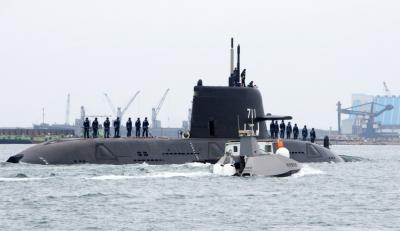
Taiwan's first indigenous defense submarine, the SS-711 Hai Kun (海鯤, or Narwhal), departed for its 13th sea trial at 7am today, marking its seventh submerged test, with delivery to the navy scheduled for July. The outing also marked its first sea deployment since President William Lai (賴清德) boarded the submarine for an inspection on March 19, drawing a crowd of military enthusiasts who gathered to show support. The submarine this morning departed port accompanied by CSBC Corp’s Endeavor Manta (奮進魔鬼魚號) uncrewed surface vessel and a navy M109 assault boat. Amid public interest in key milestones such as torpedo-launching operations and overnight submerged trials,


 RSS
RSS