


The New Zealand navy's largest ship last week encountered a Taiwanese warship as it sailed through the sensitive Taiwan Strait, the country's armed forces said today, as they published a rare photograph of what happened.
The oiler, the HMNZS Aotearoa, sailed from the South China Sea to the North Asian region via the Taiwan Strait on Friday last week, and was shadowed by seven different Chinese warships which maintained a safe and professional distance, the New Zealand Defence Force (NZDF) previously said.
In a picture published on its Web site yesterday with a story about the ship's Asia mission, the NZDF showed a New Zealand sailor using binoculars to watch a warship in the distance, although it did not identify the ship.
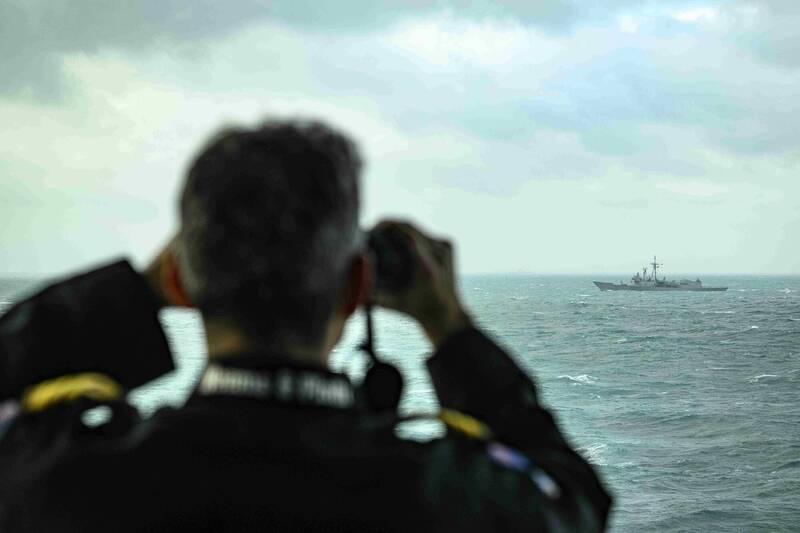
Photo courtesy of the New Zealand Defence Force Web site
The ship was the Taiwanese warship the ROCS Cheng Kung which the HMNZS Aotearoa "briefly encountered" while in the Strait, an NZDF spokesperson told Reuters.
In Taiwan, the Ministry of National Defense declined immediate comment.
While Taiwan does monitor foreign warships in the Strait, it is highly unusual for a photo of a Taiwanese warship doing so to appear publicly.
The ROCS Cheng Kung is a heavily armed Taiwan-built frigate based on the Oliver Hazard Perry class of the US navy.
A senior Taiwanese security official briefed on the matter said that it is standard practice for Taiwan to provide an "escort" to foreign vessels from like-minded countries transiting the Strait, knowing that such ships are often harassed or subjected to mock attacks by China's military.
"It is to ensure that communist ships and aircraft are unable to further harass them," said the official, who requested anonymity because of the sensitivity of the matter.
New Zealand, like most countries, has no formal diplomatic ties with Taiwan, but Taipei sees it as an important like-minded democratic partner and both maintain de facto embassies in each other's capitals.
US warships sail through the Strait every few months, and some US allies, such as Australia, Canada and the UK, have also made occasional transits in support of freedom of navigation.
Taiwan shares intelligence with international partners when they operate in those waters, National Security Bureau Director-General Tsai Ming-yen (蔡明彥) said this month.
China's military sometimes simulates attacks on foreign naval vessels in the Strait, he added.

FUKUOKA SITUATION: Japanese media reported that the pathogen is expected to be identified by the summer, while the CDC downplayed the idea that it was hMPV A “mysterious cold-like illness” reported in Japan’s Fukuoka Prefecture does not seem to be a new disease, but Japanese authorities have been asked about the situation, the Centers for Disease Control (CDC) said yesterday. The Fukuoka Prefectural Medical Association on Wednesday told a news conference that a “mystery cold” that has become a hot topic on social media is “highly likely to be caused by some kind of viral infection,” Japan’s KBC News reported. “Many people are experiencing symptoms starting with a sore throat, followed by a runny nose, phlegm and a severe cough,” KBC News reported, citing association officials. Health authorities are

Nvidia Corp CEO Jensen Huang (黃仁勳) arrived in Taiwan yesterday ahead of upcoming AI and technology events, saying he plans to meet with clients and Taiwan Semiconductor Manufacturing Co Chairman C.C. Wei (魏哲家) during his visit. After landing at Taipei Songshan Airport, Huang posed for photos with fans and handed out Yakult drinks to reporters and supporters waiting at the scene, saying he has “a lot to do” during the trip. Asked about reports that Nvidia’s planned headquarters site in Taipei’s Beitou Shilin Technology Park could break ground on May 27, Huang said that if the company holds an event, he would

The Ministry of Finance this afternoon announced the winning numbers for the March-April uniform invoice lottery. The winning number for the NT$10 million (US$318,060) special prize is 19531471, and the winning number for the NT$2 million grand prize is 85941329. Three numbers were drawn for the NT$200,000 first prize: 07225810, 20231230 and 83518781. Those with receipts matching the last seven digits of any of the first-prize numbers will win the NT$40,000 second prize, while those matching the last six digits will win the NT$10,000 third prize. Those whose receipts match the last five digits of the first-prize numbers can claim the NT$4,000 fourth prize,

SIX SUBSIDIES: The monthly allowance for older farmers is to increase to NT$10,000, and NT$5,000 is to be given to homemakers under the national pension system, Lai said The government is to implement major welfare policies for disadvantaged groups, including raising the monthly allowance for older farmers to NT$10,000 and providing homemakers with NT$5,000 per month, President William Lai (賴清德) said yesterday. Lai made the remarks during a visit to Wangling Temple in Chiayi County, saying that the planned increases were being introduced amid economic growth and an increase in tax revenue. Touting a policy, in which the government plans to provide a monthly allowance of NT$5,000 for every child under the age of 18 in a bid to address Taiwan’s low birthrate, Lai said that if received for the


 RSS
RSS