


An alliance of 32 healthcare facilities and medical research institutes was yesterday founded to bolster the nation’s clinical trial capabilities.
Taiwan’s medical techniques are among the best in the world, but its clinical trials lag behind in scale, the Taiwan Alliance of Clinical Trial Centers said.
A “clinical national team” has been set up to improve efficiency and cooperation, the alliance said.
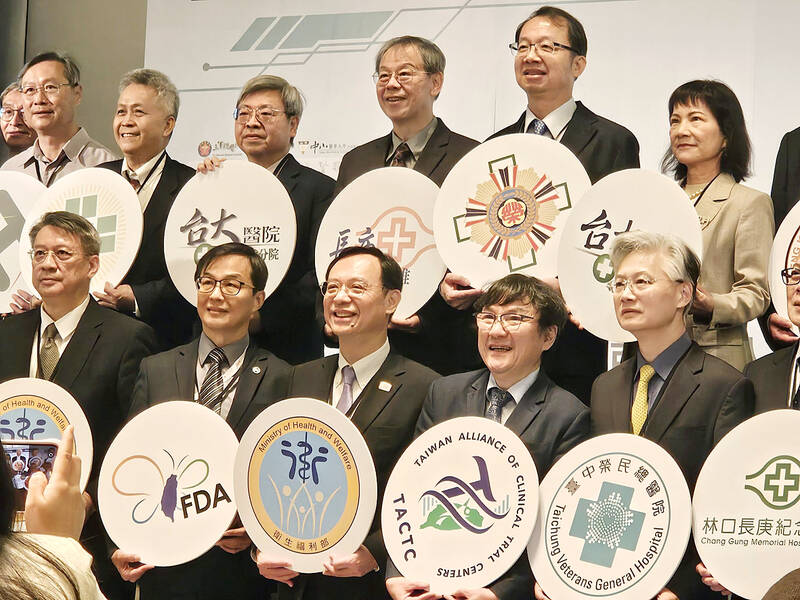
Photo: CNA
Cofounded by Taipei Medical University (TMU) and three affiliated hospitals — TMU Hospital, Shuang Ho Hospital and Wanfang Hospital — and Taichung Veterans General Hospital, the alliance aims to turn Taiwan into the Asia-Pacific region’s clinical trial hub, it said.
Taiwan conducts about 300 to 400 clinical trials a year, which is significantly lower than in South Korea or Australia, which hold more than 1,000 clinical trials per year, alliance preparation convener TMU president Wu Mai-szu (吳麥斯) said.
Clinical trials must be conducted under strict ethics and regulations to ensure the safety and efficacy of medical innovation, he said.
Whether high-quality clinical trials can be conducted across several facilities is an important indicator of a country’s medical quality and regulatory maturity, he added.
The alliance is to prioritize six major tasks, including setting a standard Institutional Review Board (IRB) document and strengthening the collaborative-IRB mechanism, creating a clinical trial contract template, and building a database of research project managers and attending physicians.
They also include establishing a national clinical trial participant enrollment platform, cooperating in cultivating clinical trial experts, and promoting an Asia-Pacific strategic alliance and international multicenter collaborations, he said.
“This is an important milestone,” Minister of Health and Welfare Shih Chung-liang (石崇良) said at the launch in Taipei.
The development of new drugs has accelerated in the past few years, and more treatments are being developed through molecular approaches and genomic research, which might induce different responses depending on ethnicity or region, making local trials important, he said.
Countries are pursuing local clinical trials to facilitate public access to drugs after they hit the market, he said.
As large pharmaceutical companies prefer to hold clinical trials in locations that have faster patient recruitment rates, the alliance can serve as a single point of contact and apply universal standards and procedures across hospitals, increasing enrollment efficiency and attracting more global pharmaceutical companies to conduct their clinical trials in Taiwan, the minister said.
“The alliance is not only beneficial for international cooperation, it can also help improve Taiwan’s development of new drugs, generic drugs or biosimilars drugs, by increasing the speed of [clinical trial] patient enrollment,” he said. “I think it is a triple-win strategy that would benefit the industry, patients and local academic research.”

NATIONAL SECURITY: Authorities are working to confirm the identities of the military personnel involved and investigating possible illegal conduct and regulatory violations Authorities are probing possible national security implications after Kinmen police and immigration officers on Sunday found a Chinese woman allegedly posing as a tourist while engaging in prostitution involving more than 10 military personnel. The woman, surnamed Chen (陳), has since been deported, authorities said, adding that investigators are still working to confirm the identities of those implicated, as the records only listed code names and aliases. The case stemmed from a report received by the Kinmen District Prosecutors’ Office on Friday last week from the Jinhu Precinct of the Kinmen County Police Bureau. On Sunday, police, along with the National Immigration

REASONS FOR TRAVEL: An assistant professor said that proposed amendments to penalize drivers if they used drugs overseas would not deter people from traveling People who operate a motor vehicle under the influence of marijuana would have their driver’s license revoked, even if they used the substance while overseas, the Ministry of Transportation and Communications said yesterday, citing proposed amendments to the Road Traffic Management and Penalty Act (道路交通管理處罰條例). The amendments would also authorize the government to revoke the licenses of people determined to have used Category 1 or Category 2 narcotics, even if they were not operating a vehicle while under the influence of drugs, as well as ban them from taking the license test for three years, the ministry said. People aged 18 or

GLOBALGIVING: ‘ Caving to external pressure is not acceptable for an organization that has cultivated justice reform and human rights for 30 years,’ one NGO said A slew of non-government organizations (NGOs) have withdrawn from the GlobalGiving fundraising platform after it announced it would use “Chinese Taipei” instead of “Taiwan” from next month. The Taiwan Good Rice Association wrote on Facebook on Friday that it was informed on April 28 via a teleconference call of the change, which was made because the platform wanted to operate in China. Taiwan Good Rice is to terminate all cooperative relationships with GlobalGiving in response to the platform’s “unilateral and non-negotiable” decision to remove references to Taiwan, the NGO said. “Taiwan is in the official name of Taiwan Good Rice Association and the

HEAVY WEATHER: Typhoon Jangmi is due to crash straight into the Ryukyus as airlines look to shift flights to larger aircraft or cancel flights to Okinawa entirely Taiwan’s international air carriers announced flight adjustments over the weekend as Typhoon Jangmi is forecast to hit the Ryukyu Islands today and tomorrow. The Central Weather Administration (CWA) upgraded Jangmi from a tropical storm to a typhoon at 8am yesterday, with the eye located 580km south of Naha city. It was moving north at 19kph. Today, China Airlines’ CI-120, CI-121, CI-122 and CI-123 flights between Taoyuan and Naha, Okinawa, have been canceled as well as CI-132 and CI-133 between Kaohsiung and Naha. EVA Air’s BR-112, BR-113, BR-186 and BR-185 flights between Taoyuan and Naha are also canceled. Low-cost carrier Tigerair Taiwan canceled IT-230,


 RSS
RSS