


The National Security Strategy (NSS) report issued by US President Donald Trump’s administration demonstrated Taiwan’s strategic importance, but also showed a shift in Washington’s commitment to Taiwan, a former China policy adviser to the US Department of State said on Friday.
“The NSS correctly identifies Taiwan’s strategic importance beyond semiconductors — recognizing it ‘provides direct access to the second island chain and splits Northeast and Southeast Asia into two distinct theaters,’” said Ryan Fedasiuk, a fellow at the Washington-based American Enterprise Institute.
“Hence deterring a conflict over Taiwan, ideally by preserving military overmatch, is a priority,” said the report, which was released earlier on Friday.
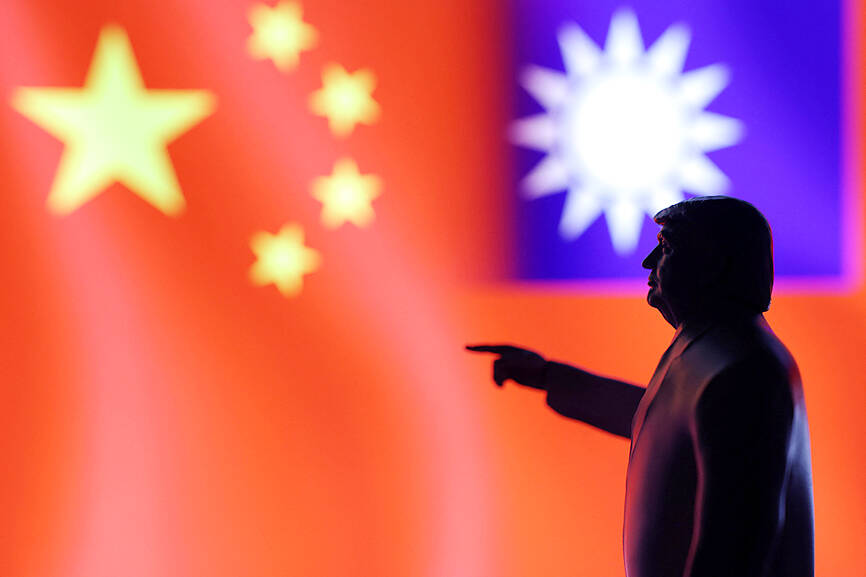
Photo: Reuters
While the report said that the US would maintain its long-standing policy on Taiwan, it changed its wording, saying that Washington “does not support” any unilateral change to the “status quo” in the Taiwan Strait, shifting from using the word “oppose,” which it had done in the previous report issued by the administration of former US president Joe Biden.
Fedasiuk said the shift from “oppose” to “does not support” unilateral changes to the “status quo” was “a meaningful downgrade.”
“Opposes” implies active opposition with potential consequences, but “does not support” suggests passive disapproval without commitment to take any action, he said.
The omissions of “oppose” was significant, as the new expression removes commitments from the US government’s formulaic strategic framework, which has created room for Trump to claim he was not confined by previous formulations in either direction, Fedasiuk said.
The new wording offers “more flexibility for which aspects of its policy the [Trump] administration would prefer to highlight at any given moment,” Fedasiuk said.
“Does not support” was “the clearest evidence of policy drift,” he added.
The weaker language could result in two problems, he said.
First, the shift softens the commitment of the US in the event of unilateral action by China from active opposition to passive disapproval, he said.
The second is that the change establishes downgraded language as the new baseline for future negotiations, he said.
As a result, if Chinese President Xi Jinping (習近平) meets with Trump next year as planned, the Chinese leader is likely to seek further adjustments, Fedasiuk said.
The 2022 report released by the Biden administration said that the US opposed any unilateral changes to the “status quo” from either side, and it did not support Taiwanese independence, while Washington remained committed to its “one China” policy, which is guided by the Taiwan Relations Act, the three joint communiques and the “six assurances.”
During Trump’s first term, the report issued by his administration in 2017 only briefly mentioned Taiwan, saying that the US would maintain its strong ties with the nation based on its “one China” policy, with its commitments under the Taiwan Relations Act to provide for its legitimate defense needs and to deter coercion.
In Taipei yesterday, Su Tzu-yun (蘇紫雲), director of the Division of Defense Strategy and Resources at the military-funded Institute for National Defense and Security Research, told reporters that the report clearly mentions “collective defense” and the prevention of specific countries from occupying Taiwan, demonstrating that the US’ commitment to the security of the Taiwan Strait is firmly anchored, Su said.
“The prevailing doubts within Taiwan about the US should be dispelled,” he said.
Taiwan is in the “golden egg” zone of the first island chain, controlling the maritime link from Northeast Asia to Southeast Asia, he said.
If Taiwan were to fall under China’s control, it would likely become “China’s Hawaii,” as the People’s Liberation Army could directly use Hualien Port as a base for nuclear submarines to threaten the US West Coast, he said.
That would be a strategic disaster that democratic allies such as the US, Japan, and South Korea could not bear, he added.
Additional reporting by Fang Wei-li

FUKUOKA SITUATION: Japanese media reported that the pathogen is expected to be identified by the summer, while the CDC downplayed the idea that it was hMPV A “mysterious cold-like illness” reported in Japan’s Fukuoka Prefecture does not seem to be a new disease, but Japanese authorities have been asked about the situation, the Centers for Disease Control (CDC) said yesterday. The Fukuoka Prefectural Medical Association on Wednesday told a news conference that a “mystery cold” that has become a hot topic on social media is “highly likely to be caused by some kind of viral infection,” Japan’s KBC News reported. “Many people are experiencing symptoms starting with a sore throat, followed by a runny nose, phlegm and a severe cough,” KBC News reported, citing association officials. Health authorities are

Nvidia Corp CEO Jensen Huang (黃仁勳) arrived in Taiwan yesterday ahead of upcoming AI and technology events, saying he plans to meet with clients and Taiwan Semiconductor Manufacturing Co Chairman C.C. Wei (魏哲家) during his visit. After landing at Taipei Songshan Airport, Huang posed for photos with fans and handed out Yakult drinks to reporters and supporters waiting at the scene, saying he has “a lot to do” during the trip. Asked about reports that Nvidia’s planned headquarters site in Taipei’s Beitou Shilin Technology Park could break ground on May 27, Huang said that if the company holds an event, he would

The Ministry of Finance this afternoon announced the winning numbers for the March-April uniform invoice lottery. The winning number for the NT$10 million (US$318,060) special prize is 19531471, and the winning number for the NT$2 million grand prize is 85941329. Three numbers were drawn for the NT$200,000 first prize: 07225810, 20231230 and 83518781. Those with receipts matching the last seven digits of any of the first-prize numbers will win the NT$40,000 second prize, while those matching the last six digits will win the NT$10,000 third prize. Those whose receipts match the last five digits of the first-prize numbers can claim the NT$4,000 fourth prize,
Taiwan Travelogue (臺灣漫遊錄), which earlier this week became the first Taiwanese novel to win the International Booker Prize, is to be adapted into a television series through a Taiwan-Japan coproduction, producer Chang Chen-yu (張辰漁) said yesterday. Chang, a producer at World Softest Production Film Co, wrote on Facebook that the company had been searching for projects with international appeal that retain a strong Taiwanese identity after colleagues and Japanese partners strongly recommended the novel. After reading the book, Chang said he immediately decided to pursue the screen rights. “A great story has the power to transcend time and borders, and connect countless people,”


 RSS
RSS