


With the rising prevalence of kidney disease, Taiwan is taking steps to address this health challenge, from prevention to integrated care, including a goal to raise the prevalence of home dialysis to 18 percent by 2035, President William Lai (賴清德) said at the opening of the Asian Pacific Congress of Nephrology yesterday.
Taiwan is hosting the event again after 25 years, Lai said, with the theme of this year’s congress being “Link the Future Kidney Health with GIVE.”
“As a nephrologist myself, I know that kidney health is one of the pillars of health and happiness for our people,” he added.
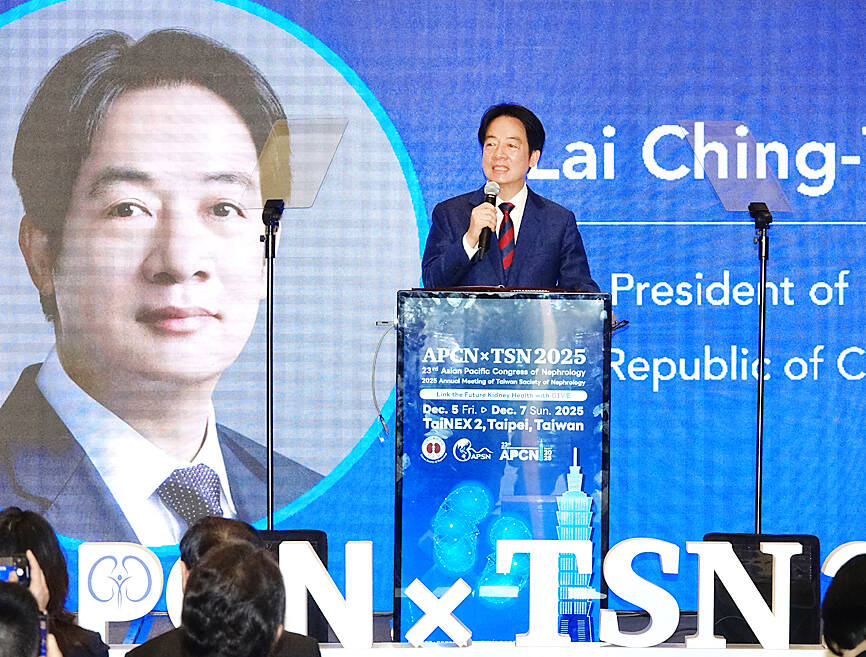
Photo: Tien Yu-hua, Taipei Times
This year’s theme calls “addressing kidney health issues from the perspectives of genetics, immunology, vast data analytics, metabolic science and sustainability ... and for scientific results to be transformed into safeguards for people’s health,” the president said.
Taiwan has achieved significant clinical and research results in nephrology, and has worked closely with the Asian Pacific Society of Nephrology and the International Society of Nephrology to share “Taiwan’s experience in dialysis quality, integrated care for chronic kidney disease and cooperation across specialties,” Lai said.
As Taiwan shifts its focus from treatment to prevention, the government has provided free exams for adults and encouraged early screening, he said.
Last year, it also launched the 888 Program for the prevention and treatment of the three highs — hyperlipidemia, hyperglycemia and hypertension — which are known causes of chronic kidney disease, Lai said.
The program aims to enroll 80 percent of people with the “three highs” in the nation’s care network by encouraging health screenings, provide 80 percent of the people in the care network with personalized lifestyle consultations on managing their own health, and ensure that these 80 percent achieve stable control of their conditions and improve their health by integrating digital tools that helps doctors assess and adjust their health management plans, the Ministry of Health and Welfare has said.
Furthermore, the government in March approved an increase in National Health Insurance (NHI) payouts for sodium-glucose co-transporter 2 inhibitors for people with chronic kidney disease in hopes of reducing the disease incidence rate or delaying its progression, Lai said.
These efforts are showing progress, with the age-standardized incidence rate of dialysis dropping from 318 per million people in 2005 to 290 per million in 2022, he said.
Growth rates for patient visits and medical expenditure are also on the decline, he added.
Lai also touted the publication of the Taiwan Home Dialysis White Paper for 2026 to 2035 — a joint collaboration of the Taiwan Society of Nephorology, the Ministry of Health and Welfare and the International Society for Peritoneal Dialysis — that aims to integrate medical care into homes and communities.
The goal is to enable more patients to safely receive dialysis at home to enhance their quality of Life, Lai said, adding that the aim is to raise home dialysis prevalence to 18 percent by 2035.
Saying that he believed “a healthier Taiwan can drive a healthier Asia-Pacific,” the president expressed the hope that the nation could “deepen engagement with other countries in research, clinical practice and policy” and that it could become “a key force for promoting kidney health in the region ... and work together to make greater contributions to global health.”
Meanwhile, Minister of Health and Welfare Shih Chung-liang (石崇良) said that while the incident rate for renal disease has dropped, given Taiwan’s aging population, the number of people on dialysis would not drop immediately and could still rise.
Taiwan has for several years the world’s highest dialysis rate per 10,000 people, Shih said, adding that with more than 900,000 people with chronic kidney disease and more than 90,000 receiving dialysis treatment, annual medical expenditure runs to about NT$50 billion (US$1.6 billion).
Preventive measures, such as increased screening rates, are being adopted to initiate early treatment and reduce or even avoid the need for dialysis, Shih said.
NHI payouts for drugs to treat diabetes, high blood pressure and high cholesterol are world class, he said.
The government is also stepping up digital education so that the public can take care of themselves instead of solely relying on medical treatment, Shih said.
Additional reporting by Pao Hui-min

FUKUOKA SITUATION: Japanese media reported that the pathogen is expected to be identified by the summer, while the CDC downplayed the idea that it was hMPV A “mysterious cold-like illness” reported in Japan’s Fukuoka Prefecture does not seem to be a new disease, but Japanese authorities have been asked about the situation, the Centers for Disease Control (CDC) said yesterday. The Fukuoka Prefectural Medical Association on Wednesday told a news conference that a “mystery cold” that has become a hot topic on social media is “highly likely to be caused by some kind of viral infection,” Japan’s KBC News reported. “Many people are experiencing symptoms starting with a sore throat, followed by a runny nose, phlegm and a severe cough,” KBC News reported, citing association officials. Health authorities are

Nvidia Corp CEO Jensen Huang (黃仁勳) arrived in Taiwan yesterday ahead of upcoming AI and technology events, saying he plans to meet with clients and Taiwan Semiconductor Manufacturing Co Chairman C.C. Wei (魏哲家) during his visit. After landing at Taipei Songshan Airport, Huang posed for photos with fans and handed out Yakult drinks to reporters and supporters waiting at the scene, saying he has “a lot to do” during the trip. Asked about reports that Nvidia’s planned headquarters site in Taipei’s Beitou Shilin Technology Park could break ground on May 27, Huang said that if the company holds an event, he would

The Ministry of Finance this afternoon announced the winning numbers for the March-April uniform invoice lottery. The winning number for the NT$10 million (US$318,060) special prize is 19531471, and the winning number for the NT$2 million grand prize is 85941329. Three numbers were drawn for the NT$200,000 first prize: 07225810, 20231230 and 83518781. Those with receipts matching the last seven digits of any of the first-prize numbers will win the NT$40,000 second prize, while those matching the last six digits will win the NT$10,000 third prize. Those whose receipts match the last five digits of the first-prize numbers can claim the NT$4,000 fourth prize,
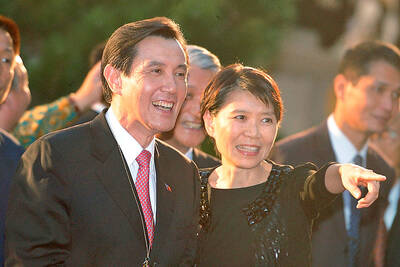
Former president Ma Ying-jeou (馬英九) yesterday expressed “shock and regret” over a statement issued by his wife without his consent, and rejected her assertion that his eldest sister, Ma Yi-nan (馬以南), would manage his medical care or act as his spokesperson amid an ongoing embezzlement probe into his foundation. Ma Ying-jeou in a statement said he was shocked by a statement by his wife, Chou Mei-ching (周美青), regarding his affairs. Ma Yi-nan “must not” be in charge of his healthcare and other personal affairs, nor can she be allowed to represent the Ma family, the former president said. He said he was also


 RSS
RSS