


Taiwan should pursue cooperation with Washington to forge supply chains and expand energy storage capacity in its quest to reinforce energy resilience, a panel of Taiwanese and US experts said in Washington on Thursday.
They made the comments at a seminar on enhancing Taiwan’s energy resilience hosted by US think tank the Atlantic Council.
The ability to sustain electricity production and energy shipments amid hostile actions are key components to resilience, they said.
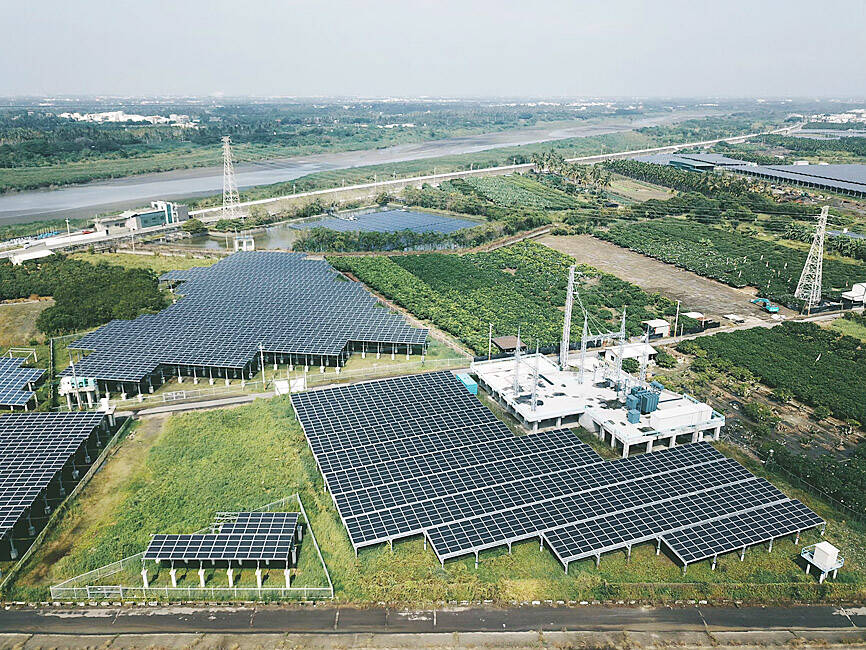
Photo courtesy of the Pingtung County Government
Atlantic Council senior fellow Joseph Webster called for a rotating team of US government personnel to advise Taiwan on energy resilience in connection with humanitarian assistance, disaster relief, cybersecurity and physical security.
The joint energy resilience task force could draw from the US Department of Energy, the US Nuclear Regulatory Commission and national labs, taking pains to reduce the publicity surrounding its work if necessary, he said.
“The US should prefer substantive support for Taiwan over showy displays and emphasis on China policy,” Webster said. “But at the same time, the US should not shy away from upsetting Beijing.”
Taiwan imports virtually all petroleum products via predictable maritime routes and the nation’s strategically key northern region — the seat of government and home to 40 percent of the population — is not self-sufficient in energy, Webster said.
Electricity sufficiency for the northern region of Taiwan requires diversifying energy sources and expanding its supply, he said.
This means building up energy reserves and investing in nuclear, oil and solar energy according to the differing needs and conditions of each region, Webster said.
Taiwan has done a commendable effort in increasing defense spending, and buying US arms, agricultural products and energy exports, he said.
Protecting national security might require Taiwan to look beyond conventional military capabilities, he said.
Liu Tsai-ying (呂采穎), director of the Energy Resilience Program at the Taiwan-based Research Institute for Democracy, Science and Emerging Technology, said Beijing could use maritime maneuvers to exhaust Taiwan’s energy stockpile.
Taiwan could begin to mitigate the impact of a Chinese blockade on energy shipments by increasing logistical flexibility, including making use of cargo swapping with Japan, South Korea and other trustworthy allies, she said.
Building power storage systems and transforming the energy structure would help Taiwan harden its energy infrastructure, Liu said, adding that coal and renewables could provide 80 percent of the nation’s essential energy needs, assuming conservation and rationing.
Additionally, Taiwan must address vulnerabilities stemming from its overly centralized power systems by dispersing critical cyber and physical nodes, she said.

FUKUOKA SITUATION: Japanese media reported that the pathogen is expected to be identified by the summer, while the CDC downplayed the idea that it was hMPV A “mysterious cold-like illness” reported in Japan’s Fukuoka Prefecture does not seem to be a new disease, but Japanese authorities have been asked about the situation, the Centers for Disease Control (CDC) said yesterday. The Fukuoka Prefectural Medical Association on Wednesday told a news conference that a “mystery cold” that has become a hot topic on social media is “highly likely to be caused by some kind of viral infection,” Japan’s KBC News reported. “Many people are experiencing symptoms starting with a sore throat, followed by a runny nose, phlegm and a severe cough,” KBC News reported, citing association officials. Health authorities are

Nvidia Corp CEO Jensen Huang (黃仁勳) arrived in Taiwan yesterday ahead of upcoming AI and technology events, saying he plans to meet with clients and Taiwan Semiconductor Manufacturing Co Chairman C.C. Wei (魏哲家) during his visit. After landing at Taipei Songshan Airport, Huang posed for photos with fans and handed out Yakult drinks to reporters and supporters waiting at the scene, saying he has “a lot to do” during the trip. Asked about reports that Nvidia’s planned headquarters site in Taipei’s Beitou Shilin Technology Park could break ground on May 27, Huang said that if the company holds an event, he would

The Ministry of Finance this afternoon announced the winning numbers for the March-April uniform invoice lottery. The winning number for the NT$10 million (US$318,060) special prize is 19531471, and the winning number for the NT$2 million grand prize is 85941329. Three numbers were drawn for the NT$200,000 first prize: 07225810, 20231230 and 83518781. Those with receipts matching the last seven digits of any of the first-prize numbers will win the NT$40,000 second prize, while those matching the last six digits will win the NT$10,000 third prize. Those whose receipts match the last five digits of the first-prize numbers can claim the NT$4,000 fourth prize,

SIX SUBSIDIES: The monthly allowance for older farmers is to increase to NT$10,000, and NT$5,000 is to be given to homemakers under the national pension system, Lai said The government is to implement major welfare policies for disadvantaged groups, including raising the monthly allowance for older farmers to NT$10,000 and providing homemakers with NT$5,000 per month, President William Lai (賴清德) said yesterday. Lai made the remarks during a visit to Wangling Temple in Chiayi County, saying that the planned increases were being introduced amid economic growth and an increase in tax revenue. Touting a policy, in which the government plans to provide a monthly allowance of NT$5,000 for every child under the age of 18 in a bid to address Taiwan’s low birthrate, Lai said that if received for the


 RSS
RSS