


The legislature yesterday passed preliminary review of most provisions in a bill that would increase pay and mandate insurance for delivery service drivers, clearing a hurdle for the anticipated legislation.
Lawmakers in the Social Welfare and Environmental Hygiene Committee agreed to support the bulk of a government-backed special act governing delivery platforms, while leaving its name and regulatory purpose to interparty negotiations.
The approved portions of the bill stipulate that drivers must be compensated at a rate equivalent to 1.25 times the minimum wage and no less than NT$45 per delivery.

Photo: Liao Chen-huei, Taipei Times
The minimum pay per job is determined by applying the 1.25 multiplier to the product of the minimum wage of NT$4.1 per minute and the average work time of 10 to 12 minutes per delivery, the Ministry of Labor said.
Officials took the high-end estimate to compensate for fuel costs, vehicle maintenance and time spent idling, which employers do not cover, it said.
The bill would authorize an independent arbitration panel for drivers to appeal against terminations and wage deductions consisting of at least one union representative and two other members.
It would also forbid delivery service platforms from retaliating against employees who file a complaint with the panel.
In addition, delivery platforms would be obligated to provide drivers with group personal injury insurance and liability before offering services to consumers.
The platforms would be allowed to suspend payment on the insurance policies if the driver does not furnish services for three consecutive days.
Delivery platforms must report work-related accidents and injuries to regulators within eight hours or face a fine of NT$30,000 to NT$300,000, according to the bill.
Attempts to evade or obstruct regulatory oversight would result in a fine of between NT$30,000 and NT$150,000, and contravening regulations governing drivers’ pay would result in a fine of between NT$20,000 and NT$100,000.
Regulators would be authorized to publish each infraction by a platform that resulted in a fine and impose additional fines on platforms that fail to rectify issues.
The bill would go into effect within six months of its promulgation, should it become law.
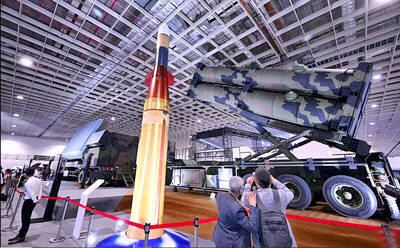
Taiwan is to commence mass production of the Tien Kung (天弓, “Sky Bow”) III, IV and V missiles by the second quarter of this year if the legislature approves the government’s NT$1.25 trillion (US$39.78 billion) special defense budget, an official said yesterday. Commenting on condition of anonymity, a defense official with knowledge of the matter said that the advanced systems are expected to provide crucial capabilities against ballistic and cruise missiles for the proposed “T-Dome,” an advanced, multi-layered air defense network. The Tien Kung III is an air defense missile with a maximum interception altitude of 35km. The Tien Kung IV and V
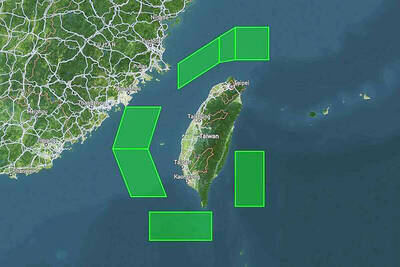
The disruption of 941 flights in and out of Taiwan due to China’s large-scale military exercises was no accident, but rather the result of a “quasi-blockade” used to simulate creating the air and sea routes needed for an amphibious landing, a military expert said. The disruptions occurred on Tuesday and lasted about 10 hours as China conducted live-fire drills in the Taiwan Strait. The Civil Aviation Administration (CAA) said the exercises affected 857 international flights and 84 domestic flights, affecting more than 100,000 travelers. Su Tzu-yun (蘇紫雲), a research fellow at the government-sponsored Institute for National Defense and Security Research, said the air
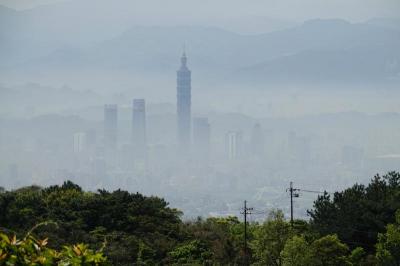
A strong continental cold air mass is to bring pollutants to Taiwan from tomorrow, the Ministry of Environment said today, as it issued an “orange” air quality alert for most of the country. All of Taiwan except for Hualien and Taitung counties is to be under an “orange” air quality alert tomorrow, indicating air quality that is unhealthy for sensitive groups. In China, areas from Shandong to Shanghai have been enveloped in haze since Saturday, the ministry said in a news release. Yesterday, hourly concentrations of PM2.5 in these areas ranged from 65 to 160 micrograms per cubic meter (mg/m³), and pollutants were
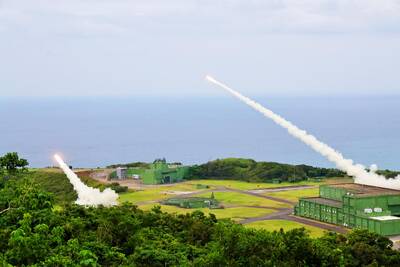
Taiwan lacks effective and cost-efficient armaments to intercept rockets, making the planned “T-Dome” interception system necessary, two experts said on Tuesday. The concerns were raised after China’s military fired two waves of rockets during live-fire drills around Taiwan on Tuesday, part of two-day exercises code-named “Justice Mission 2025.” The first wave involved 17 rockets launched at 9am from Pingtan in China’s Fujian Province, according to Lieutenant General Hsieh Jih-sheng (謝日升) of the Office of the Deputy Chief of the General Staff for Intelligence at the Ministry of National Defense. Those rockets landed 70 nautical miles (129.6km) northeast of Keelung without flying over Taiwan,


 RSS
RSS