

Environmental advocates yesterday urged the Executive Yuan to reverse the National Property Administration’s decision to end national farmland leases to build an incinerator in Nantou County’s Mingjian Township (名間), saying it would make local agricultural workers ineligible for the new national farmland distribution program.
A farmer from the county, surnamed Lai (賴), said her family has been farming their land for decades, but the agency told her brother that the land has been allocated to the county government and would not be passed down in her family.
President William Lai (賴清德) announced a program to release farmland for private ownership, but her family became ineligible due to the county’s decision, she said.
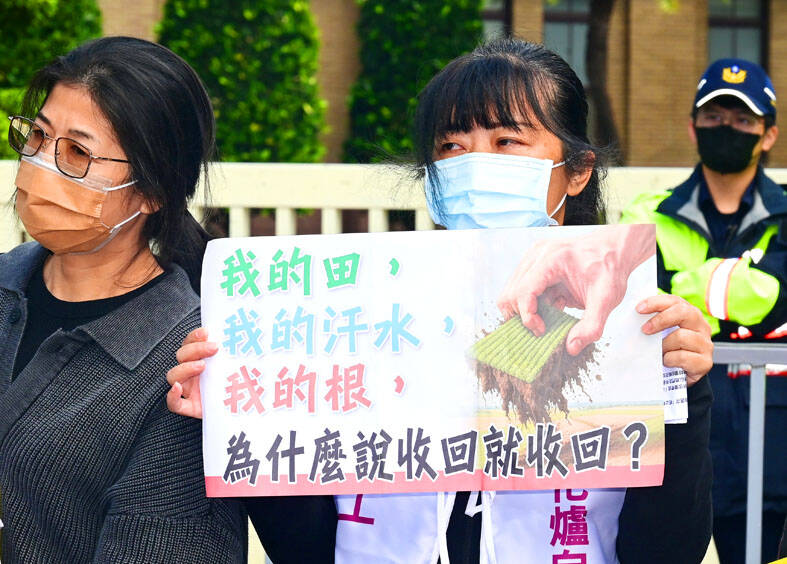
Photo: Wang Yi-sung, Taipei Times
The agency’s decision involved 11 plots of farmland and would affect more than 20 local farmers such as Lai, Changhua Environmental Protection Union president Chang Shu-fen (張淑芬) said.
Government Watch Alliance executive director Hsu Hsin-hsin (許心欣) said the agency allocated the national farmland to the county government for the incinerator project, but that should not have happened, as it infringes on Article 38 of the National Property Act (國有財產法), which specifies that non-public properties — including national farmland — could not be appropriated for official or public use if it would contradict regional planning.
The action also contravened Article 17 of the 37.5 Percent Arable Rent Reduction Act (耕地三七五減租條例), which stipulates that farmland leases would not be terminated until the land has been legally changed to non-agricultural land, she said.
Taiwan Watch Institute secretary-general Herlin Hsieh (謝和霖) said the appropriated farmlands are near Jhuoshuei River (濁水溪), with an area of 7.5 hectares, and are categorized as part of the region’s special agricultural zone.
That means the farmlands should be prioritized for agricultural use, he said.
The agency in March allocated the farmland for the county’s incinerator project after the latter filed an application in February, even though the farms’ rezoning and the project’s environmental impact assessment review had not been conducted, Hsieh said.
In response, the agency has cited two official letters from the Ministry of the Interior written in 1993, which allowed local authorities to allocate national land for different use without prior applications for land use change and if they can prove that the change would not disrupt regional planning, he said.
The letters were about the Six-Year National Construction Plan from 1991 to 1997 and should not be applied to other land use change cases, Hsieh said.
Neither can the letters override statutes such as the two acts, he said, urging the Executive Yuan to revoke the agency’s decision and restore the farmers’ eligibility to apply for the land-releasing program.
An official from the Department of Fiscal, Statistical and Financial Affairs yesterday said that it would examine the issue and respond as soon as possible.
Lai last month announced the program, which would allow agricultural or aquacultural workers to own the farmland they have been cultivating since at least Sept. 24, 1976.
The program is expected to cover about 2,000 hectares of national farmlands nationwide and could benefit at least 4,440 farmers.

A total of 400 foreign “high- level” professionals have been naturalized as Republic of China (Taiwan) citizens over the past decade as the government has eased nationality rules to attract talent from a wider range of fields, the Ministry of the Interior said yesterday. The 400th high-level professional, who works in the electronics industry, was approved for ROC citizenship on Aug. 26, the MOI said. The MOI quoted the newly naturalized citizen as saying that Taiwan is a leader in fields such as semiconductors, electronics manufacturing, artificial intelligence development and energy technology. He also said
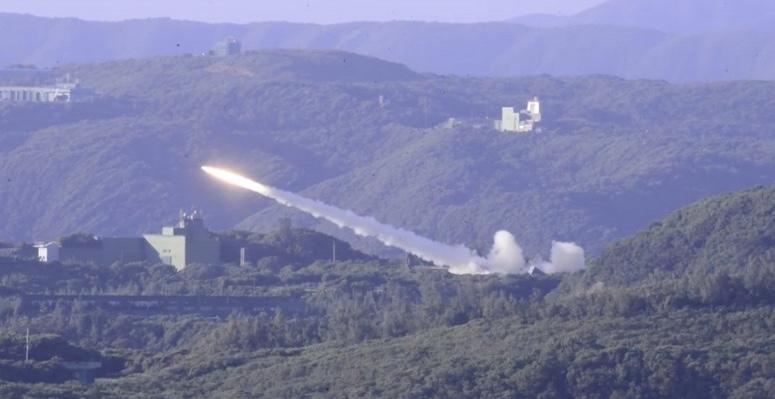
A Chinese military drone was spotted conducting reconnaissance off Taitung County as President William Lai (賴清德) visited Pingtung County this morning to inspect a drill of the armed forces’ precision-strike capabilities, prompting the military to closely monitor its actions. Today was the final day of a three-day military exercise at Jioupeng Base (九鵬基地) to test the joint combat capabilities of the armed forces and coast guard. The exercise began on Wednesday simulating air defense interception and yesterday tested long-range strike capabilities and new air defense weapons. This morning, the military conducted a final exercise involving air defense, anti-ship and drone operations. Military sources said

OCT. 31: The antiviral drugs Tamiflu and Eraflu have been distributed to about 4,000 medical facilities nationwide for people in seven groups who develop flu-like symptoms As the domestic influenza epidemic enters its peak season and continues to escalate, the Centers for Disease Control (CDC) yesterday announced that publicly funded influenza antiviral drugs for seven eligible groups have been extended to Oct. 31, allowing those who develop flu-like symptoms to receive the medication without undergoing a rapid influenza test. The CDC has extended the expanded use of flu antiviral drugs to seven groups: healthcare and influenza-prevention personnel; residents and staff at nursing homes, long-term care facilities and similar institutions; kindergarten and daycare workers and home-based caregivers; students from kindergarten through high school, vocational high school and the
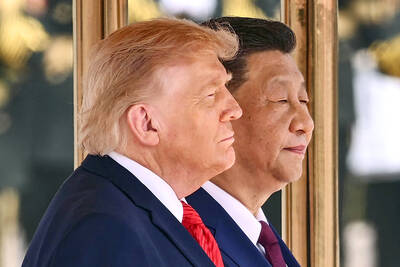
China has warned that it could cancel a planned US-China leaders’ summit if Washington approves new arms sales to Taiwan, a Japanese media outlet quoted sources as saying yesterday. US President Donald Trump, “apparently eager to showcase some diplomatic achievements ahead of November’s midterm congressional elections, places great importance on holding the summit with Chinese President Xi Jinping (習近平),” Japan’s Kyodo News reported. “While preparing for Xi’s upcoming trip, China has restated its position that the Taiwan issue is a ‘red line’ in bilateral relations,” the report said. The report said that when Xi met with Trump in Beijing in May, Xi said


 RSS
RSS