


The Executive Yuan yesterday approved a four-year, NT$24 billion (US$765.8 million) project to enable domestic production of more than 50 key drugs and enhance the resilience of the domestic drug supply chain.
Globalization has narrowed the production of drugs, as demonstrated by drug shortages resulting from shipping delays and other factors during the COVID-19 pandemic, highlighting the national security implications of pharmaceutical production capabilities, the Ministry of Health and Welfare said during the Cabinet meeting yesterday.
The project, beginning next year, is a comprehensive plan that combines investment and policies to strengthen Taiwanese
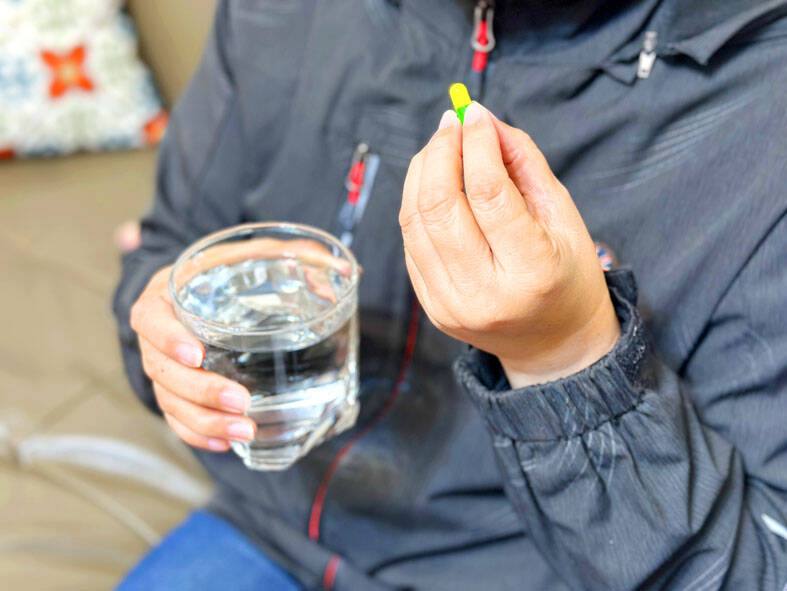
Photo: Chen Chien-chih, Taipei Times
pharmaceutical production, storage and logistics, the ministry said.
The program seeks to enhance Taiwan’s organic capability to produce active pharmaceutical components, and to increase production and export of generic drugs, locally produce biomedicine and radiopharmaceuticals, control critical medical ingredients, adopt artificial intelligence in monitoring, draft relevant laws before introducing policies and step up international cooperation, it said.
Minister of Health and Welfare Shih Chung-liang (石崇良) said that Taiwan currently has 30 companies that produce active pharmaceutical ingredients and 144 pharmaceutical manufacturers.
Only 16 percent of domestically produced active pharmaceutical ingredients are used locally, while 64 percent of necessary drugs are imported, Shih said, adding that this is a weakness in Taiwan’s pharmaceutical supply chain.
The project aims to increase the resilience of domestic pharmaceutical supply chains, enabling them to respond quickly in times of need, as well as generate NT$1 trillion in economic benefits, the ministry added.
The project would be overseen by a joint task force, with the ministry providing a list of key pharmaceuticals to be manufactured, providing legal and scientific consultation, formulating policies to encourage the use of generic drugs, overseeing international collaboration and amending regulations when necessary.
The Ministry of Environment would oversee environmental assessment and waste disposal, and the Ministry of Finance would assist with tax reduction policies to support research and development and investment.
The Ministry of Economic Affairs would provide subsidies for industry upgrades and assistance, and would lead delegations to encourage foreign investment.
Executive Yuan spokeswoman Michelle Lee (李慧芝) quoted Premier Cho Jung-tai (卓榮泰) as saying that the NT$24 billion funding is an important part of attracting peripheral financial benefits.
Shih said the health ministry is working with the Ministry of Economic Affairs to include domestic pharmaceutical production as a means to apply for tax deductions, and that a Pharmaceutical Drug Resilience Fund has been established to cover any funding shortfalls.
Shih said pharmaceutical storage would prioritize drugs and medical equipment for treating field injuries common to a wartime situation, adding that medicine for dealing with other high-risk incidents would be added to storage based on supply stability.
Additional reporting by Chung Li-hua

FUKUOKA SITUATION: Japanese media reported that the pathogen is expected to be identified by the summer, while the CDC downplayed the idea that it was hMPV A “mysterious cold-like illness” reported in Japan’s Fukuoka Prefecture does not seem to be a new disease, but Japanese authorities have been asked about the situation, the Centers for Disease Control (CDC) said yesterday. The Fukuoka Prefectural Medical Association on Wednesday told a news conference that a “mystery cold” that has become a hot topic on social media is “highly likely to be caused by some kind of viral infection,” Japan’s KBC News reported. “Many people are experiencing symptoms starting with a sore throat, followed by a runny nose, phlegm and a severe cough,” KBC News reported, citing association officials. Health authorities are

Nvidia Corp CEO Jensen Huang (黃仁勳) arrived in Taiwan yesterday ahead of upcoming AI and technology events, saying he plans to meet with clients and Taiwan Semiconductor Manufacturing Co Chairman C.C. Wei (魏哲家) during his visit. After landing at Taipei Songshan Airport, Huang posed for photos with fans and handed out Yakult drinks to reporters and supporters waiting at the scene, saying he has “a lot to do” during the trip. Asked about reports that Nvidia’s planned headquarters site in Taipei’s Beitou Shilin Technology Park could break ground on May 27, Huang said that if the company holds an event, he would

The Ministry of Finance this afternoon announced the winning numbers for the March-April uniform invoice lottery. The winning number for the NT$10 million (US$318,060) special prize is 19531471, and the winning number for the NT$2 million grand prize is 85941329. Three numbers were drawn for the NT$200,000 first prize: 07225810, 20231230 and 83518781. Those with receipts matching the last seven digits of any of the first-prize numbers will win the NT$40,000 second prize, while those matching the last six digits will win the NT$10,000 third prize. Those whose receipts match the last five digits of the first-prize numbers can claim the NT$4,000 fourth prize,

SIX SUBSIDIES: The monthly allowance for older farmers is to increase to NT$10,000, and NT$5,000 is to be given to homemakers under the national pension system, Lai said The government is to implement major welfare policies for disadvantaged groups, including raising the monthly allowance for older farmers to NT$10,000 and providing homemakers with NT$5,000 per month, President William Lai (賴清德) said yesterday. Lai made the remarks during a visit to Wangling Temple in Chiayi County, saying that the planned increases were being introduced amid economic growth and an increase in tax revenue. Touting a policy, in which the government plans to provide a monthly allowance of NT$5,000 for every child under the age of 18 in a bid to address Taiwan’s low birthrate, Lai said that if received for the


 RSS
RSS