


Taiwan has to demonstrate that it is determined to defend itself to the new US administration, Minister of National Defense Wellington Koo (顧立雄) said today when asked about a potential defense budget cut.
When asked whether a three-percent budget cut being proposed by the Taiwan People’s Party would convey a wrong message to Taiwan’s allies, Koo said it would affect the military’s operation and investment projects.
The ministry hopes its NT$476 billion (US$14.46 billion) budget could be passed in its entirety in order to signify to the incoming administration of US President-elect Donald Trump that Taiwan is determined to defend itself, he said.
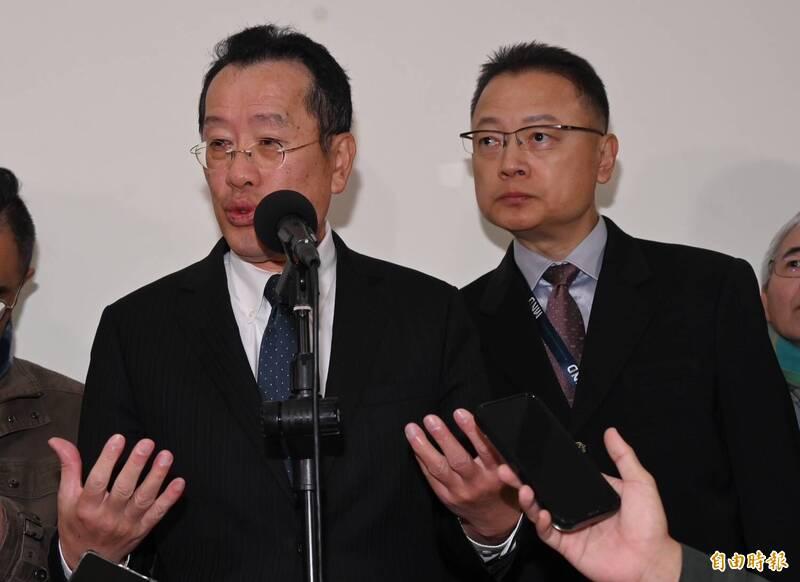
Photo: Liu Hsin-te, Taipei Times
Regarding the Chinese Nationalist Party’s (KMT) proposal to suspend NT$1.8 billion of the ministry’s NT$2 billion budget for the indigenous defense submarine program, Koo said he had “made a promise” that the ministry would only use the budget after the Hai Kun (海鯤), or Narwhal, passes the sea acceptance test which is expected to be held in April, so the ministry does not want the budget to be frozen or slashed.
Speaking about a recent incident in which a Chinese-linked ship was suspected of damaging one of Taiwan’s undersea cables, Koo said Taiwan will dispatch its navy if necessary to help the coast guard respond to any suspicious activity near undersea communication cables.
The authorities said a ship owned by a Hong Kong company but registered in both Cameroon and Tanzania damaged a cable to the north of the island earlier this month, although it says it has not been able to verify the ship's intentions and was unable to board it due to bad weather.
The ship's owner has denied involvement, and China's government has said Taiwan was making up accusations before the facts were clear.
The incident has particularly alarmed Taiwan given it has repeatedly complained about "grey-zone" Chinese activities around it, which are intended to pressure Taiwan without direct confrontation such as balloon overflights and sand dredging.
Speaking to reporters at parliament, Koo said the armed forces would closely coordinate with the coast guard and help monitor areas where sea cables are located.
"Once something happens, the coast guard will go out first, and if needed the navy will immediately cooperate if a response is required," he added.
Also speaking to the media at parliament, National Security Bureau Director-General Tsai Ming-yen (蔡明彥) said the government has already activated a mechanism with "international friends" to exchange information about Chinese "grey-zone" maritime activities, though he did not provide details.
Taiwan's focus will be on ships carrying flags of convenience — those registered in countries other than the one where their actual owner is based in — and how China might be using them in the waters around Taiwan, Tsai said.
The authorities have pointed to similarities between what it experienced and damage to undersea cables in the Baltic Sea following Russia's invasion of Ukraine.
Last week, the government said Chinese ships flying flags of convenience have "the mark of evil about them."

REASONS FOR TRAVEL: An assistant professor said that proposed amendments to penalize drivers if they used drugs overseas would not deter people from traveling People who operate a motor vehicle under the influence of marijuana would have their driver’s license revoked, even if they used the substance while overseas, the Ministry of Transportation and Communications said yesterday, citing proposed amendments to the Road Traffic Management and Penalty Act (道路交通管理處罰條例). The amendments would also authorize the government to revoke the licenses of people determined to have used Category 1 or Category 2 narcotics, even if they were not operating a vehicle while under the influence of drugs, as well as ban them from taking the license test for three years, the ministry said. People aged 18 or

GLOBALGIVING: ‘ Caving to external pressure is not acceptable for an organization that has cultivated justice reform and human rights for 30 years,’ one NGO said A slew of non-government organizations (NGOs) have withdrawn from the GlobalGiving fundraising platform after it announced it would use “Chinese Taipei” instead of “Taiwan” from next month. The Taiwan Good Rice Association wrote on Facebook on Friday that it was informed on April 28 via a teleconference call of the change, which was made because the platform wanted to operate in China. Taiwan Good Rice is to terminate all cooperative relationships with GlobalGiving in response to the platform’s “unilateral and non-negotiable” decision to remove references to Taiwan, the NGO said. “Taiwan is in the official name of Taiwan Good Rice Association and the

HEAVY WEATHER: Typhoon Jangmi is due to crash straight into the Ryukyus as airlines look to shift flights to larger aircraft or cancel flights to Okinawa entirely Taiwan’s international air carriers announced flight adjustments over the weekend as Typhoon Jangmi is forecast to hit the Ryukyu Islands today and tomorrow. The Central Weather Administration (CWA) upgraded Jangmi from a tropical storm to a typhoon at 8am yesterday, with the eye located 580km south of Naha city. It was moving north at 19kph. Today, China Airlines’ CI-120, CI-121, CI-122 and CI-123 flights between Taoyuan and Naha, Okinawa, have been canceled as well as CI-132 and CI-133 between Kaohsiung and Naha. EVA Air’s BR-112, BR-113, BR-186 and BR-185 flights between Taoyuan and Naha are also canceled. Low-cost carrier Tigerair Taiwan canceled IT-230,
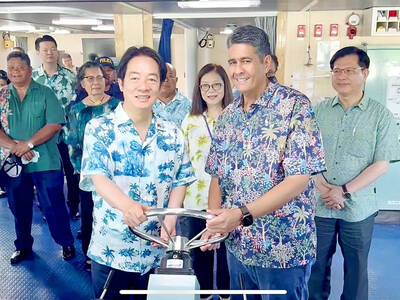
MULTIPRONGED APPROACH: China has sought to pressure Palau across a number of fronts, but the island nation has staunchly resisted overtures to ditch Taiwan Palau has been firm in backing Taiwan despite Chinese pressure that uses tourism economics, cyberattacks and criminal infiltration as tools to threaten the Pacific ally into renouncing its recognition of Taiwan as a sovereign state. The Presidential Office yesterday announced that Vice President Hsiao Bi-khim (蕭美琴) would visit Palau from Saturday to Wednesday next week at the invitation of Palauan President Surangel Whipps Jr. Whipps in April said in an interview that China had outspokenly asked Palau to “denounce Taiwan.” “And we have said: ‘We have no enemies, but nobody tells us who our friends are,’” he said. Whipps has told reporters multiple times


 RSS
RSS