


The Executive Yuan today approved a plan to ban the use of household kitchen waste for pig farming starting next year, which would include a one-year grace period before the full ban is instated in 2027.
During the transition period, pig farmers may continue using kitchen waste under certain conditions, the Ministry of Agriculture (MOA) told a news conference following the Cabinet meeting today.
The conditions are to include obtaining local government approval, installing systems for monitoring cooking temperatures and video surveillance, equipping transport vehicles with GPS and passing inter-ministerial inspections, the ministry said.
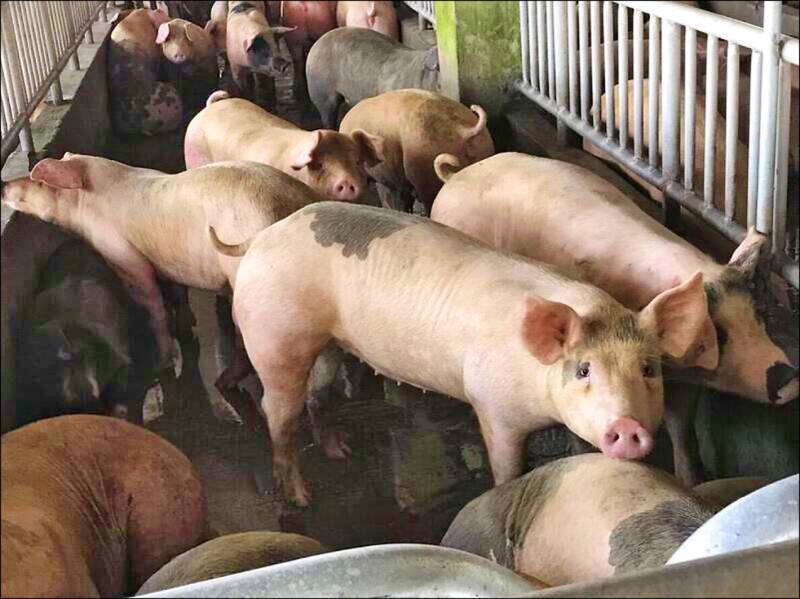
Photo: Taipei Times
The kitchen waste permitted is to be limited to business-generated waste, animal residues and livestock slaughter byproducts, with household kitchen waste strictly prohibited, it said.
Each municipality or county government may announce its own earlier timeline for halting kitchen waste pig farming and related improvements, balancing disease prevention, waste disposal and practical support for affected farmers, it said.
To assist the industry in accelerating the transition, the ministry said it is to provide subsidies for feed conversion and feeding equipment, supporting kitchen waste pig farmers in steadily shifting to feed-based methods to reduce disease risks.
For those transitioning immediately to feed-based pig farming during the buffer period, feed conversion subsidies of NT$3,600 (US$114) per pig would be provided, it said.
In addition, operators continuing to use cooked kitchen waste in compliance with regulations during the buffer period would still qualify for feed conversion subsidies, but at half the amount, NT$1,800 per pig, with other subsidies matching those for immediate transitions to feed-based methods, it said.
Feeding equipment subsidies would depend on farm scale, ranging from NT$300,000 to NT$3 million, it said.
The ministry said it would also provide financial support through interest subsidies on specialized agricultural loans, such as those for livestock industry operations, young farmers starting out and farmer production and marketing groups, with guarantee fees waived within the subsidy limits.
The Ministry of Environment said it has launched four complementary measures: establishing real-time monitoring systems for pig farms, strengthening controls at incinerators, enhancing the capacity of recycling facilities and promoting education on reducing food waste to strengthen kitchen waste reuse management and disposal planning.
Nationwide kitchen waste processing facilities currently face shortfalls, the ministry said.
The ministry is to assist local governments in boosting capacity by optimizing existing recycling facilities and constructing new ones, it said.
Premier Cho Jung-tai (卓榮泰) has instructed the agriculture and environment ministries to assist local governments in implementing rigorous control mechanisms and technological tools to ensure that business kitchen waste used during the transition complies with regulations, Executive Yuan spokesperson Michelle Lee (李慧芝) told the news conference.
Kitchen waste pig farming must strictly adhere to cooking requirements to eliminate the threat of African swine fever, Lee quoted Cho as saying during today’s Cabinet meeting.
The construction of kitchen waste recycling facilities should be sped up to handle proper disposal after the full ban, achieving disease prevention and environmental protection, he said.
Cho also directed the MOA to promote transition guidance measures, including feed subsidies, feeding equipment subsidies and necessary technical support, to enhance operators' management capabilities, Lee said.
The ministry should assist the industry in a smooth shift to feed-based pig farming and ensure that the nationwide transition deadline of Dec. 31 next year can be met, Cho said.
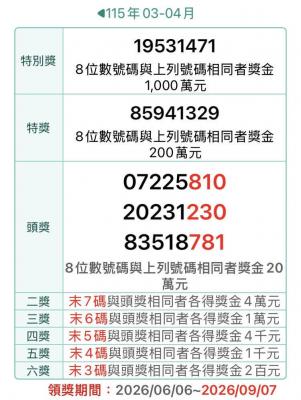
The Ministry of Finance this afternoon announced the winning numbers for the March-April uniform invoice lottery. The winning number for the NT$10 million (US$318,060) special prize is 19531471, and the winning number for the NT$2 million grand prize is 85941329. Three numbers were drawn for the NT$200,000 first prize: 07225810, 20231230 and 83518781. Those with receipts matching the last seven digits of any of the first-prize numbers will win the NT$40,000 second prize, while those matching the last six digits will win the NT$10,000 third prize. Those whose receipts match the last five digits of the first-prize numbers can claim the NT$4,000 fourth prize,

SIX SUBSIDIES: The monthly allowance for older farmers is to increase to NT$10,000, and NT$5,000 is to be given to homemakers under the national pension system, Lai said The government is to implement major welfare policies for disadvantaged groups, including raising the monthly allowance for older farmers to NT$10,000 and providing homemakers with NT$5,000 per month, President William Lai (賴清德) said yesterday. Lai made the remarks during a visit to Wangling Temple in Chiayi County, saying that the planned increases were being introduced amid economic growth and an increase in tax revenue. Touting a policy, in which the government plans to provide a monthly allowance of NT$5,000 for every child under the age of 18 in a bid to address Taiwan’s low birthrate, Lai said that if received for the
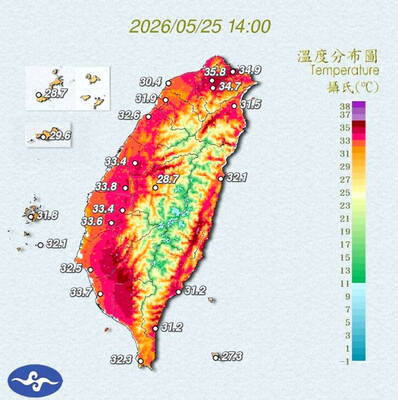
STAY COOL: The HPA recommended that people stay hydrated, use air-conditioning or fans while indoors, wear loose-fitting clothes and walk in the shade while outdoors Employers must implement measures such as installing cooling equipment, and providing drinking water and rest breaks for outdoor workers starting from Monday next week, the Taipei Department of Labor said on Sunday. Employers who fail to comply could face fines of NT$30,000 to NT$300,000 under the Occupational Safety and Health Act (職業安全衛生法), the department said. Businesses in Taipei employing fewer than 100 workers, as well as registered self-employed workers with labor insurance coverage, could receive on-site assessments and guidance from occupational safety consultants to help them apply for central government subsidies to implement or improve heat-protection measures, it said. Under the Ministry of
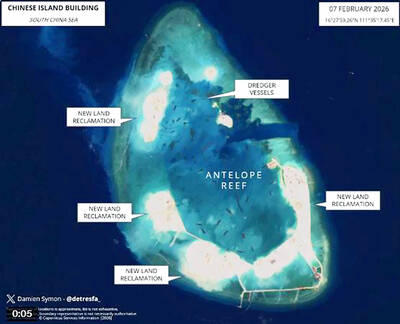
ISOLATION: The outposts would serve as support and backup bases, forcing US forces to either face China head-on or reroute, increasing travel time and operational costs China’s outposts in the South China Sea could be used to delay and constrain foreign forces during a conflict in the Taiwan Strait, giving Beijing a critical window to carry out amphibious landing and blockade operations, a report said. The Chinese Communist Party’s (CCP) forward operating bases on islands and reclaimed features in the South China Sea could delay foreign forces long enough for the Chinese People’s Liberation Army (PLA) to secure a key 48-to-72-hour window in the Taiwan Strait, a report commissioned by the Mainland Affairs Council found. The report, conducted by the Institute for National Defense and Security Research, examined


 RSS
RSS