


The Health Promotion Administration (HPA) yesterday awarded 19 hospitals for outstanding performances in creating breastfeeding-friendly environments, including a hospital that introduced an interactive robot to teach new mothers how to breastfeed.
The WHO says breastfeeding is an unequaled way of providing food for infants’ healthy growth and development, providing antibodies that help protect them against many common childhood illnesses and chronic diseases later in life.
The WHO and UNICEF in 1991 launched the Baby-Friendly Hospital Initiative to encourage health facilities worldwide to better support breastfeeding, and also developed the “10 steps to successful breastfeeding” framework to promote optimal clinical care for new mothers and their infants.

Photo: CNA
The HPA in 2001 launched a national baby-friendly healthcare facility certification, based on the 10 steps, and there are now 139 certified baby-friendly healthcare facilities across the country.
The administration held a ceremony to award 19 baby-friendly healthcare facilities for their excellent performances this year.
Although the government encourages breastfeeding, it also respects every woman’s autonomy and their decisions, HPA Director-General Shen Ching-fen (沈靜芬) said.
The government prioritizes new mothers’ mental state, and that both the mother and baby are healthy, Shen said.
Hospitals need to provide customized health education counseling, companionship and care, which are the key to creating a breastfeeding-friendly environment, she said.
About 70 percent of infants are born in certified baby-friendly hospitals, she said, adding that if new mothers learn how to breastfeed during hospitalization, they are more likely to build confidence and continue after returning home.
The evaluation for the awards was conducted by specialists and academics, based on the hospitals’ effectiveness in promoting baby-friendly policies, cross-team collaboration, creative strategies and care quality, the HPA said.
Eight hospitals were awarded the “High Distinction Award,” 11 hospitals were awarded the “Excellence Award,” and two were awarded the “Innovative Award.”
Among them, three hospitals — National Cheng Kung University Hospital (NCKUH), and Taipei City Hospital’s Renai and Heping Fuyou branches — received both the “High Distinction” and “Innovative” awards.
The NCKUH introduced an interactive robot named “Kebbi” teaching new mothers how to breastfeed through voice and touch-based interactions, the HPA said.
Kebbi makes health education counseling more interesting, as well as saving nurses’ time by about 50 percent, it said.
Aside from assisting nurses in teaching breastfeeding techniques to new mothers, Kebbi can also read story books to infants in a soothing tone, it said.
Taipei City Hospital’s Renai Branch developed a smart care companionship model, in which it can promptly interact with parents through the Line messaging app, listening and responding to their questions, and giving suggestions, the HPA said.
In addition to breastfeeding consultations provided by the hospitals, the HPA said new parents can call its pregnancy and free infant care hotline (0800-870-870) or find more information on its maternity care Web site (mammy.hpa.gov.tw).

FUKUOKA SITUATION: Japanese media reported that the pathogen is expected to be identified by the summer, while the CDC downplayed the idea that it was hMPV A “mysterious cold-like illness” reported in Japan’s Fukuoka Prefecture does not seem to be a new disease, but Japanese authorities have been asked about the situation, the Centers for Disease Control (CDC) said yesterday. The Fukuoka Prefectural Medical Association on Wednesday told a news conference that a “mystery cold” that has become a hot topic on social media is “highly likely to be caused by some kind of viral infection,” Japan’s KBC News reported. “Many people are experiencing symptoms starting with a sore throat, followed by a runny nose, phlegm and a severe cough,” KBC News reported, citing association officials. Health authorities are

Nvidia Corp CEO Jensen Huang (黃仁勳) arrived in Taiwan yesterday ahead of upcoming AI and technology events, saying he plans to meet with clients and Taiwan Semiconductor Manufacturing Co Chairman C.C. Wei (魏哲家) during his visit. After landing at Taipei Songshan Airport, Huang posed for photos with fans and handed out Yakult drinks to reporters and supporters waiting at the scene, saying he has “a lot to do” during the trip. Asked about reports that Nvidia’s planned headquarters site in Taipei’s Beitou Shilin Technology Park could break ground on May 27, Huang said that if the company holds an event, he would

The Ministry of Finance this afternoon announced the winning numbers for the March-April uniform invoice lottery. The winning number for the NT$10 million (US$318,060) special prize is 19531471, and the winning number for the NT$2 million grand prize is 85941329. Three numbers were drawn for the NT$200,000 first prize: 07225810, 20231230 and 83518781. Those with receipts matching the last seven digits of any of the first-prize numbers will win the NT$40,000 second prize, while those matching the last six digits will win the NT$10,000 third prize. Those whose receipts match the last five digits of the first-prize numbers can claim the NT$4,000 fourth prize,
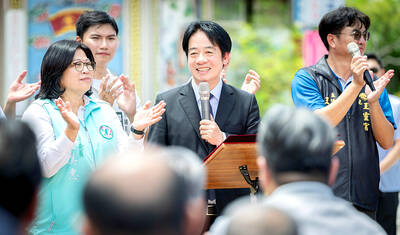
SIX SUBSIDIES: The monthly allowance for older farmers is to increase to NT$10,000, and NT$5,000 is to be given to homemakers under the national pension system, Lai said The government is to implement major welfare policies for disadvantaged groups, including raising the monthly allowance for older farmers to NT$10,000 and providing homemakers with NT$5,000 per month, President William Lai (賴清德) said yesterday. Lai made the remarks during a visit to Wangling Temple in Chiayi County, saying that the planned increases were being introduced amid economic growth and an increase in tax revenue. Touting a policy, in which the government plans to provide a monthly allowance of NT$5,000 for every child under the age of 18 in a bid to address Taiwan’s low birthrate, Lai said that if received for the


 RSS
RSS