


The Shilin District Court today handed a trash collector surnamed Huang (黃) a three-month suspended sentence for giving a discarded rice cooker to an elderly woman who scavenges garbage for a living.
The sentence is suspended for two years, meaning Huang would not have to serve jail time if he meets the court’s conditions over the period.
The ruling may also be appealed.

Photo: Taipei Times
As an employee of the trash collecting unit in Taipei’s Beitou District (北投), Huang is responsible for household garbage collection as well as dismantling and sorting recyclables, the Shilin District Prosecutors’ Office said in its indictment.
On July 26 last year, Huang took home a discarded rice cooker valued at NT$32.56, prosecutors said.
After confirming that the rice cooker still worked, Huang gave it to a woman in New Taipei City’s Sinjhuang District (新莊) the next day, they said.
Huang later turned himself in to the Ministry of Justice’s Agency Against Corruption.
After an investigation, prosecutors in June charged Huang with breaching Article 6 of the Anti-Corruption Act (貪污治罪條例) by “stealing or misappropriating private property or equipment that is in his or her possession due to official position, but not for official use,” as trash collectors are city employees.
However, prosecutors asked the court for a lenient sentence, saying that Huang had turned himself in, admitted to his offense and returned the proceeds from it, and because his offense was very minor.
Huang’s sentence should be reduced according to self-surrendering and confession provisions of the Anti-Corruption Act, and as the value he obtained was less than NT$50,000, prosecutors said.
The case sparked public outcry, with many saying he had good intentions, but was accused of seeking personal gain, while others expressed concern over the fairness of the justice system.
The Taipei Department of Environmental Protection said that Huang is a long-time employee who values personal relationships and simply wanted to help a vulnerable person.
Huang used his own money to buy a new rice cooker to replace the one he originally gave to the woman, the department said, adding that he had no mal intent.
Following hearings on the case in September, Huang said he only wanted to help an elderly woman who collects recyclables by giving her a usable appliance so she could cook for herself, but never imagined it would become such a serious matter.
The Ministry of Justice in September said that it had proposed an amendment allowing those with “minor corruption offenses” to apply for a reduced term or suspended sentence, aiming to align legal outcomes with social expectations of fairness and justice.
The High Prosecutors’ Office said that when prosecutors investigate corruption cases, they should be empathetic and make decisions that are fair, measured and aligned with public sentiment.
Additional reporting by Lin Chia-tung, Tsai Kai-cheng and Jason Pan

The military has spotted two Chinese warships operating in waters near Penghu County in the Taiwan Strait and sent its own naval and air forces to monitor the vessels, the Ministry of National Defense (MND) said. Beijing sends warships and warplanes into the waters and skies around Taiwan on an almost daily basis, drawing condemnation from Taipei. While the ministry offers daily updates on the locations of Chinese military aircraft, it only rarely gives details of where Chinese warships are operating, generally only when it detects aircraft carriers, as happened last week. A Chinese destroyer and a frigate entered waters to the southwest
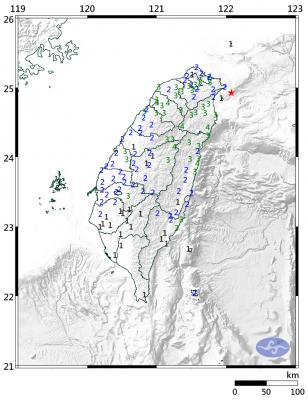
A magnitude 6.1 earthquake struck off the coast of Yilan County at 8:39pm tonight, the Central Weather Administration (CWA) said, with no immediate reports of damage or injuries. The epicenter was 38.7km east-northeast of Yilan County Hall at a focal depth of 98.3km, the CWA’s Seismological Center said. The quake’s maximum intensity, which gauges the actual physical effect of a seismic event, was a level 4 on Taiwan’s 7-tier intensity scale, the center said. That intensity level was recorded in Yilan County’s Nanao Township (南澳), Hsinchu County’s Guansi Township (關西), Nantou County’s Hehuanshan (合歡山) and Hualien County’s Yanliao (鹽寮). An intensity of 3 was

Japanese Prime Minister Sanae Takaichi’s comment last year on Tokyo’s potential reaction to a Taiwan-China conflict has forced Beijing to rewrite its invasion plans, a retired Japanese general said. Takaichi told the Diet on Nov. 7 last year that a Chinese naval blockade or military attack on Taiwan could constitute a “survival-threatening situation” for Japan, potentially allowing Tokyo to exercise its right to collective self-defense. Former Japan Ground Self-Defense Force general Kiyofumi Ogawa said in a recent speech that the remark has been interpreted as meaning Japan could intervene in the early stages of a Taiwan Strait conflict, undermining China’s previous assumptions

Taiwan Railways Corp (TRC) today announced that Shin Kong Mitsukoshi has been selected as the preferred bidder to operate the Taipei Railway Station shopping mall, replacing the current operator, Breeze Development Co Ltd. Among eight qualified firms that delivered presentations and were evaluated by a review committee, Shin Kong Mitsukoshi was ranked first, while Breeze was named the runner-up, the rail company said in a statement. Contract negotiations are to proceed in accordance with regulations, it said, adding that if negotiations with the top bidder fail, it could invite the second-ranked applicant to enter talks. Breeze in a statement today expressed doubts over


 RSS
RSS