


Passersby kept a man alive until paramedics could arrive and transport him to a hospital within the “golden hour,” after the American traveler experienced a massive heart attack while hiking in Taipei last month, Taipei Medical University Hospital said on Friday.
The man, who preferred to use the pseudonym Atom, suddenly lost consciousness and fell to the ground on Xiangshan (象山), other hikers rushed to check on him and found that his heart had stopped beating, the man and hospital staff told the news conference.
One of the hikers performed cardiopulmonary resuscitation (CPR) on him, while others retrieved a nearby automated external defibrillator (AED).
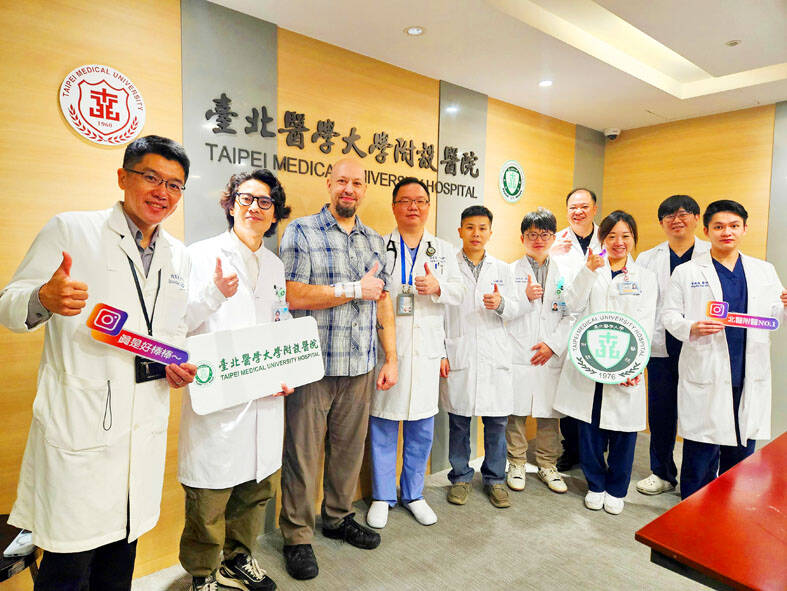
Photo courtesy of the Taipei Medical University Hospital
When paramedics arrived, they took over resuscitation and rushed Atom, who was determined to be in out-of-hospital cardiac arrest, to nearby Taipei Medical University Hospital.
The emergency medical team performed catheterization and extracorporeal membrane oxygenation (ECMO) on Atom, saving his life.
Atom, who underwent two weeks of treatment following the incident, told the news conference that he was determined to have had a left anterior descending artery occlusion, which is often called a “widow-maker” heart attack due to its high fatality rate of about 88 percent if treatment is delayed.
“I would not be standing here if it were not for all of you,” he said, thanking the passersby who performed CPR and called the paramedics, as well as the paramedics and medical team.
Tsai Hung-wei (蔡鴻維), a doctor who first treated Atom at the emergency room, said the treatment of myocardial infarction is a race against time, and Atom was fortunate that he was found by people who could perform CPR and that an AED cabinet was nearby.
The paramedics were able to use the AED and rush him to the hospital within the “golden hour,” for a smooth transition to catheterization and ECMO, Tsai said, adding that the key to a successful rescue is the seamless transition from emergency pre-hospital treatment to hospital treatment.
As Atom was in cardiogenic shock when he arrived at the hospital, medical staff had to perform critical measures — ECMO to support cardiopulmonary function, then catheterization to remove artery blockage and stent placement — in a short time, said Yang Tsung-lin (楊宗霖), a cardiologist at the hospital.
After being admitted to an intensive care unit, he was placed under therapeutic hypothermia to protect his brain, Yang said, adding that Atom regained consciousness without any lasting neurological damage, and can move around normally.
Chao Chun-chien (趙君傑), director of the hospital’s Department of Emergency and Critical Care Medicine, said that cold temperatures can cause blood vessels to constrict and blood pressure to rise, making the heart work harder, and hiking sometimes requires high myocardial oxygen consumption.
Therefore, if a person has the “three highs” — high levels of blood lipids, blood sugar or blood pressure — is obese or is a smoker, they are more likely to trigger angina pectoris (chest pain caused by reduced blood flow to the heart) or a heart attack from hiking uphill, Chao said.
A study suggested that the risk of heart attacks is highest during the morning, particularly from 4am to 10am, when many hikers like to start their hikes, putting them at higher risk of having a heart attack, he said.
People who have the “three highs” or have been diagnosed with coronary artery disease should consult with a doctor before hiking or mountain climbing in the winter, and should perform warm-up exercises for 10 to 15 minutes before setting out, to prevent a sudden rise in blood pressure, Chao said.
Sudden chest tightness or pressure, cold sweats, shortness of breath and extreme fatigue could be signs of myocardial ischemia — abnormally reduced blood flow in the coronary circulation, he said.
If a hiker experiences those symptoms, they should not try to return on their own, but should immediately stop walking, stay warm and call 119 for help, he added.

FUKUOKA SITUATION: Japanese media reported that the pathogen is expected to be identified by the summer, while the CDC downplayed the idea that it was hMPV A “mysterious cold-like illness” reported in Japan’s Fukuoka Prefecture does not seem to be a new disease, but Japanese authorities have been asked about the situation, the Centers for Disease Control (CDC) said yesterday. The Fukuoka Prefectural Medical Association on Wednesday told a news conference that a “mystery cold” that has become a hot topic on social media is “highly likely to be caused by some kind of viral infection,” Japan’s KBC News reported. “Many people are experiencing symptoms starting with a sore throat, followed by a runny nose, phlegm and a severe cough,” KBC News reported, citing association officials. Health authorities are

Nvidia Corp CEO Jensen Huang (黃仁勳) arrived in Taiwan yesterday ahead of upcoming AI and technology events, saying he plans to meet with clients and Taiwan Semiconductor Manufacturing Co Chairman C.C. Wei (魏哲家) during his visit. After landing at Taipei Songshan Airport, Huang posed for photos with fans and handed out Yakult drinks to reporters and supporters waiting at the scene, saying he has “a lot to do” during the trip. Asked about reports that Nvidia’s planned headquarters site in Taipei’s Beitou Shilin Technology Park could break ground on May 27, Huang said that if the company holds an event, he would

Carrefour Taiwan is to begin using a new name from the start of July, but it cannot divulge the name until then, the chairman of the supermarket chain's parent company said today. President Chain Store Co chairman Lo Chih-hsien (羅智先) was asked by reporters after a shareholders' meeting to confirm whether the company has settled on a new name for the supermarket brand. In March, the government-registered name of two Carrefour Taiwan branches was quietly changed to "Le Chia Kang" (樂家康) in Chinese, raising speculation that has been selected as the name. Lo said that because of local regulations and contractual obligations, the

The Philippines would likely be involved in any conflict over Taiwan due to its proximity to the democracy claimed by China, President Ferdinand Marcos Jr said, reiterating a stance that risks angering Beijing. “In the Philippines, we do not have a choice because Taiwan is so close to the Philippines and we have almost 200,000 Filipino nationals living and working in Taiwan,” Marcos said in an interview with Japanese media in Manila on Monday. The Philippine leader’s comments come ahead of a state visit to Japan next week, where he is to meet with Japanese Prime Minister Sanae Takaichi to discuss security


 RSS
RSS