


Screening for muscle loss among Asians should start at age 50, a research team from National Yang Ming Chiao Tung University (NYCU) and Taipei Veterans General Hospital (TVGH) said yesterday, citing a cross-national study they participated in.
Reducing sarcopenia — an age-related condition characterized by the progressive loss of muscle mass and strength — is critical to achieving President William Lai’s (賴清德) “Healthy Taiwan” goal, TVGH superintendent Chen Wei-ming (陳威明) told a news conference in Taipei.
“When people have insufficient muscle mass and muscle strength, they can easily develop a degenerative joint disease and many other chronic diseases, which would affect their mobility and quality of life,” Chen said.
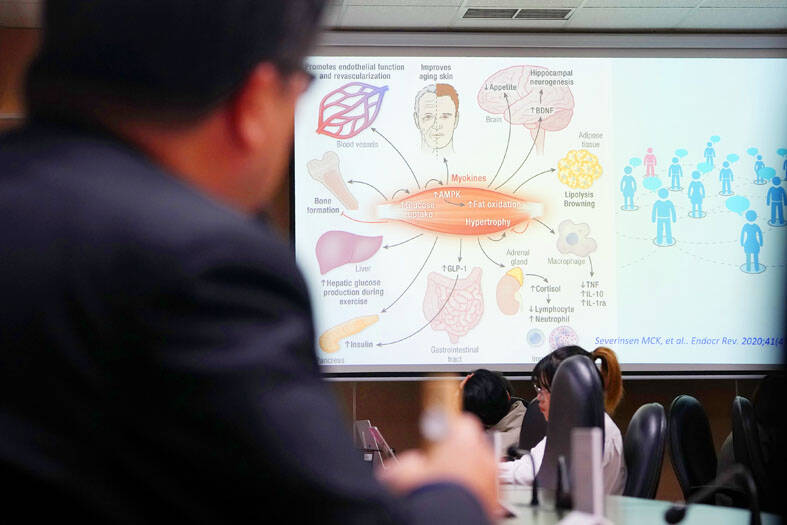
Photo: CNA
Taiwan has become a “super-aged society,” in which at least 20 percent of the population is 65 or older, making disability prevention just as important as medical intervention for a single disease, NYCU president Lin Chi-hung (林奇宏) said.
Based on the study, the Asian Working Group for Sarcopenia this year updated its consensus on diagnosis and treatment, in which it recommended expanding sarcopenia screening to include adults aged 50 to 64, he said.
TVGH-managed Taipei Municipal Guandu Hospital superintendent and NYCU Center for Healthy Longevity and Aging Sciences director Chen Liang-kung (陳亮恭), who led the research team in Taiwan, said the group’s updated consensus was based on eight large-scale cohort studies with long-term follow-ups on nearly 35,000 cases from several Asian countries.
Clinical diagnoses of sarcopenia were previously based on European standards, but studies have found that Asian populations have a slightly different body composition, mainly characterized by a higher percentage of body fat and lower muscle mass compared with Caucasians, especially among Asian women, he said.
The Asian Working Group for Sarcopenia in 2014 began collecting data from Asian countries, finding that Asians begin significantly losing muscle mass from age 55 and muscle strength at an accelerating rate from age 45 and 70, Chen Liang-kung said.
Individuals with more muscle strength, such as handgrip strength, could delay muscle strength decline by years, he added.
Building muscle mass and training muscle strength after they start declining can improve their condition, but they might feel frustrated as the effectiveness is relatively limited, he said.
Therefore, the group suggested that sarcopenia screening be moved up from age 65 to as early as 50, to detect if a person is at high risk of developing sarcopenia and begin prevention earlier, Chen Liang-kung said.
The group’s updated consensus also simplifies the diagnostic criteria of sarcopenia to require only concurrent “low muscle mass” and “low muscle strength,” with physical performance as an outcome measure, he said.
The updated consensus was published last month in the international journal Nature Aging, the TVGH said, adding that sarcopenia is one of the few diseases that Taiwan has led in defining the diagnosis and treatment, demonstrating academic leadership in geriatric medicine.
Additional reporting by CNA

FUKUOKA SITUATION: Japanese media reported that the pathogen is expected to be identified by the summer, while the CDC downplayed the idea that it was hMPV A “mysterious cold-like illness” reported in Japan’s Fukuoka Prefecture does not seem to be a new disease, but Japanese authorities have been asked about the situation, the Centers for Disease Control (CDC) said yesterday. The Fukuoka Prefectural Medical Association on Wednesday told a news conference that a “mystery cold” that has become a hot topic on social media is “highly likely to be caused by some kind of viral infection,” Japan’s KBC News reported. “Many people are experiencing symptoms starting with a sore throat, followed by a runny nose, phlegm and a severe cough,” KBC News reported, citing association officials. Health authorities are

Nvidia Corp CEO Jensen Huang (黃仁勳) arrived in Taiwan yesterday ahead of upcoming AI and technology events, saying he plans to meet with clients and Taiwan Semiconductor Manufacturing Co Chairman C.C. Wei (魏哲家) during his visit. After landing at Taipei Songshan Airport, Huang posed for photos with fans and handed out Yakult drinks to reporters and supporters waiting at the scene, saying he has “a lot to do” during the trip. Asked about reports that Nvidia’s planned headquarters site in Taipei’s Beitou Shilin Technology Park could break ground on May 27, Huang said that if the company holds an event, he would
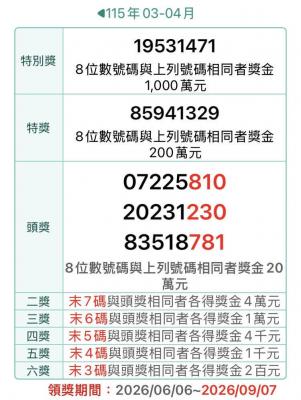
The Ministry of Finance this afternoon announced the winning numbers for the March-April uniform invoice lottery. The winning number for the NT$10 million (US$318,060) special prize is 19531471, and the winning number for the NT$2 million grand prize is 85941329. Three numbers were drawn for the NT$200,000 first prize: 07225810, 20231230 and 83518781. Those with receipts matching the last seven digits of any of the first-prize numbers will win the NT$40,000 second prize, while those matching the last six digits will win the NT$10,000 third prize. Those whose receipts match the last five digits of the first-prize numbers can claim the NT$4,000 fourth prize,

SIX SUBSIDIES: The monthly allowance for older farmers is to increase to NT$10,000, and NT$5,000 is to be given to homemakers under the national pension system, Lai said The government is to implement major welfare policies for disadvantaged groups, including raising the monthly allowance for older farmers to NT$10,000 and providing homemakers with NT$5,000 per month, President William Lai (賴清德) said yesterday. Lai made the remarks during a visit to Wangling Temple in Chiayi County, saying that the planned increases were being introduced amid economic growth and an increase in tax revenue. Touting a policy, in which the government plans to provide a monthly allowance of NT$5,000 for every child under the age of 18 in a bid to address Taiwan’s low birthrate, Lai said that if received for the


 RSS
RSS