


Democratic Progressive Party (DPP) caucus chief executive Chung Chia-pin (鍾佳濱) yesterday said that he welcomes and supports civic groups’ exercise of “direct democracy” regarding ongoing referendum signature drives.
The civic group People as Masters (人民作主志工團) has launched referendum initiatives to repeal amendments to the Constitutional Court Procedure Act (憲法訴訟法) and the Civil Servants Election and Recall Act (公職選罷法).
The proposal to repeal amendments to the Constitutional Court Procedure Act seeks to abolish requirements concerning the minimum number of justices needed for Constitutional Court proceedings. The signature drive started in late July and runs until late January next year.
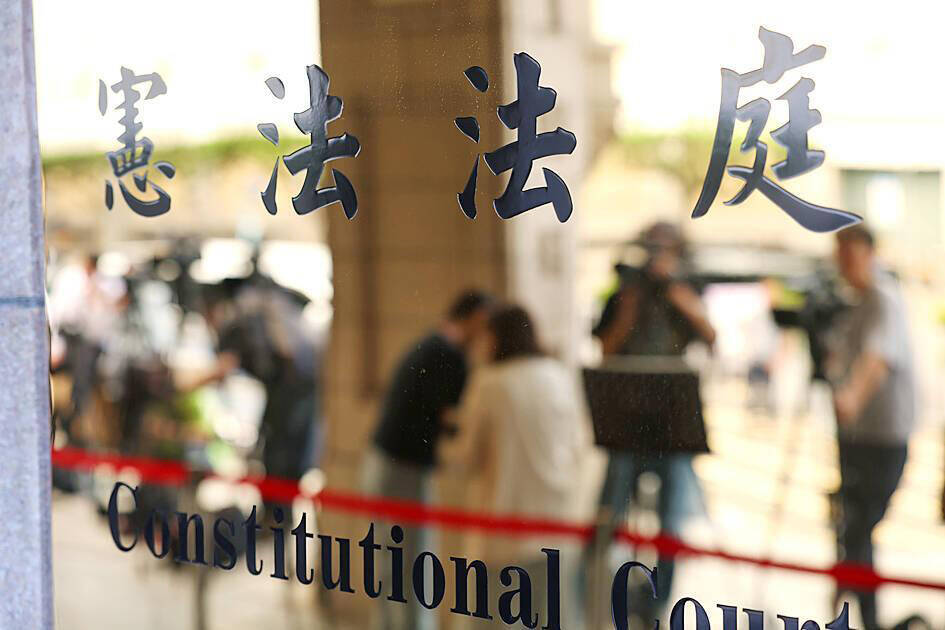
Photo: CNA
The initiative stemmed from amendments passed at the legislature on Dec. 20 last year, which require the president to nominate additional Constitutional Court justices within two months if there are fewer than 15 sitting justices. The amendments require at least 10 justices to participate in deliberations, and at least nine to agree in order to issue a ruling of unconstitutionality.
At present, the Constitutional Court has only eight justices. President William Lai (賴清德) has twice nominated seven candidates, all of whom were rejected by the legislature, in which the opposition holds a majority.
The referendum proposal, spearheaded by People as Masters member Chao Wei-cheng (趙偉程), asks signatories whether they disagree with the amendment and think it should be repealed.
A separate set of referendum proposals targets amendments to the Civil Servants Election and Recall Act, and seeks to abolish the requirement to attach ID card photocopies when initiating a recall, abolish the same requirement when collecting recall signatures, and repeal criminal penalties for forging or misusing personal data in signature drives. Their signature period began in late September and runs until late March next year.
These initiatives mark Taiwan’s first use of electronic signature collection for referendums. Participants must first obtain a physical Citizen Digital Certificate and use a computer card reader to sign the petition, resulting in a surge in certificate applications.
Since an amendment to the Referendum Act (公民投票法) passed by the Chinese Nationalist Party (KMT) and the Taiwan People’s Party+ on Nov. 21 calls for referendums to be held alongside major elections, the referendums are likely to be held during local elections in August next year.
According to the Ministry of the Interior, the number of physical Citizen Digital Certificate applications reached 21,332 in the days following the passage of that amendment, up 11,400 (115 percent) from the previous week.
Chung yesterday said that lawmakers are subject to public oversight, and when representative democracy fails, people naturally step forward to exercise direct democracy, including referendums.
“When civic groups initiate
direct-democracy actions such as referendums, we welcome and support them,” he said, adding that the DPP caucus would not itself be the initiator.
With four referendum signature drives under way, Chung said the party “will not remain bystanders” and would participate with concrete action.
Because electronic signature collection is a new system, the caucus must learn how to help promote and assist the process, he said.
DPP local councilors’ offices have already begun assisting with signature collection since last week, and the DPP has invited civic groups to meet tomorrow to discuss the referendum efforts, he said.
Regarding the referendum challenging the constitutionality of the Constitutional Court Procedure Act amendments, DPP Legislator Wang Ting-yu (王定宇) yesterday said it is “extremely meaningful,” adding: “I even believe the DPP should proactively assist, because the KMT–TPP bloc has used this law to paralyze the Constitutional Court, throwing the nation’s constitutional operations into serious crisis.”

FUKUOKA SITUATION: Japanese media reported that the pathogen is expected to be identified by the summer, while the CDC downplayed the idea that it was hMPV A “mysterious cold-like illness” reported in Japan’s Fukuoka Prefecture does not seem to be a new disease, but Japanese authorities have been asked about the situation, the Centers for Disease Control (CDC) said yesterday. The Fukuoka Prefectural Medical Association on Wednesday told a news conference that a “mystery cold” that has become a hot topic on social media is “highly likely to be caused by some kind of viral infection,” Japan’s KBC News reported. “Many people are experiencing symptoms starting with a sore throat, followed by a runny nose, phlegm and a severe cough,” KBC News reported, citing association officials. Health authorities are

Nvidia Corp CEO Jensen Huang (黃仁勳) arrived in Taiwan yesterday ahead of upcoming AI and technology events, saying he plans to meet with clients and Taiwan Semiconductor Manufacturing Co Chairman C.C. Wei (魏哲家) during his visit. After landing at Taipei Songshan Airport, Huang posed for photos with fans and handed out Yakult drinks to reporters and supporters waiting at the scene, saying he has “a lot to do” during the trip. Asked about reports that Nvidia’s planned headquarters site in Taipei’s Beitou Shilin Technology Park could break ground on May 27, Huang said that if the company holds an event, he would

The Ministry of Finance this afternoon announced the winning numbers for the March-April uniform invoice lottery. The winning number for the NT$10 million (US$318,060) special prize is 19531471, and the winning number for the NT$2 million grand prize is 85941329. Three numbers were drawn for the NT$200,000 first prize: 07225810, 20231230 and 83518781. Those with receipts matching the last seven digits of any of the first-prize numbers will win the NT$40,000 second prize, while those matching the last six digits will win the NT$10,000 third prize. Those whose receipts match the last five digits of the first-prize numbers can claim the NT$4,000 fourth prize,

SIX SUBSIDIES: The monthly allowance for older farmers is to increase to NT$10,000, and NT$5,000 is to be given to homemakers under the national pension system, Lai said The government is to implement major welfare policies for disadvantaged groups, including raising the monthly allowance for older farmers to NT$10,000 and providing homemakers with NT$5,000 per month, President William Lai (賴清德) said yesterday. Lai made the remarks during a visit to Wangling Temple in Chiayi County, saying that the planned increases were being introduced amid economic growth and an increase in tax revenue. Touting a policy, in which the government plans to provide a monthly allowance of NT$5,000 for every child under the age of 18 in a bid to address Taiwan’s low birthrate, Lai said that if received for the


 RSS
RSS