


Eleven automatic detection stations have been set up around the Tamsui River (淡水河) to monitor water quality in real time, with the goal of promoting more water activities in the river, the Ministry of Environment said on Friday.
Deputy Minister of Environment Yeh Jiunn-horng (葉俊宏) said the river’s water quality has improved thanks to efforts made over the past three decades, including removing large piles of trash from the Dahan River (大漢溪) — the biggest branch of the Tamsui River — relocating pig farms around the riverbank and building a sewage piping system.
The construction project for the piping system began in the 1980s and has a sewer connection rate of more than 83 percent in Taipei, he said.
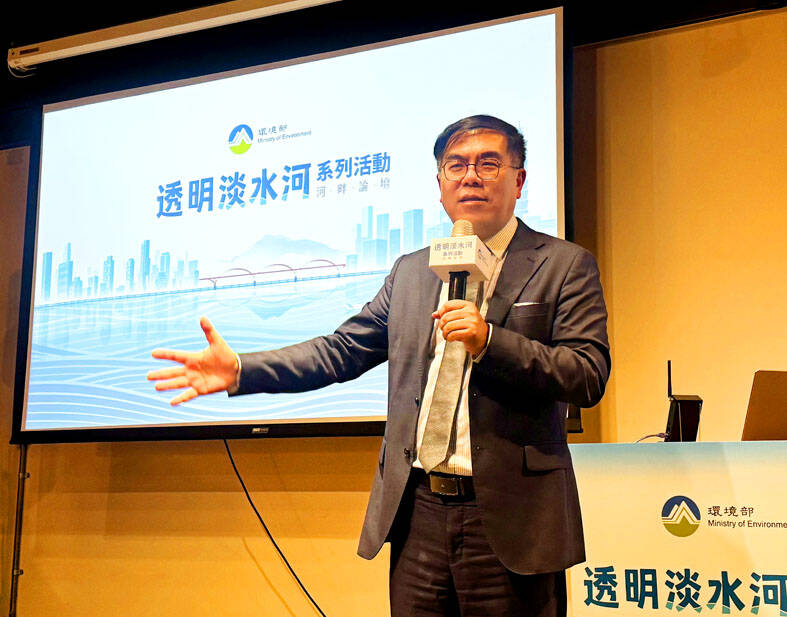
Photo: Huang Yi-ching, Taipei Times
Interception stations were also set up in Taipei and New Taipei City to divert raw sewage in areas without sewers to nearby sewage treatment plants, Yeh said.
The wetlands along the Dahan River were built in the 2000s, when the New Taipei City Government’s Environment Protection Department was promoting on-site treatment of wastewater, he said.
These sites are not just for treating and discharging sewage into the Tamsui River system, they are also linked to wetlands in Taipei’s Guandu District (關渡), forming an ecological corridor, Yeh added.
He also called on people not to discard rubbish around rivers, especially near mangrove forests.
The garbage would drift into the river when the tide comes into the forest and is difficult to collect, as the land gets too muddy, Yeh said, adding that the government would try to resolve such issues through public-private cooperation.
The Tamsui River does not smell as bad as before, and the government would continue to improve the river’s water quality to achieve its next target: to allow people to engage in more water activities in the river, he said.
Water Quality Protection Department Diretor-General Wang Yue-bin (王嶽斌) said the overall quality of the Tamsui River has improved by more than 50 percent since 2002, with its average river pollution index decreasing from 4.4 that year to 2.1 last year.
Ecosystems near the Tamsui River’s branches have gradually recovered, including those of various big fishes and mitten crabs in the Sindian River (新店溪) and great cormorants around the Keelung River (基隆河), he said.
In related news, the ministry yesterday invited the European Economic and Trade Office (EETO) and the Ministry of Sports to participate in a mountain cleanup hike on New Taipei City’s Guanyin Mountain (觀音山).
Attendees included Vice President Hsiao Bi-khim (蕭美琴), Minister of Foreign Affairs Lin Chia-lung (林佳龍), Minister of Environment Peng Chi-ming (彭啟明), Minister of Sports Lee Yang (李洋), and more than 200 officials from nine EU member states’ representative offices in Taiwan and other governmental personnel.
Hsiao said in her address that people from Taiwan and the EU took part in the hike together to demonstrate the shared values of sustainability, health and environmental protection.
“Our common goal is to build a more sustainable Earth for future generations,” she said, expressing thanks to the EU for continuing to deepen bilateral ties through years of beach cleanup initiatives and this year’s mountain cleanup event.
EETO Director Lutz Gullner said the mountain cleanup aimed to send a signal to the world about the importance of environmental protection, with participants following the low-carbon, sustainable principle to finish the hike.
The EU and its member states have long been working closely with Taiwan in environmental protection, as both sides have common values and visions, he added.
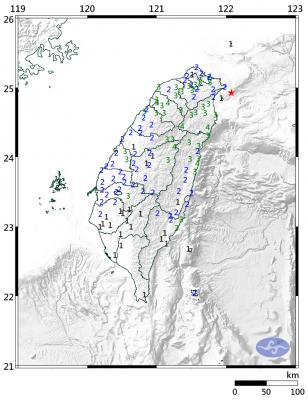
A magnitude 6.1 earthquake struck off the coast of Yilan County at 8:39pm tonight, the Central Weather Administration (CWA) said, with no immediate reports of damage or injuries. The epicenter was 38.7km east-northeast of Yilan County Hall at a focal depth of 98.3km, the CWA’s Seismological Center said. The quake’s maximum intensity, which gauges the actual physical effect of a seismic event, was a level 4 on Taiwan’s 7-tier intensity scale, the center said. That intensity level was recorded in Yilan County’s Nanao Township (南澳), Hsinchu County’s Guansi Township (關西), Nantou County’s Hehuanshan (合歡山) and Hualien County’s Yanliao (鹽寮). An intensity of 3 was
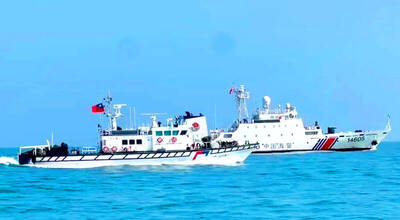
Instead of focusing solely on the threat of a full-scale military invasion, the US and its allies must prepare for a potential Chinese “quarantine” of Taiwan enforced through customs inspections, Stanford University Hoover fellow Eyck Freymann said in a Foreign Affairs article published on Wednesday. China could use various “gray zone” tactics in “reconfiguring the regional and ultimately the global economic order without a war,” said Freymann, who is also a nonresident research fellow at the US Naval War College. China might seize control of Taiwan’s links to the outside world by requiring all flights and ships entering or leaving Taiwan

The next minimum wage hike is expected to exceed NT$30,000, President William Lai (賴清德) said yesterday during an award ceremony honoring “model workers,” including migrant workers, at the Presidential Office ahead of Workers’ Day today. Lai said he wished to thank the awardees on behalf of the nation and extend his most sincere respect for their hard work, on which Taiwan’s prosperity has been built. Lai specifically thanked 10 migrant workers selected for the award, saying that although they left their home countries to further their own goals, their efforts have benefited Taiwan as well. The nation’s industrial sector and small businesses lay
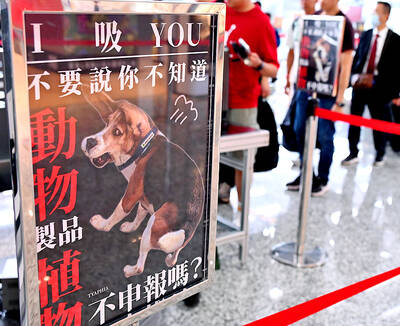
Quarantine awareness posters at Taiwan Taoyuan International Airport have gone viral for their use of wordplay. Issued by the airport branch of the Animal and Plant Health Inspection Agency, the posters feature sniffer dogs making a range of facial expressions, paired with advisory messages built around homophones. “We update the messages for holidays and campaign needs, periodically refreshing materials to attract people’s attention,” quarantine officials said. “The aim is to use the dogs’ appeal to draw focus to quarantine regulations.” A Japanese traveler visiting Taiwan has posted a photo on X of a poster showing a quarantine dog with a


 RSS
RSS