


The Ministry of Transportation and Communications (MOTC) said it plans to launch Cycling Route No. 2 (自行車環島2號線) next year, aiming to connect distinctive scenic spots and local scenery, and to promote Taiwan internationally as a cycling destination.
Cycling Route No. 1 (自行車環島1號線), which opened in 2015, spans about 961km along provincial highways 1 and 9, and is supplemented by 25 branch lines and 14 connecting lines, bringing the total network length to 2,690km, with rest stations about every 20km.
However, some sections remain poorly connected, with elevation differences where riverside paths meet regular roads, posing safety risks for riders. To improve the network, the ministry launched a project to upgrade the route and integrate an array of pathways, along with soft and hard infrastructure.
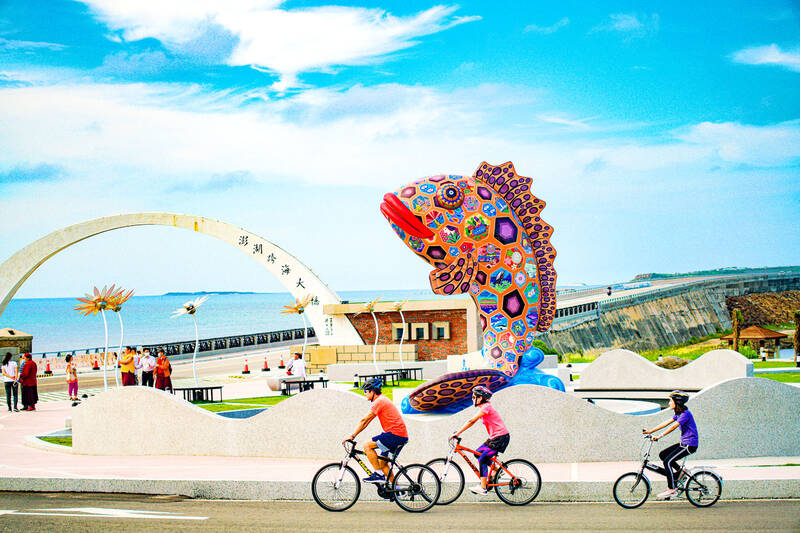
Photo courtesy of the Tourism Administration
The first phase, from 2020 to 2023, had a budget of NT$2.619 billion (US$83.39 million), while the second phase, spanning last year to 2027, is allocated NT$5.775 billion, for a combined investment of NT$8.394 billion to enhance the cycling environment.
The first phase upgraded 1,028.3km of the network and added 16 new diverse cycling routes in national scenic areas.
The second phase aims to improve the cycling route’s environment, such as fixing the missing link on Provincial Highway No. 2 between Tamsui (淡水) and Shihcheng (石城), and connecting New Taipei’s Bali District (八里) with Taoyuan’s Guanyin District’s (觀音) coastal bicycle corridor.
Local governments are granted NT$2.428 billion of the budget to improve their cycling routes.
Deputy Minister of Transportation and Communications Chen Yen-po (陳彥伯) said Cycling Route No. 1 is situated mostly along provincial highways, emphasizing speed and efficiency for cycling enthusiasts.
Cycling Route No. 2 would highlight scenic spots and local scenery, and integrate existing branch lines, alternative routes, connecting lines and diverse routes, he said, adding that the focus would be international promotion.
Preliminary plans suggest the route would be heavily centered on scenic experiences, people familiar with the matter said.
The Yilan-to-Miaoli section would hug the coastline, taking riders past surfing hotspot Waiao Beach (外澳沙灘), Taiwan’s easternmost point at Cape Santiago Lighthouse (三貂角), Heping Island (和平島) and the northernmost point at Cape Fugui Lighthouse (富貴角), showcasing sweeping ocean views, the ministry said.
The Hsinchu-Miaoli section would incorporate Sinwu District’s (新屋) Green Corridor and link it to the “most beautiful bicycle path in northern Taiwan” — the 17km Hsinchu coastal route — passing the Nanliao Fishing Harbor (南寮漁港), the Nanliao Stairway and the Crab Watching Boardwalk in Xiangshan District (香山), offering food, fun and scenery, it said.
From Taichung to Pingtung, the network would connect routes such as the Jiahou to Taohsiang (甲后稻香) diverse cycling route, the Green Sky Corridor and the Pingtung railway cycling path, giving cyclists views of rural landscapes, tea plantations, canal scenery, railway heritage and spectacular sunsets, the ministry said.
The Hualien-Taitung section would mainly follow the Huadong Valley (East Rift Valley, 花東縱谷), allowing cyclists to experience the valley’s mountains and rivers, and the warm hospitality of eastern Taiwan, it said.
To promote bicycle tourism, the Tourism Administration has since 2010 organized the Taiwan Cycling Festival, which has 10 major events.
The Taiwan King of the Mountain Challenge is internationally recognized as a grueling route, with foreign participation rising from about 20 percent in early years to 56 percent last year, the ministry said.
The Formosa 900 event also draws many international cyclists, while the Sun Moon Lake (日月潭) biking carnival, the Penghu Island-Hopping 101K Cycling Event and the Extreme Slow Travel tour are steadily gaining fame, it added.
Taiwan last year also hosted a Tour de France event for the first time, attracting more than 3,000 domestic and foreign participants, the ministry said, adding that the event was a milestone in cooperation between the Tourism Administration and private organizers.
The Tourism Administration cited data as showing that cycling events it organized or subsidized drew about 27,700 participants in 2020, generating roughly NT$117 million in tourism revenue.
Participation last year rose to about 89,500 people, generating NT$338 million in tourism revenue, the data showed.

FUKUOKA SITUATION: Japanese media reported that the pathogen is expected to be identified by the summer, while the CDC downplayed the idea that it was hMPV A “mysterious cold-like illness” reported in Japan’s Fukuoka Prefecture does not seem to be a new disease, but Japanese authorities have been asked about the situation, the Centers for Disease Control (CDC) said yesterday. The Fukuoka Prefectural Medical Association on Wednesday told a news conference that a “mystery cold” that has become a hot topic on social media is “highly likely to be caused by some kind of viral infection,” Japan’s KBC News reported. “Many people are experiencing symptoms starting with a sore throat, followed by a runny nose, phlegm and a severe cough,” KBC News reported, citing association officials. Health authorities are

Nvidia Corp CEO Jensen Huang (黃仁勳) arrived in Taiwan yesterday ahead of upcoming AI and technology events, saying he plans to meet with clients and Taiwan Semiconductor Manufacturing Co Chairman C.C. Wei (魏哲家) during his visit. After landing at Taipei Songshan Airport, Huang posed for photos with fans and handed out Yakult drinks to reporters and supporters waiting at the scene, saying he has “a lot to do” during the trip. Asked about reports that Nvidia’s planned headquarters site in Taipei’s Beitou Shilin Technology Park could break ground on May 27, Huang said that if the company holds an event, he would

The Ministry of Finance this afternoon announced the winning numbers for the March-April uniform invoice lottery. The winning number for the NT$10 million (US$318,060) special prize is 19531471, and the winning number for the NT$2 million grand prize is 85941329. Three numbers were drawn for the NT$200,000 first prize: 07225810, 20231230 and 83518781. Those with receipts matching the last seven digits of any of the first-prize numbers will win the NT$40,000 second prize, while those matching the last six digits will win the NT$10,000 third prize. Those whose receipts match the last five digits of the first-prize numbers can claim the NT$4,000 fourth prize,

SIX SUBSIDIES: The monthly allowance for older farmers is to increase to NT$10,000, and NT$5,000 is to be given to homemakers under the national pension system, Lai said The government is to implement major welfare policies for disadvantaged groups, including raising the monthly allowance for older farmers to NT$10,000 and providing homemakers with NT$5,000 per month, President William Lai (賴清德) said yesterday. Lai made the remarks during a visit to Wangling Temple in Chiayi County, saying that the planned increases were being introduced amid economic growth and an increase in tax revenue. Touting a policy, in which the government plans to provide a monthly allowance of NT$5,000 for every child under the age of 18 in a bid to address Taiwan’s low birthrate, Lai said that if received for the


 RSS
RSS