


The Democratic Progressive Party (DPP) is countering the opposition’s proposed legislation for absentee voting with a proposal for two consecutive days off around elections.
The Chinese Nationalist Party (KMT) and the Taiwan People’s Party (TPP) caucuses have proposed separate versions of a draft absentee voting act, allowing those who are not at their registered residence to be eligible for a single transferable vote or to vote in designated areas.
According to the KMT caucus, nationwide long-term statistics show that as many as 2 million people work or study away from home and cannot return to vote, adding that indigenous voters in particular have a high need for absentee voting.
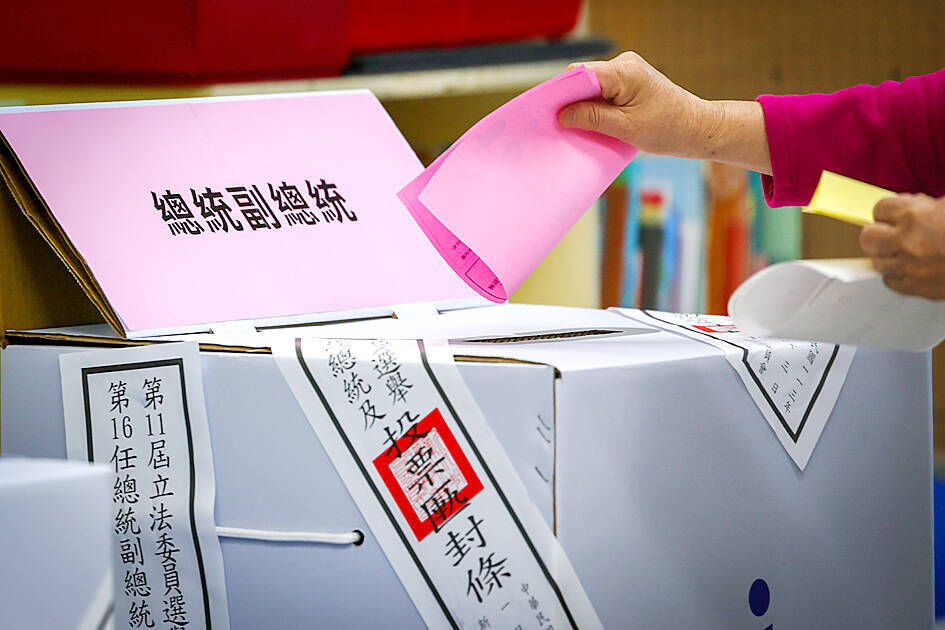
Photo: CNA
The KMT urged the DPP to be a responsible government and not to engage in smear campaigns or create conflict among the public, adding that its proposal sought to uphold the principle of equal rights for people by ensuring every citizen’s right to vote.
Saying that the DPP’s opposition to absentee voting stems from concerns that absentee voting in China could come under pressure from external forces and undermine voting fairness, the KMT caucus added its version excludes people “in foreign countries and China.”
There is no question of possible intervention from external forces, it said.
The TPP caucus has listed its proposed absentee voting bill as a priority for this legislative session. Its draft states that absentee voting would be carried out through transferred voting or voting at designated locations.
The TPP caucus likewise said that its version of absentee voting applies only to domestic transfer voting, limited to Taiwan proper, Penghu, Kinmen and Matsu, and does not extend overseas.
Under the Public Officials Election and Recall Act (公職人員選舉罷免法) and the Referendum Act (公民投票法), election, recall, and referendum voting days are each designated as a one-day holiday.
The DPP caucus has drafted a “democratic voting promotion act,” which on Friday was forwarded to the legislature’s Interior Committee for review.
The DPP’s counterproposal states that the day of the vote and the day before elections, recalls, and referendums should be considered off days, and that local governments and corporations should encourage people to return to their registered residences to vote.
Local governments should establish regulations that allow citizens returning to their registered residence to vote from the location where they work, with transport subsidies or other assistance, the draft act says.
It states that national exams should not take place on voting day or the day prior, and that the central and local governments should assist people with physical or mental disabilities in exercising their voting rights.
Local governments should assist pregnant women, child carers, elderly people, those under guardianship or requiring assistance, and guardians or assistants as they vote, it says.
DPP caucus secretary-general Chen Pei-yu (陳培瑜) said yesterday that China has gone through great lengths to place agents in Taiwan whose job was to spread Chinese views.
Absentee voting is risky, as personal information could be leaked when ballots are moved or if voting booths are moved to other locations, she said, adding that if booths have only one voter, the secrecy of their vote cannot be guaranteed.
The DPP caucus has proposed an alternative that is both low-risk and promotes voting, aiming to make a tangible impact for the people, she said.
Additional reporting by Lin Che-yuan

The Ministry of Finance this afternoon announced the winning numbers for the March-April uniform invoice lottery. The winning number for the NT$10 million (US$318,060) special prize is 19531471, and the winning number for the NT$2 million grand prize is 85941329. Three numbers were drawn for the NT$200,000 first prize: 07225810, 20231230 and 83518781. Those with receipts matching the last seven digits of any of the first-prize numbers will win the NT$40,000 second prize, while those matching the last six digits will win the NT$10,000 third prize. Those whose receipts match the last five digits of the first-prize numbers can claim the NT$4,000 fourth prize,

SIX SUBSIDIES: The monthly allowance for older farmers is to increase to NT$10,000, and NT$5,000 is to be given to homemakers under the national pension system, Lai said The government is to implement major welfare policies for disadvantaged groups, including raising the monthly allowance for older farmers to NT$10,000 and providing homemakers with NT$5,000 per month, President William Lai (賴清德) said yesterday. Lai made the remarks during a visit to Wangling Temple in Chiayi County, saying that the planned increases were being introduced amid economic growth and an increase in tax revenue. Touting a policy, in which the government plans to provide a monthly allowance of NT$5,000 for every child under the age of 18 in a bid to address Taiwan’s low birthrate, Lai said that if received for the
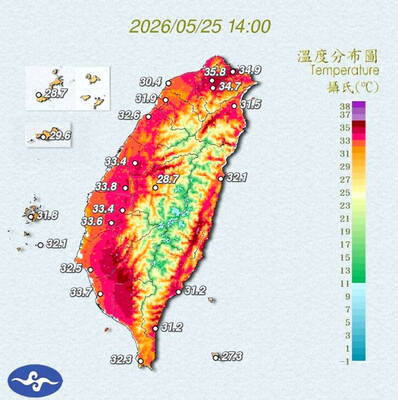
STAY COOL: The HPA recommended that people stay hydrated, use air-conditioning or fans while indoors, wear loose-fitting clothes and walk in the shade while outdoors Employers must implement measures such as installing cooling equipment, and providing drinking water and rest breaks for outdoor workers starting from Monday next week, the Taipei Department of Labor said on Sunday. Employers who fail to comply could face fines of NT$30,000 to NT$300,000 under the Occupational Safety and Health Act (職業安全衛生法), the department said. Businesses in Taipei employing fewer than 100 workers, as well as registered self-employed workers with labor insurance coverage, could receive on-site assessments and guidance from occupational safety consultants to help them apply for central government subsidies to implement or improve heat-protection measures, it said. Under the Ministry of
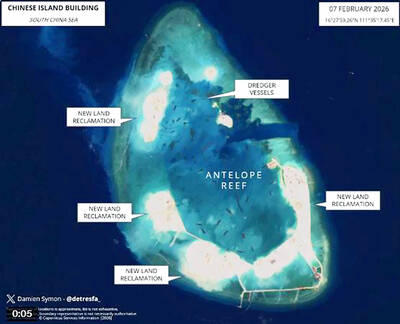
ISOLATION: The outposts would serve as support and backup bases, forcing US forces to either face China head-on or reroute, increasing travel time and operational costs China’s outposts in the South China Sea could be used to delay and constrain foreign forces during a conflict in the Taiwan Strait, giving Beijing a critical window to carry out amphibious landing and blockade operations, a report said. The Chinese Communist Party’s (CCP) forward operating bases on islands and reclaimed features in the South China Sea could delay foreign forces long enough for the Chinese People’s Liberation Army (PLA) to secure a key 48-to-72-hour window in the Taiwan Strait, a report commissioned by the Mainland Affairs Council found. The report, conducted by the Institute for National Defense and Security Research, examined


 RSS
RSS