


A "Taiwan dome alliance" would be set up to help implement a civilian defense system, civil groups including the Taiwan Society North told a news conference in Taipei yesterday.
Taiwan Society North president Lo Chun-hsuan (羅浚晅) said that more than 50 pro-Taiwan organizations would form the alliance and give full backing to a government plan to invest more in defense-related industries.
President William Lai (賴清德) outlined the proposed defense spending bill on Wednesday.
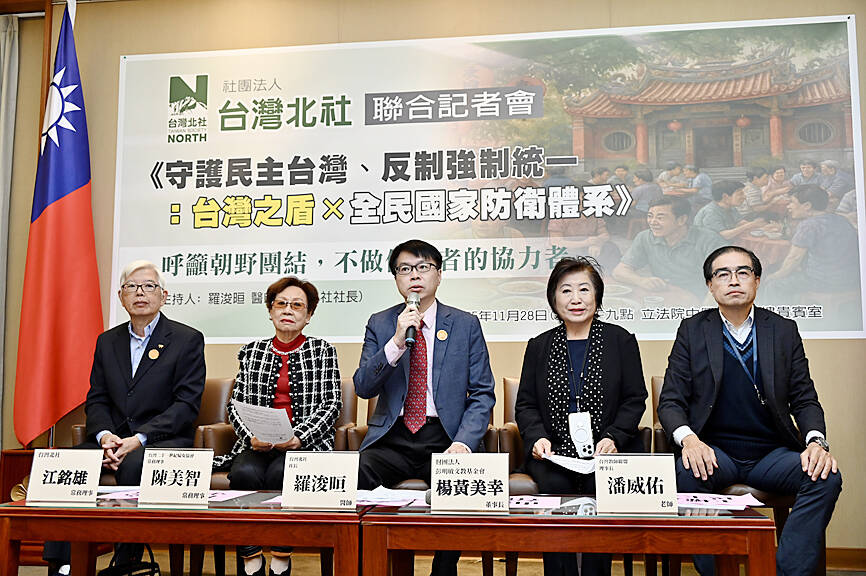
Photo: George Tsorng, Taipei Times
Lai previously announced plans for a “Taiwan dome” missile defense system. The plan is for a multi-layered defense system with high-level detection and effective interception to protect the nation from potential attack.
Beijing has instigated an onslaught of propaganda to turn democratic Taiwan into “China’s Taiwan,” while some people in Taiwan are promoting Beijing’s agenda, touting the “one country, two systems” and “peaceful unification” models, Lo said.
“It is not mere political rhetoric, but would destroy Taiwan’s democracy from within,” he said. “We must deal with such comments in accordance with the law, punishing those who collude with foreign forces to dismantle our country.”
The nation needs the Taiwan dome, and Taiwanese must learn about history and be discerning of media, Union of Taiwanese Teachers vice president Pan Wei-you (潘威佑) said.
“It is vital that young people understand that it was not easy for Taiwan to gain its freedom and democracy,” Pan said.
National security expert Chen Wen-chia (陳文甲) said Lai’s plan to defend democracy would turn a strategic concept into action items, eliminating the “passive defense” mode.
Lai’s proposed NT$1.25 trillion (US$39.8 billion) special defense budget bill to develop Taiwan’s capabilities in asymmetrical warfare and artificial intelligence-enhanced defense systems symbolizes the start of a new era of “defense of democracy combined with applied high-technology to safeguard Taiwan,” Chen said.
After the news conference, Lo led a march to the Mainland Affairs Council to demand punitive action against Chien Li (錢麗), a Chinese living in Taiwan who has publicly urged Beijing to forcefully unify with Taiwan.
“We must not have people colluding with the enemy state and calling for the destruction of Taiwan,” Lo said.
“The government must apply national security laws governing residency requirements for Chinese and not allow them to stay if they create societal strife,” he said.

REASONS FOR TRAVEL: An assistant professor said that proposed amendments to penalize drivers if they used drugs overseas would not deter people from traveling People who operate a motor vehicle under the influence of marijuana would have their driver’s license revoked, even if they used the substance while overseas, the Ministry of Transportation and Communications said yesterday, citing proposed amendments to the Road Traffic Management and Penalty Act (道路交通管理處罰條例). The amendments would also authorize the government to revoke the licenses of people determined to have used Category 1 or Category 2 narcotics, even if they were not operating a vehicle while under the influence of drugs, as well as ban them from taking the license test for three years, the ministry said. People aged 18 or

GLOBALGIVING: ‘ Caving to external pressure is not acceptable for an organization that has cultivated justice reform and human rights for 30 years,’ one NGO said A slew of non-government organizations (NGOs) have withdrawn from the GlobalGiving fundraising platform after it announced it would use “Chinese Taipei” instead of “Taiwan” from next month. The Taiwan Good Rice Association wrote on Facebook on Friday that it was informed on April 28 via a teleconference call of the change, which was made because the platform wanted to operate in China. Taiwan Good Rice is to terminate all cooperative relationships with GlobalGiving in response to the platform’s “unilateral and non-negotiable” decision to remove references to Taiwan, the NGO said. “Taiwan is in the official name of Taiwan Good Rice Association and the

HEAVY WEATHER: Typhoon Jangmi is due to crash straight into the Ryukyus as airlines look to shift flights to larger aircraft or cancel flights to Okinawa entirely Taiwan’s international air carriers announced flight adjustments over the weekend as Typhoon Jangmi is forecast to hit the Ryukyu Islands today and tomorrow. The Central Weather Administration (CWA) upgraded Jangmi from a tropical storm to a typhoon at 8am yesterday, with the eye located 580km south of Naha city. It was moving north at 19kph. Today, China Airlines’ CI-120, CI-121, CI-122 and CI-123 flights between Taoyuan and Naha, Okinawa, have been canceled as well as CI-132 and CI-133 between Kaohsiung and Naha. EVA Air’s BR-112, BR-113, BR-186 and BR-185 flights between Taoyuan and Naha are also canceled. Low-cost carrier Tigerair Taiwan canceled IT-230,
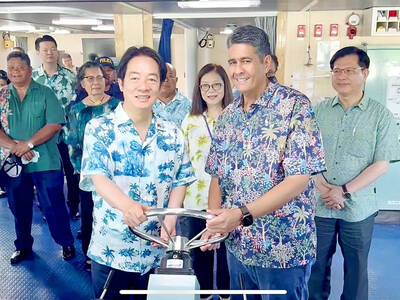
MULTIPRONGED APPROACH: China has sought to pressure Palau across a number of fronts, but the island nation has staunchly resisted overtures to ditch Taiwan Palau has been firm in backing Taiwan despite Chinese pressure that uses tourism economics, cyberattacks and criminal infiltration as tools to threaten the Pacific ally into renouncing its recognition of Taiwan as a sovereign state. The Presidential Office yesterday announced that Vice President Hsiao Bi-khim (蕭美琴) would visit Palau from Saturday to Wednesday next week at the invitation of Palauan President Surangel Whipps Jr. Whipps in April said in an interview that China had outspokenly asked Palau to “denounce Taiwan.” “And we have said: ‘We have no enemies, but nobody tells us who our friends are,’” he said. Whipps has told reporters multiple times


 RSS
RSS