


Representative to Japan Lee Yi-yang (李逸洋) yesterday thanked the Japanese public for "understanding the differences between Taiwanese and Chinese people" following official comments rejecting the term "Taiwan Province."
Lee, posting via the Taipei Economic and Cultural Representative Office in Japan’s X account, cited recent survey data showing 74.5 percent of Japanese respondents feel an affinity toward Taiwan, while a 2024 poll found 89 percent hold negative views of China.
"We sincerely appreciate that Japanese people do not conflate Taiwan with China," he wrote.
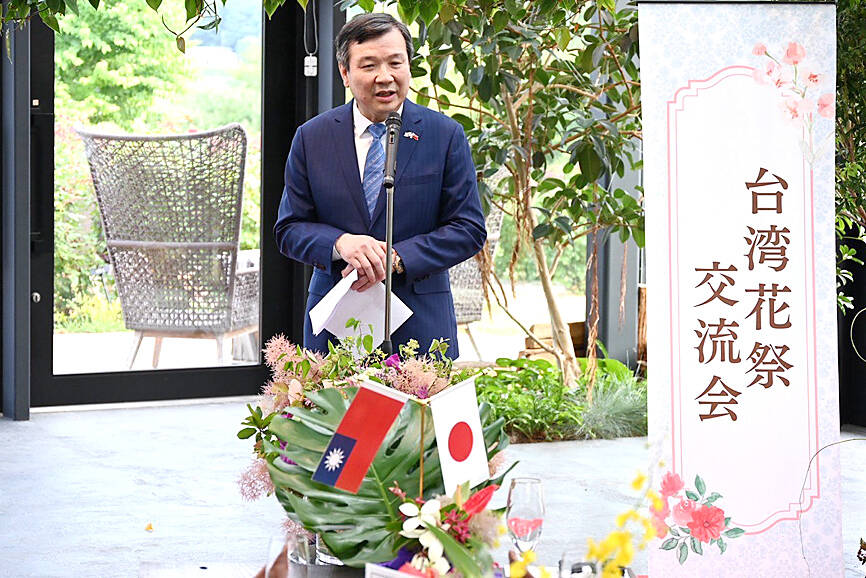
Photo: CNA
His remarks followed a Wednesday post by the office stating, "Taiwan is Taiwan, not Taiwan Province."
As of last night, that post attracted 2.9 million views, about 91,000 likes, and nearly 1,000 comments, with many Japanese users expressing support.
The message was seen as a response to a post on X by Chinese Ambassador to Japan Wu Jianghao (吳江浩) on Tuesday, which stated that "people from all sectors in Taiwan Province are demanding that Sanae Takaichi apologize for her erroneous remarks," while sharing a news clip by Chinese state broadcaster CCTV carrying the same headline.
The "erroneous remarks" referred to Japanese Prime Minister Takaichi’s Nov. 7 statement in parliament that a Chinese naval blockade of Taiwan could constitute a "survival-threatening situation" for Japan, according to the Asahi Shimbun.
"If warships are used and armed actions are involved, I think it may count," she was quoted as saying, adding the government would judge such situations case by case.
Under Japan’s security laws, such a scenario enables the use of "collective self-defense" if an attack on the United States or another closely related country is deemed to threaten Japan’s survival, even without a direct attack on Japan.

A magnitude 6.1 earthquake struck off the coast of Yilan County at 8:39pm tonight, the Central Weather Administration (CWA) said, with no immediate reports of damage or injuries. The epicenter was 38.7km east-northeast of Yilan County Hall at a focal depth of 98.3km, the CWA’s Seismological Center said. The quake’s maximum intensity, which gauges the actual physical effect of a seismic event, was a level 4 on Taiwan’s 7-tier intensity scale, the center said. That intensity level was recorded in Yilan County’s Nanao Township (南澳), Hsinchu County’s Guansi Township (關西), Nantou County’s Hehuanshan (合歡山) and Hualien County’s Yanliao (鹽寮). An intensity of 3 was
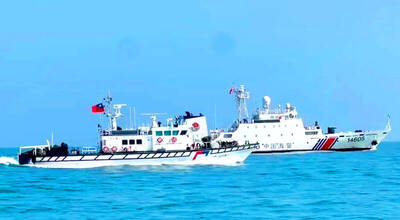
Instead of focusing solely on the threat of a full-scale military invasion, the US and its allies must prepare for a potential Chinese “quarantine” of Taiwan enforced through customs inspections, Stanford University Hoover fellow Eyck Freymann said in a Foreign Affairs article published on Wednesday. China could use various “gray zone” tactics in “reconfiguring the regional and ultimately the global economic order without a war,” said Freymann, who is also a nonresident research fellow at the US Naval War College. China might seize control of Taiwan’s links to the outside world by requiring all flights and ships entering or leaving Taiwan

The next minimum wage hike is expected to exceed NT$30,000, President William Lai (賴清德) said yesterday during an award ceremony honoring “model workers,” including migrant workers, at the Presidential Office ahead of Workers’ Day today. Lai said he wished to thank the awardees on behalf of the nation and extend his most sincere respect for their hard work, on which Taiwan’s prosperity has been built. Lai specifically thanked 10 migrant workers selected for the award, saying that although they left their home countries to further their own goals, their efforts have benefited Taiwan as well. The nation’s industrial sector and small businesses lay
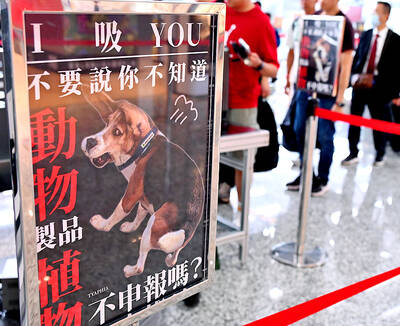
Quarantine awareness posters at Taiwan Taoyuan International Airport have gone viral for their use of wordplay. Issued by the airport branch of the Animal and Plant Health Inspection Agency, the posters feature sniffer dogs making a range of facial expressions, paired with advisory messages built around homophones. “We update the messages for holidays and campaign needs, periodically refreshing materials to attract people’s attention,” quarantine officials said. “The aim is to use the dogs’ appeal to draw focus to quarantine regulations.” A Japanese traveler visiting Taiwan has posted a photo on X of a poster showing a quarantine dog with a


 RSS
RSS