


Most respondents questioned whether Taiwan has sufficient defense capacity amid increased geopolitical risks, while a majority believed Chinese infiltration is severe, the Taiwan Inspiration Association said yesterday, citing a survey.
The poll showed that 65 percent doubted the sufficiency of Taiwan’s defense capacity, while 61.7 percent believed Chinese infiltration is severe, the association said.
Thirty-three percent of respondents believed Taiwan’s defense capacity is enough, while among those who disagreed, 27.8 percent said it was “very insufficient” and 37.2 percent said it was “insufficient,” the poll showed.
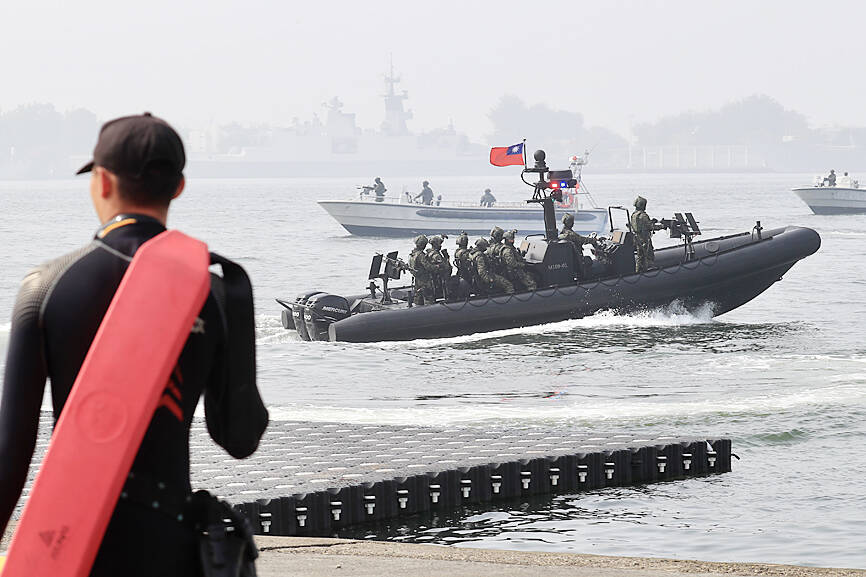
Photo: Ritchie B. Tongo, EPA-EFE
In the 30-to-49 age group, 70 percent said defense capacity is insufficient, it showed.
Broken down by political preference, 63.8 percent of respondents who backed the Democratic Progressive Party (DPP) said defense capacity is lacking, while the rate was 64 percent among those who backed the Chinese Nationalist Party (KMT) and 74 percent for those who supported the Taiwan People’s Party (TPP), it showed.
Asked why they believed Taiwan’s defense capacity is insufficient, 30.7 percent said “insufficient arms,” while 37.3 percent said “insufficient personnel” and 30.4 percent said “insufficient international support,” the poll showed.
Chen Fang-yu (陳方隅), an associate professor of political science at Soochow University, said that confidence in the armed forces would influence determination regarding national defense.
Asked whether they were confident that the US would send troops to Taiwan in a cross-strait conflict, 36.9 percent said “yes,” while 60.9 percent said “no,” the poll showed.
Among KMT and TPP supporters, the rate was in excess of 80 percent, while 34.8 percent of DPP supporters said they did not believe that the US would help defend Taiwan, it showed.
The willingness of Washington to send troops to help defend Taiwan has lost relevance when assessing the determination of Taiwanese to defend the nation, Chen said.
Asked about Chinese infiltration in Taiwan, 61.7 percent of respondents said that it was “severe,” while 36.4 percent said it was “not severe,” the poll showed.
Among respondents who said infiltration was severe, 36.5 percent backed the KMT, 40.5 percent backed the TPP and 86.4 percent backed the DPP, it showed.
“Social media platforms and online remarks” was the category most commonly linked to Chinese infiltration tactics at 70 percent, while 45.9 percent cited media and 16 percent said it was inviting village or borough wardens to tour China, the poll showed.
Asked about approval rates for the government, 53.5 percent said they were satisfied with its performance, while 45.8 percent were not satisfied, it showed.
Among those who were unsatisfied, 51.1 percent said it was due to “political fighting,” while 42.2 percent said it was “scams” and 23.4 percent said it was “cost of living” issues, the poll showed
Wang Hung-jen (王宏仁), a professor of political science at National Cheng Kung University, said that political fighting is irrelevant when assessing the government, as it should be focused on policies.
Political fighting involves the ruling and opposition parties, Wang said, adding that the poll showed people are unhappy with tensions between the ruling and opposition parties, including over how the national budget bill was boycotted.
Regarding the domestic economy, 45.9 percent of respondents said it was good, while 54 percent said it was not good, the poll showed.
Asked why they thought the economy was not good, 47.7 percent cited the high cost of living, with high housing prices and low incomes blamed to a lesser extent, it showed.
The results show that the high cost of living is what most people want the government to fix most, not the cross-strait relationship, Wang said.
The telephone poll garnered 1,200 valid samples from people aged 20 or older nationwide. It was conducted from Nov. 3 to Nov. 8 and has a margin of error of 2.83 percentage points.

A magnitude 6.1 earthquake struck off the coast of Yilan County at 8:39pm tonight, the Central Weather Administration (CWA) said, with no immediate reports of damage or injuries. The epicenter was 38.7km east-northeast of Yilan County Hall at a focal depth of 98.3km, the CWA’s Seismological Center said. The quake’s maximum intensity, which gauges the actual physical effect of a seismic event, was a level 4 on Taiwan’s 7-tier intensity scale, the center said. That intensity level was recorded in Yilan County’s Nanao Township (南澳), Hsinchu County’s Guansi Township (關西), Nantou County’s Hehuanshan (合歡山) and Hualien County’s Yanliao (鹽寮). An intensity of 3 was
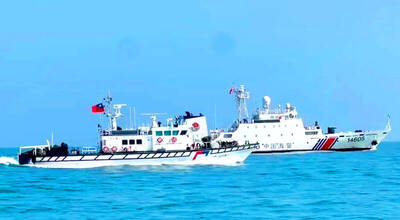
Instead of focusing solely on the threat of a full-scale military invasion, the US and its allies must prepare for a potential Chinese “quarantine” of Taiwan enforced through customs inspections, Stanford University Hoover fellow Eyck Freymann said in a Foreign Affairs article published on Wednesday. China could use various “gray zone” tactics in “reconfiguring the regional and ultimately the global economic order without a war,” said Freymann, who is also a nonresident research fellow at the US Naval War College. China might seize control of Taiwan’s links to the outside world by requiring all flights and ships entering or leaving Taiwan
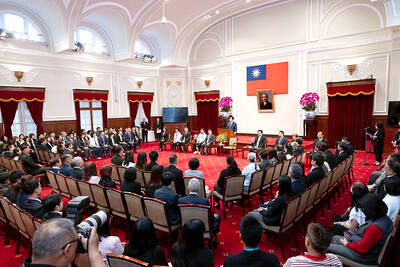
The next minimum wage hike is expected to exceed NT$30,000, President William Lai (賴清德) said yesterday during an award ceremony honoring “model workers,” including migrant workers, at the Presidential Office ahead of Workers’ Day today. Lai said he wished to thank the awardees on behalf of the nation and extend his most sincere respect for their hard work, on which Taiwan’s prosperity has been built. Lai specifically thanked 10 migrant workers selected for the award, saying that although they left their home countries to further their own goals, their efforts have benefited Taiwan as well. The nation’s industrial sector and small businesses lay
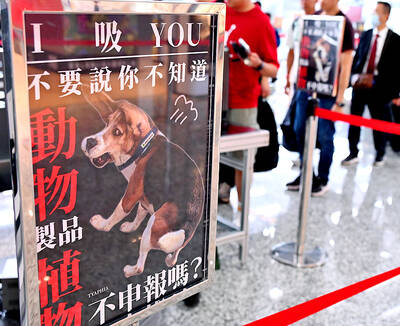
Quarantine awareness posters at Taiwan Taoyuan International Airport have gone viral for their use of wordplay. Issued by the airport branch of the Animal and Plant Health Inspection Agency, the posters feature sniffer dogs making a range of facial expressions, paired with advisory messages built around homophones. “We update the messages for holidays and campaign needs, periodically refreshing materials to attract people’s attention,” quarantine officials said. “The aim is to use the dogs’ appeal to draw focus to quarantine regulations.” A Japanese traveler visiting Taiwan has posted a photo on X of a poster showing a quarantine dog with a


 RSS
RSS