


The government will take measures to protect those listed by the Chinese Communist Party (CCP) as “die-hard separatists” and punish local collaborators, a government official said yesterday.
The comments came after President William Lai (賴清德) on Wednesday announced action plans to defend Taiwan’s democratic systems and invest in national defense, including an NT$1.25 trillion (US$39.9 billion) budget for equipment procurement.
The Executive Yuan would work with the National Security Council to implement countermeasures against Chinese transnational oppression, Lai said.
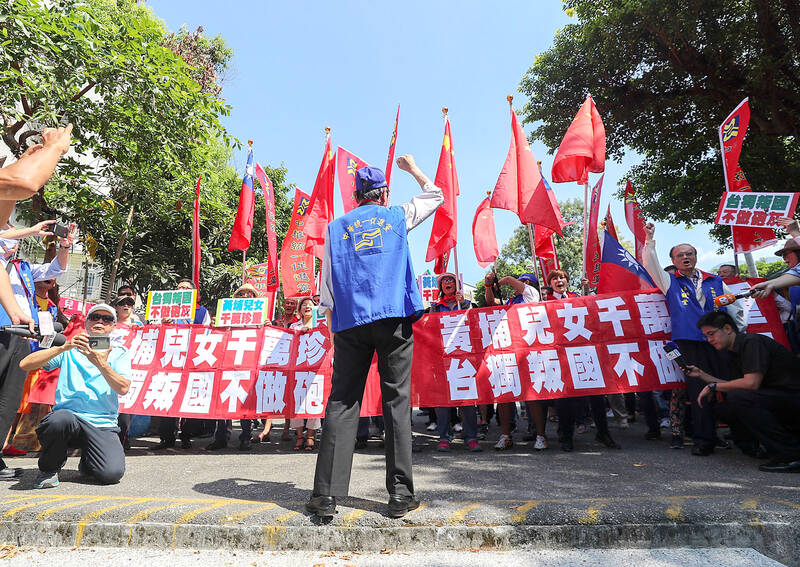
Photo: CNA
The CCP has listed 74 people as “die-hard Taiwanese separatists,” presenting a severe national security threat to Taiwan, an official said yesterday on condition of anonymity.
Government measures would include channels through which people could inform the government of the situation and request protection, and punishments for local actors who hurt Taiwan and their fellow citizens by assisting the CCP in its acts of transnational oppression, they said.
Any person or industry providing China with information regarding “wanted notices” is at risk of contravening the National Security Act (國家安全法), the National Intelligence Services Act (國家情報工作法), the Criminal Code, and the Act Governing Relations Between the People of the Taiwan Area and the Mainland Area (臺灣地區與大陸地區人民關係條例), they added.
The most severe penalty is a seven-year prison sentence, the official said.
Regarding the president’s instructions to expedite passage of legislation related to national defense, the official said policies have been implemented in line with the president’s 17-point national defense directive issued in March.
Executive Yuan spokeswoman Michelle Lee (李慧芝) said the majority of the legislation is being reviewed by the Executive Yuan, and changes would be proposed if necessary.
The Executive Yuan has established a cross-ministerial task force to better address potential scenarios faced by Taiwanese abroad, Lee said, adding that the government would work with international organizations, and foreign friends and allies.
Minister of National Defense Wellington Koo (顧立雄) said China was able to obtain information on “die-hard separatists” due to Taiwan’s transparency.
The Ministry of National Defense is taking steps to protect the identities of its personnel, he said, but added that he was not at liberty to clarify.
Mainland Affairs Council official Tung Yu-yun (董玉芸) said China has no jurisdiction over Taiwan, and that its transnational oppressive actions contravene international accords.
The government will protect its citizens’ safety and severely punish those who aid and abet China, Tung said.
The 74 “separatists” include former premier Su Tseng-chang (蘇貞昌), former legislative speaker You Si-kun (游錫?), National Security Council Secretary-General Joseph Wu (吳釗燮), Democratic Progressive Party Legislator Puma Shen (沈伯洋), United Microelectronics Corp founder Robert Tsao (曹興誠), and groups such as the Taiwan Foundation for Democracy, the International Cooperation and Development Fund and the Vision Foundation.
The CCP has also issued wanted notices for people in the Taiwanese information, communications and technology sector, accusing them of being hackers and attacking Chinese networks, the official said.
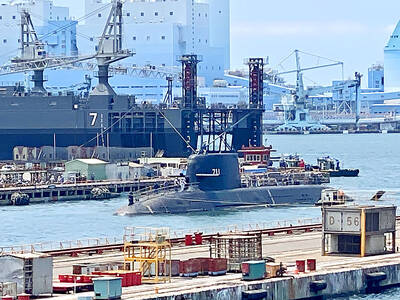
AGING: While Japan has 22 submarines, Taiwan only operates four, two of which were commissioned by the US in 1945 and 1946, and transferred to Taiwan in 1973 Taiwan would need at least 12 submarines to reach modern fleet capabilities, CSBC Corp, Taiwan chairman Chen Cheng-hung (陳政宏) said in an interview broadcast on Friday, citing a US assessment. CSBC is testing the nation’s first indigenous defense submarine, the Hai Kun (海鯤, Narwhal), which is scheduled to be delivered to the navy next month or in July. The Hai Kun has completed torpedo-firing tests and is scheduled to undergo overnight sea trials, Chen said on an SET TV military affairs program. Taiwan would require at least 12 submarines to establish a modern submarine force after assessing the nation’s operational environment and defense

A white king snake that frightened passengers and caused a stir on a Taipei MRT train on Friday evening has been claimed by its owner, who would be fined, Taipei Rapid Transit Corp (TRTC) said yesterday. A person on Threads posted that he thought he was lucky to find an empty row of seats on Friday after boarding a train on the Bannan (Blue) Line, only to spot a white snake with black stripes after sitting down. Startled, he jumped up, he wrote, describing the encounter as “terrifying.” “Taipei’s rat control plan: Release snakes on the metro,” one person wrote in reply, referring
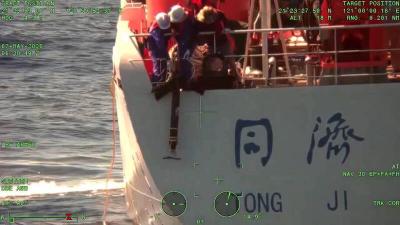
The coast guard today said that it had disrupted "illegal" operations by a Chinese research ship in waters close to the nation and driven it away, part of what Taipei sees a provocative pattern of China's stepped up maritime activities. The coast guard said that it on Thursday last week detected the Chinese ship Tongji (同濟號), which was commissioned only last year, 29 nautical miles (54km) southeast of the southern tip of Taiwan, although just outside restricted waters. The ship was observed lowering ropes into the water, suspected to be the deployment of scientific instruments for "illegal" survey operations, and the coast
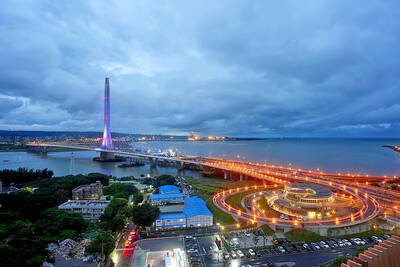
An inauguration ceremony was held yesterday for the Danjiang Bridge, the world’s longest single-mast asymmetric cable-stayed bridge, ahead of its official opening to traffic on Tuesday, marking a major milestone after nearly three decades of planning and construction. At the ceremony in New Taipei City attended by President William Lai (賴清德), Premier Cho Jung-tai (卓榮泰), Minister of Transportation and Communications Chen Shih-kai (陳世凱) and New Taipei City Mayor Hou Yu-ih (侯友宜), the bridge was hailed as both an engineering landmark and a long-awaited regional transport link connecting Tamsui (淡水) and Bali (八里)


 RSS
RSS