


The government is launching the third iteration of its long-term healthcare program ahead of schedule next year, proposing an integrated health policy that would apply to people, animals, plants and the environment, President William Lai (賴清德) said following a meeting of the government’s Healthy Taiwan Promotion Committee yesterday.
The early implementation of the long-term healthcare program is due to Taiwan’s status as a hyper-aged society, Lai said.
The Ministry of Health and Welfare has a detailed plan to address the challenges facing long-term healthcare, so that the elderly can age healthily, remain in their homes, and enjoy hospice and palliative care until their deaths, Lai said.
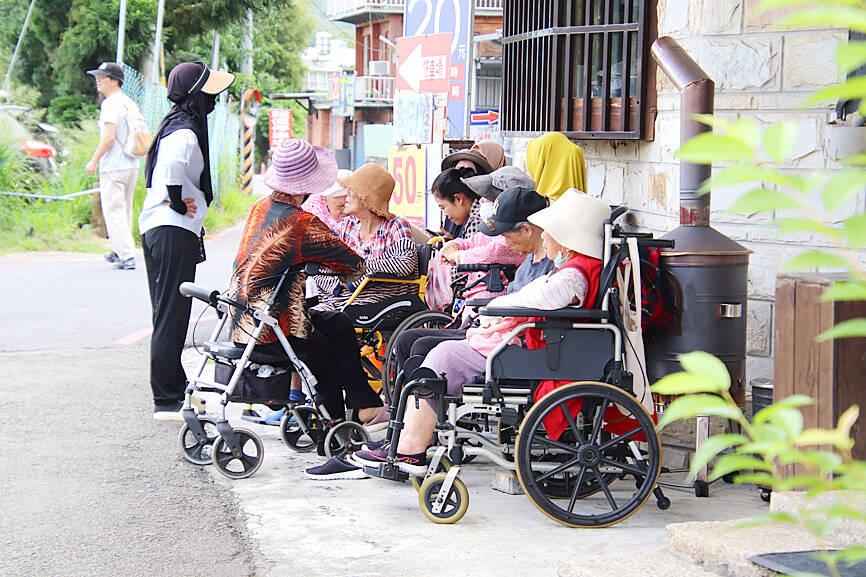
Photo: Huang Mei-chu, Taipei Times
The government should achieve this through forward-looking and effective policies, use of “smart” technology, providing effective support for families of the elderly and empowering care facilities, Lai said.
Deputy Minister of Health and Welfare Lu Chien-te (呂建德) said that the implementation of the long-term healthcare policy next year aims to provide better support for families in need and reduce the number of days between a patient’s hospital discharge and the start of care by the program, which is currently four days, down from 51 when the previous version was first introduced.
The ministry hopes that the transition would be seamless by 2030, Lu said, adding that the interim goal is to reduce the transition period to two days by next year.
Under the revised program, at-home care for acute symptoms would be expanded to provide long-term home health to those in need, Lu said.
In addition to the challenges posed by a hyper-aged society, contagious diseases, climate change and changes to ecological systems have affected the health of not only humans, but also plants and animals, Lai said.
Lai said Taiwan should observe the WHO’s “One Health” concept and recognize that the “health of humans, domestic and wild animals, plants, and the wider environment (including ecosystems) are closely linked and interdependent,” and propose policies and frameworks that would allow the government to better protect Taiwanese.
Deputy Minister of Health and Welfare Chuang Jen-hsiang (莊人祥) said that the ministry has budgeted NT$1.6 billion (US$51.1 million) to observe the “One Health” concept from next year through 2030.
The government has implemented a ministry-level platform to coordinate and develop plans to address the possibility of composite disasters caused by contagious diseases, climate change and antibiotic resistance, which the committee would oversee, he said.
The government would assess Taiwan’s capabilities to prevent contagious diseases and its response speed compared with the rest of the international community to develop precisely crafted policies and systems, Chuang added.
Additional reporting by Chiu Chih-jou

FUKUOKA SITUATION: Japanese media reported that the pathogen is expected to be identified by the summer, while the CDC downplayed the idea that it was hMPV A “mysterious cold-like illness” reported in Japan’s Fukuoka Prefecture does not seem to be a new disease, but Japanese authorities have been asked about the situation, the Centers for Disease Control (CDC) said yesterday. The Fukuoka Prefectural Medical Association on Wednesday told a news conference that a “mystery cold” that has become a hot topic on social media is “highly likely to be caused by some kind of viral infection,” Japan’s KBC News reported. “Many people are experiencing symptoms starting with a sore throat, followed by a runny nose, phlegm and a severe cough,” KBC News reported, citing association officials. Health authorities are

Nvidia Corp CEO Jensen Huang (黃仁勳) arrived in Taiwan yesterday ahead of upcoming AI and technology events, saying he plans to meet with clients and Taiwan Semiconductor Manufacturing Co Chairman C.C. Wei (魏哲家) during his visit. After landing at Taipei Songshan Airport, Huang posed for photos with fans and handed out Yakult drinks to reporters and supporters waiting at the scene, saying he has “a lot to do” during the trip. Asked about reports that Nvidia’s planned headquarters site in Taipei’s Beitou Shilin Technology Park could break ground on May 27, Huang said that if the company holds an event, he would

The Ministry of Finance this afternoon announced the winning numbers for the March-April uniform invoice lottery. The winning number for the NT$10 million (US$318,060) special prize is 19531471, and the winning number for the NT$2 million grand prize is 85941329. Three numbers were drawn for the NT$200,000 first prize: 07225810, 20231230 and 83518781. Those with receipts matching the last seven digits of any of the first-prize numbers will win the NT$40,000 second prize, while those matching the last six digits will win the NT$10,000 third prize. Those whose receipts match the last five digits of the first-prize numbers can claim the NT$4,000 fourth prize,

SIX SUBSIDIES: The monthly allowance for older farmers is to increase to NT$10,000, and NT$5,000 is to be given to homemakers under the national pension system, Lai said The government is to implement major welfare policies for disadvantaged groups, including raising the monthly allowance for older farmers to NT$10,000 and providing homemakers with NT$5,000 per month, President William Lai (賴清德) said yesterday. Lai made the remarks during a visit to Wangling Temple in Chiayi County, saying that the planned increases were being introduced amid economic growth and an increase in tax revenue. Touting a policy, in which the government plans to provide a monthly allowance of NT$5,000 for every child under the age of 18 in a bid to address Taiwan’s low birthrate, Lai said that if received for the


 RSS
RSS