


Several US senators on Monday proposed a strategic subsea cables act of 2025 to spur US government engagement related to the security, installation and maintenance, and repair of undersea fiber-optic cables.
One of those proposing the bill, ranking Senate Foreign Relations Committee member Jeanne Shaheen, referred to fiber-optic cables as “strategic” and “critical infrastructure” that “form the bedrock of global Internet traffic,” a committee statement said.
The US must respond to the rise of cable cuts in the Baltic Sea and the Taiwan Strait, she said in a statement.
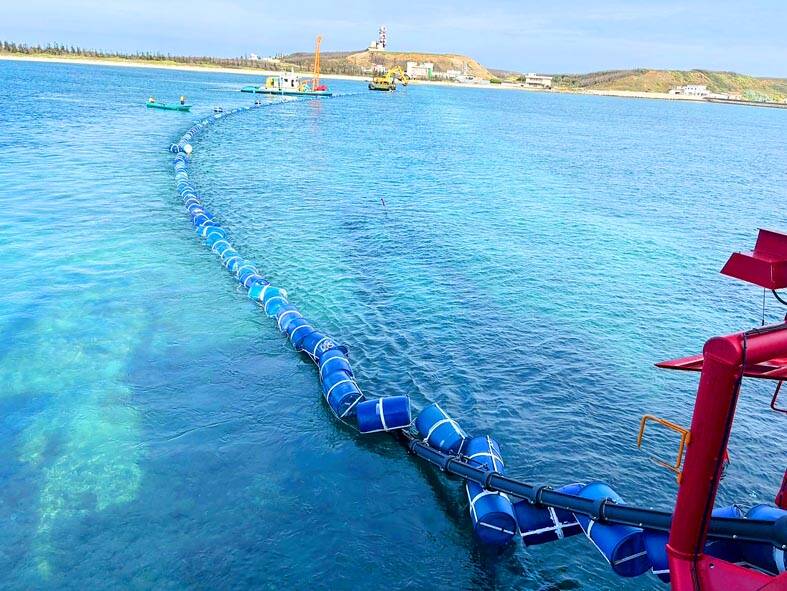
Photo courtesy of Taiwan Power Co
Another of the bill’s sponsors, US Senator John Barrasso, echoed Shaheen’s views, saying that adversaries such as China and Russia continue to target cables to “disrupt communications in Taiwan, and for our allies across Europe and the Middle East.”
The US should ensure that the vital telecommunications infrastructure is safeguarded from “terrorist threats,” Barrasso said.
The bill calls for greater US participation in international bodies such as the International Cable Protection Committee and increased US Department of State investment, including hiring at least two full-time staff dedicated to the effort.
It would require the US president to impose sanctions against people who intentionally damage undersea cables and establish an inter-agency committee to coordinate related efforts.
It would also mandate a federal strategy to work with industry partners and require federal agencies to develop procedures to ensure timely communication of threat information with private undersea cable operators.
Undersea cables connected to Taiwan have faced ongoing disruptions.
The National Security Bureau in September said that about seven to eight undersea cable breaks occurred around Taiwan over the past three years, with four occurring within two months of the beginning of this year.
A Chinese captain was found responsible for one of the aforementioned incidents in June.
In related news, members of the US House of Representatives have proposed a bill that requires the US secretary of state to develop a strategic approach to secure Taiwan’s membership in the International Criminal Police Organization (Interpol).
Led by Republican Lance Gooden, the proposed Taiwan Interpol endorsement and inclusion act is cosponsored by lawmakers across party lines.
Gooden said Taiwan’s “proven” global crime-fighting capabilities are deserving of full membership of Interpol and that its inclusion would “fill a gap in the global security network and reinforce the effectiveness of international law enforcement cooperation.”
Taiwan has been excluded from Interpol since 1984.

NATIONAL SECURITY: Authorities are working to confirm the identities of the military personnel involved and investigating possible illegal conduct and regulatory violations Authorities are probing possible national security implications after Kinmen police and immigration officers on Sunday found a Chinese woman allegedly posing as a tourist while engaging in prostitution involving more than 10 military personnel. The woman, surnamed Chen (陳), has since been deported, authorities said, adding that investigators are still working to confirm the identities of those implicated, as the records only listed code names and aliases. The case stemmed from a report received by the Kinmen District Prosecutors’ Office on Friday last week from the Jinhu Precinct of the Kinmen County Police Bureau. On Sunday, police, along with the National Immigration

GLOBALGIVING: ‘ Caving to external pressure is not acceptable for an organization that has cultivated justice reform and human rights for 30 years,’ one NGO said A slew of non-government organizations (NGOs) have withdrawn from the GlobalGiving fundraising platform after it announced it would use “Chinese Taipei” instead of “Taiwan” from next month. The Taiwan Good Rice Association wrote on Facebook on Friday that it was informed on April 28 via a teleconference call of the change, which was made because the platform wanted to operate in China. Taiwan Good Rice is to terminate all cooperative relationships with GlobalGiving in response to the platform’s “unilateral and non-negotiable” decision to remove references to Taiwan, the NGO said. “Taiwan is in the official name of Taiwan Good Rice Association and the

HEAVY WEATHER: Typhoon Jangmi is due to crash straight into the Ryukyus as airlines look to shift flights to larger aircraft or cancel flights to Okinawa entirely Taiwan’s international air carriers announced flight adjustments over the weekend as Typhoon Jangmi is forecast to hit the Ryukyu Islands today and tomorrow. The Central Weather Administration (CWA) upgraded Jangmi from a tropical storm to a typhoon at 8am yesterday, with the eye located 580km south of Naha city. It was moving north at 19kph. Today, China Airlines’ CI-120, CI-121, CI-122 and CI-123 flights between Taoyuan and Naha, Okinawa, have been canceled as well as CI-132 and CI-133 between Kaohsiung and Naha. EVA Air’s BR-112, BR-113, BR-186 and BR-185 flights between Taoyuan and Naha are also canceled. Low-cost carrier Tigerair Taiwan canceled IT-230,

REASONS FOR TRAVEL: An assistant professor said that proposed amendments to penalize drivers if they used drugs overseas would not deter people from traveling People who operate a motor vehicle under the influence of marijuana would have their driver’s license revoked, even if they used the substance while overseas, the Ministry of Transportation and Communications said yesterday, citing proposed amendments to the Road Traffic Management and Penalty Act (道路交通管理處罰條例). The amendments would also authorize the government to revoke the licenses of people determined to have used Category 1 or Category 2 narcotics, even if they were not operating a vehicle while under the influence of drugs, as well as ban them from taking the license test for three years, the ministry said. People aged 18 or


 RSS
RSS