


US President Donald Trump’s administration is negotiating a deal that could commit Taiwan to fresh investment and training of US workers in semiconductor manufacturing and other advanced industries, five people familiar with the matter said.
Under the arrangement, Taiwanese companies, including Taiwan Semiconductor Manufacturing Co (TSMC), the world’s largest contract chipmaker, would send new capital and workers to expand their US operations and train US workers, the sources said.
Taiwan’s exports to the US are subject to a 20 percent tariff and Taipei has been in talks to reduce that figure as part of an overarching deal with Washington.
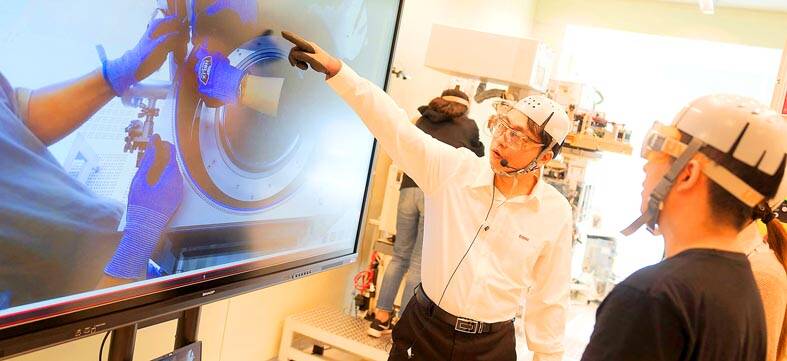
Photo: screen grab from the Taiwan Semiconductor Manufacturing Co Web site
Semiconductors, vital for all kinds of high-tech products, are exempt from tariffs while the US builds domestic capacity.
One of the people said that the total US investment to be pledged by Taiwan would be smaller than that of its main regional economic rivals, and would include support to help Washington build science park infrastructure drawing on Taiwanese know-how.
The person and others spoke on condition of anonymity because of the sensitivity of the matter.
South Korea and Japan have pledged a total of US$350 billion and US$550 billion in investment in the US respectively, under deals to trim US tariffs on most of their goods to 15 percent from 25 percent.
It was unclear when the Taiwan deal would close or what specifics would make it into the final agreement, the people said.
They cautioned that any deal terms could change until they are finalized in negotiations.
The workforce training aspect of the deal has not previously been reported.
“Until announced by President Trump, reporting about potential trade deals is speculation,” White House spokesman Kush Desai said.
Trump has previously said some skilled foreign workers might be necessary to train Americans in state-of-the-art factories.
TSMC, which declined to comment on the trade talks, has struggled to find the right workers for its US projects.
TSMC chief executive officer and chairman C.C. Wei (魏哲家) in January said that building the new factory in Arizona has taken at least twice as long as in Taiwan, citing a shortage of skilled workers and gaps in the supply chain.
Taiwan’s Office of Trade Negotiations in a statement said that its team was continuing to discuss supply chain cooperation with the US under a “Taiwan model.”
Speaking to reporters in Taipei yesterday, Premier Cho Jung-tai (卓榮泰) said the two sides are at the stage of exchanging documents to firm up certain details.
“It is very difficult for other countries to do this kind of work, because only we have this concept, practice, and track record of service parks, which allows us to undertake this kind of initiative in the United States,” he said.
While Taipei has been keen to show its commitment to Trump’s call to boost US manufacturing, it has also said the most advanced semiconductor technologies and research would remain in Taiwan.
Taiwan’s representative to the APEC summit, Lin Hsin-i (林信義), earlier this month said that he and US Secretary of the Treasury Scott Bessent had discussed supply chains and semiconductors during a meeting on the sidelines of the event in South Korea.
Lin said Bessent had been keen to hear about Taiwan’s experience in building its semiconductor clusters.
Trump in August said that the US would impose a tariff of about 100 percent on imports of semiconductors, but exempted companies that are manufacturing in the US or have committed to do so, which includes TSMC, although US officials are privately saying that they might not levy them soon, Reuters reported this month.
TSMC, whose business is surging on strong demand for artificial intelligence applications, is investing US$165 billion to build chip factories in Arizona, though the bulk of its production would remain in Taiwan.

FUKUOKA SITUATION: Japanese media reported that the pathogen is expected to be identified by the summer, while the CDC downplayed the idea that it was hMPV A “mysterious cold-like illness” reported in Japan’s Fukuoka Prefecture does not seem to be a new disease, but Japanese authorities have been asked about the situation, the Centers for Disease Control (CDC) said yesterday. The Fukuoka Prefectural Medical Association on Wednesday told a news conference that a “mystery cold” that has become a hot topic on social media is “highly likely to be caused by some kind of viral infection,” Japan’s KBC News reported. “Many people are experiencing symptoms starting with a sore throat, followed by a runny nose, phlegm and a severe cough,” KBC News reported, citing association officials. Health authorities are

Nvidia Corp CEO Jensen Huang (黃仁勳) arrived in Taiwan yesterday ahead of upcoming AI and technology events, saying he plans to meet with clients and Taiwan Semiconductor Manufacturing Co Chairman C.C. Wei (魏哲家) during his visit. After landing at Taipei Songshan Airport, Huang posed for photos with fans and handed out Yakult drinks to reporters and supporters waiting at the scene, saying he has “a lot to do” during the trip. Asked about reports that Nvidia’s planned headquarters site in Taipei’s Beitou Shilin Technology Park could break ground on May 27, Huang said that if the company holds an event, he would

The Ministry of Finance this afternoon announced the winning numbers for the March-April uniform invoice lottery. The winning number for the NT$10 million (US$318,060) special prize is 19531471, and the winning number for the NT$2 million grand prize is 85941329. Three numbers were drawn for the NT$200,000 first prize: 07225810, 20231230 and 83518781. Those with receipts matching the last seven digits of any of the first-prize numbers will win the NT$40,000 second prize, while those matching the last six digits will win the NT$10,000 third prize. Those whose receipts match the last five digits of the first-prize numbers can claim the NT$4,000 fourth prize,
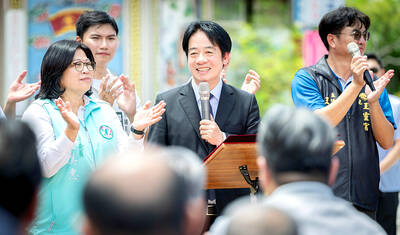
SIX SUBSIDIES: The monthly allowance for older farmers is to increase to NT$10,000, and NT$5,000 is to be given to homemakers under the national pension system, Lai said The government is to implement major welfare policies for disadvantaged groups, including raising the monthly allowance for older farmers to NT$10,000 and providing homemakers with NT$5,000 per month, President William Lai (賴清德) said yesterday. Lai made the remarks during a visit to Wangling Temple in Chiayi County, saying that the planned increases were being introduced amid economic growth and an increase in tax revenue. Touting a policy, in which the government plans to provide a monthly allowance of NT$5,000 for every child under the age of 18 in a bid to address Taiwan’s low birthrate, Lai said that if received for the


 RSS
RSS