


Democratic Progressive Party (DPP) lawmakers representing constituencies in Kaohsiung yesterday expressed deep support for Japanese Prime Minister Sanae Takaichi by urging Taiwanese to buy Japanese goods and travel there as Japan weathers Chinese economic sanctions following Takaichi’s remarks supporting Taiwan.
The shorthand for Kaohsiung in traditional Mandarin (高市) and the kanji characters (高市) of “Takaichi” in Japanese are shaped the same.
Citing former Japanese prime minister Shinzo Abe’s statement that “a Taiwan emergency is a Japanese emergency,” DPP Legislator Chiu Yi-ying (邱議瑩) said Taiwan would continue to support Japan against China’s sanctions, saying “a Japan emergency is a Taiwanese emergency.”
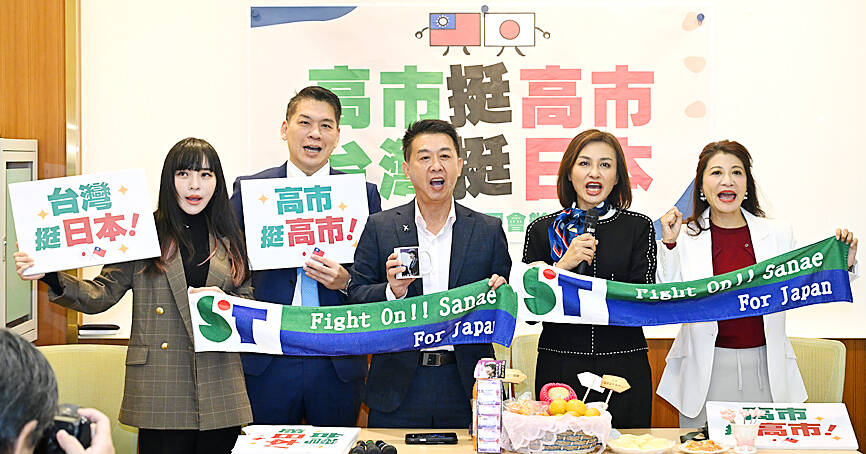
Photo: Liao Chen-huei, Taipei Times
With the disbursement of NT$10,000 cash handouts under way in Taiwan, airlines could issue discount vouchers, and run travel promotions with the Tourism Administration and Japanese tourism authorities to encourage Taiwanese tourists to visit Japan and support its economy, Chiu said at a press conference in Taipei.
DPP Legislator Lee Po-yi (李柏毅) said the Kaohsiung Film Festival had been blacklisted by Beijing years ago, adding that lawmakers representing Kaohsiung constituencies should speak up for Japan at this moment as it faces similar pressure from China over its pro-Taiwan stance.
DPP Legislator Huang Jie (黃捷) said Takaichi’s support for Taiwan is crucial and Taiwan should not let Japan handle the economic hardship alone, calling on people to buy more Japanese seafood or include Japan in their travel itineraries.

Photo: screengrab from Mizuho Umemura’s social media account
DPP Legislator Michelle Lin (林楚茵) said Abe used to support Taiwan by including Taiwanese agricultural products in his meals, calling on people in Taiwan to return the favor.
In Tokyo, Representative to Japan Lee Yi-yang (李逸洋) yesterday called on Taiwanese to support Japan by purchasing Japanese agricultural and seafood.
Takaichi values Taiwan’s security, as it affects Japan’s own security, and her attitude resonates with many Taiwanese, he said.
While China banned imports of Japanese seafood to undermine Japan’s economy, Taiwanese can help protect it by buying as much Japanese seafood as possible, Lee said.
Abe helped promote Taiwan-grown pineapples in 2021 when China banned importing the fruit from Taiwan, making Japan the biggest buyer of Taiwanese pineapples, Lee said, adding that Japan also buys the most bananas, mangoes and tuna from Taiwan.
On the other hand, Taiwan is the world’s largest importer of Japanese apples, grapes, yams and persimmons, Lee said.
Taiwan is also the second-largest importer of scallops, wagyu beef, peaches, strawberries and pears from Japan, he added.
Lee called on Taiwanese to buy more Japanese scallops, the export category hardest hit by Chinese sanctions.
President William Lai (賴清德) on Thursday posted on social media that his lunch was “sushi and miso soup” with “yellowtail from Kagoshima and scallops from Hokkaido.”
His comments caught attention from mainstream Japanese media, including NHK and Kyodo news agency, and were published on digital billboards around Tokyo’s Shinjuku and Akihabara districts, as well as onboard trains.
Lai’s post was shared by Japanese House of Councilors member Mizuho Umemura on Thursday afternoon, who said she would have braised pork rice and mangoes, well-known Taiwanese dishes, as lunch the next day and posted “the virtuous attracts the like-minded and is never alone.”
Umemura posted a photo later that day of her meal, writing: “I couldn’t wait until lunch tomorrow, so I had braised pork rice and mango yogurt for dinner.”

FUKUOKA SITUATION: Japanese media reported that the pathogen is expected to be identified by the summer, while the CDC downplayed the idea that it was hMPV A “mysterious cold-like illness” reported in Japan’s Fukuoka Prefecture does not seem to be a new disease, but Japanese authorities have been asked about the situation, the Centers for Disease Control (CDC) said yesterday. The Fukuoka Prefectural Medical Association on Wednesday told a news conference that a “mystery cold” that has become a hot topic on social media is “highly likely to be caused by some kind of viral infection,” Japan’s KBC News reported. “Many people are experiencing symptoms starting with a sore throat, followed by a runny nose, phlegm and a severe cough,” KBC News reported, citing association officials. Health authorities are

Nvidia Corp CEO Jensen Huang (黃仁勳) arrived in Taiwan yesterday ahead of upcoming AI and technology events, saying he plans to meet with clients and Taiwan Semiconductor Manufacturing Co Chairman C.C. Wei (魏哲家) during his visit. After landing at Taipei Songshan Airport, Huang posed for photos with fans and handed out Yakult drinks to reporters and supporters waiting at the scene, saying he has “a lot to do” during the trip. Asked about reports that Nvidia’s planned headquarters site in Taipei’s Beitou Shilin Technology Park could break ground on May 27, Huang said that if the company holds an event, he would

The Ministry of Finance this afternoon announced the winning numbers for the March-April uniform invoice lottery. The winning number for the NT$10 million (US$318,060) special prize is 19531471, and the winning number for the NT$2 million grand prize is 85941329. Three numbers were drawn for the NT$200,000 first prize: 07225810, 20231230 and 83518781. Those with receipts matching the last seven digits of any of the first-prize numbers will win the NT$40,000 second prize, while those matching the last six digits will win the NT$10,000 third prize. Those whose receipts match the last five digits of the first-prize numbers can claim the NT$4,000 fourth prize,

SIX SUBSIDIES: The monthly allowance for older farmers is to increase to NT$10,000, and NT$5,000 is to be given to homemakers under the national pension system, Lai said The government is to implement major welfare policies for disadvantaged groups, including raising the monthly allowance for older farmers to NT$10,000 and providing homemakers with NT$5,000 per month, President William Lai (賴清德) said yesterday. Lai made the remarks during a visit to Wangling Temple in Chiayi County, saying that the planned increases were being introduced amid economic growth and an increase in tax revenue. Touting a policy, in which the government plans to provide a monthly allowance of NT$5,000 for every child under the age of 18 in a bid to address Taiwan’s low birthrate, Lai said that if received for the


 RSS
RSS